


Rubio, meanwhile, told The New York Times that he was reserving judgment and would assess her actions. “We think they’re going to have some unique and historic opportunities to do a great service for the country, and we hope that they’ll accept that opportunity,” he told the paper.
Trump cool on opposition leader
Trump dismissed the idea of installing opposition leader Maria Corina Machado to guide a transition, calling her a “nice woman” who doesn’t have the support of the Venezuelan people.
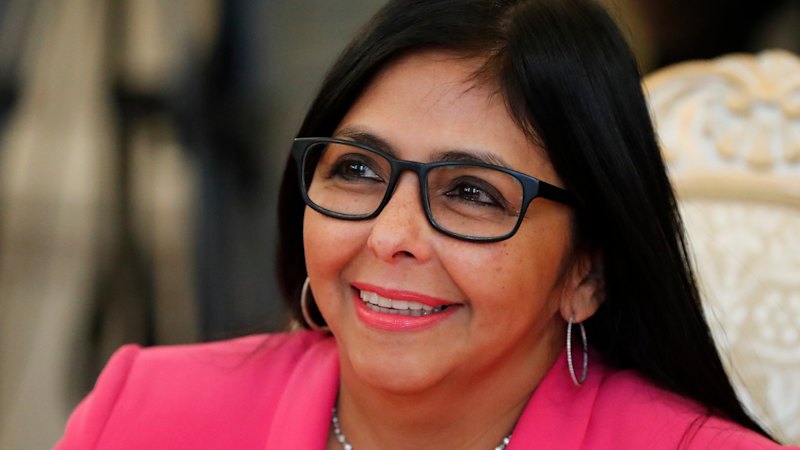
Rodriguez is considered by many to be the most powerful person in the country after Maduro. Fluent in English, she is sometimes portrayed as a well-educated, market-friendly moderate in contrast to the military hardliners who took up arms with former president Hugo Chavez against Venezuela’s democratically elected president in the 1990s.
She is one of Maduro’s closest allies, rising through the ranks in roles such as information and foreign minister, and was named oil minister in 2024 after the contested presidential vote.

Donald Trump has dismissed the idea of installing opposition leader Maria Corina Machado to guide a transition, saying she doesn’t have the support of the Venezuelan people.Credit: Bloomberg
Some Trump advisers have viewed a transition to Rodriguez as an off-ramp from Maduro’s hard-line regime, according to people familiar with the Trump administration’s deliberations. That view holds that a gradual transition away from Maduro’s leadership would be less disruptive and destabilising than a transition to Machado or Edmundo Gonzalez, the candidate she backed for the 2024 election.
The view in part is that if the democratic opposition were to gain power, it would require US military protection from domestic threats, both from the officials in the former Maduro regime and the paramilitaries and drug cartels that control large parts of Venezuelan territory, particularly its jungles and border regions.
Trump didn’t commit to sending US troops to aid in a transition, saying only that his government would help ensure oil infrastructure was protected and improved.
Trump’s remarks contrasted with the defiant tone from government officials in Venezuela on Saturday morning, Caracas time. State television alternated archival footage of Maduro calling for peace “with dignity” with statements of support from international allies, and remarks from regional military and civilian leaders rejecting what they described as an attack on the country. Officials repeatedly insisted that Venezuela remained calm, pledged loyalty to Maduro and his socialist agenda, and demanded proof that Maduro was alive.
“We pledged loyalty many years ago, and today more than ever we will defend it firmly and completely,” said a person identified on state TV as an official from Yaracuy state. Addressing a crowd of soldiers and civilians, the official asked, “How is morale?” The crowd replied in unison: “High. Long live Nicolás Maduro.”
Trump, on the other hand, said the military would need to fall in line.
“All political and military figures in Venezuela should understand what happened to Maduro can happen to them, and it will happen to them” if they weren’t “fair” to the Venezuelan people, he said.
Loading
Rodriguez talked on Saturday to Russian Foreign Minister Sergei Lavrov, whose country was among the Venezuela allies that condemned Maduro’s capture by US forces.
Rodriguez, 56, has played a key role in the nation’s budget planning and has led diplomatic outreach to consolidate alliances with some of Venezuela’s biggest allies, including China and Russia. She recently pressed China to increase purchases of Venezuelan oil and provide diluents needed to keep shipments flowing amid US sanctions.
She began her political career under former president Hugo Chavez after graduating as a lawyer from the Central University of Venezuela. Her father, Jorge Antonio Rodriguez, was a prominent figure on the Venezuelan radical left in the 1960s and 1970s and the founder of a Marxist party. He died in 1976 under interrogation in prison after being tortured by state security forces, an event that became a defining part of Delcy Rodriguez’s political narrative.
Those who have worked alongside Rodriguez often remark on her long hours, with Maduro recently saying she responded to messages well into the night and early morning.
What role for other Maduro allies?

Jorge Rodriguez is another key figure in the regime as head of the National Assembly and one of Maduro’s closest advisers.Credit: AP
Alongside Rodriguez on Saturday were the heads of the legislative branch, her brother Jorge Rodriguez; the judicial branch, Caryslia Rodriguez, and Defence Minister Vladimir Padrino Lopez.
Jorge Rodriguez is another key figure in the regime as head of the National Assembly and one of Maduro’s closest advisers. The 60-year-old psychiatrist became politically active in college, where he was a student leader, and after graduation, he transitioned into government roles.
A loyal ally of Chavez and his successor Maduro, he’s held several high-profile political posts, serving as vice president, communications minister and head of the electoral authority. He’s also acted as negotiator for the Maduro government in several rounds of talks with the US and the country’s opposition.
Despite his mediator role, Jorge Rodriguez is also known for his explosive temperament, lashing out in Congress and publicly threatening and insulting members of the opposition.
He would be a key figure in ensuring continuity and political unity within the ruling party. He was re-elected as a legislator in May 2025 and was expected to take office on January 5.
Military factor
Amid rumours that his home had been attacked and that he had been killed, Venezuelan Defence Minister Vladimir Padrino Lopez, 62, was the first senior government official to appear in a video on social media, more than three hours after the unrest began.
In the message, he urged Venezuelans to remain calm, backed Maduro’s declaration of a state of emergency, and said national defence measures would be activated to restore order and stability.

Vladimir Padrino Lopez (left) with Maduro, has been Venezuela’s defence minister since October 2014, making him one of the longest-serving officials in the government.Credit: AP
Padrino has been Venezuela’s defence minister since October 2014, making him one of the longest-serving officials in the government.
He was appointed during a tense period marked by large anti-government protests, when Maduro was seeking to strengthen control over the armed forces and secure loyalty at the highest levels. A career army officer trained in Venezuela’s traditional military system, Padrino was seen as a figure capable of keeping the military united as the country’s political and economic crisis worsened.
Loading
During Padrino’s time in office, the armed forces have taken on roles far beyond national defence.
The military now oversees important parts of the economy, including food distribution, ports, mining, and oil-related logistics. This expansion has tied senior officers more closely to the government’s survival, giving the military a direct stake in maintaining the current political system.
Padrino has consistently supported Maduro during major moments of unrest, including the 2017 protests, the 2019 challenge following international recognition of Juan Guaido as interim president, and repeated reports of unrest within the military. He has been sanctioned by the US and other governments, which accuse him of backing authoritarian rule, human rights abuses, and corruption. The US has offered a $US15 million ($22 million) reward for information leading to his capture.
Socialist strongman
Venezuelan Interior Minister Diosdado Cabello also appeared on state television early on Saturday to urge calm and call for international attention to what he called attacks on areas inhabited by civilians.
“What they tried to do with bombs and missiles, they achieved partially,” he said, questioning whether the international community would “become accomplices to this massacre”.
Cabello, 62, is the government’s socialist party strongman, controlling loyalists and followers across the country, as well as heading prisons, police and intelligence forces, which the United Nations has said enabled crimes against humanity.

Diosdado Cabello has held key posts and is the government’s socialist party strongman, controlling loyalists and followers across the country.Credit: Bloomberg
As an army lieutenant, Cabello was part of a handful of young officials, led by Chavez, who were responsible for a 1992 coup attempt. After Chavez was elected president, Cabello was appointed to key posts, including minister of housing and telecommunications, head of the National Assembly, and governor of Miranda state.
Cabello was a key figure in furthering government controls over the free press and the persecution of politicians, journalists and human rights activists. The US accused Cabello of narco-trafficking and terrorism in 2018. He’s charged in a Southern District of New York federal indictment with conspiracy to commit narco-terrorism. In 2025, the State Department announced it was raising a reward for information leading to Cabello’s capture to as much as $25 million.
Bloomberg
Get a note directly from our foreign correspondents on what’s making headlines around the world. Sign up for our weekly What in the World newsletter.
