


Updated ,first published
A major fire at one of Australia’s two remaining oil refineries has knocked out at least a fifth of the plant’s production capacity, heightening fears about the nation’s fragile fuel security and raising the prospect of new emergency measures to secure supplies.
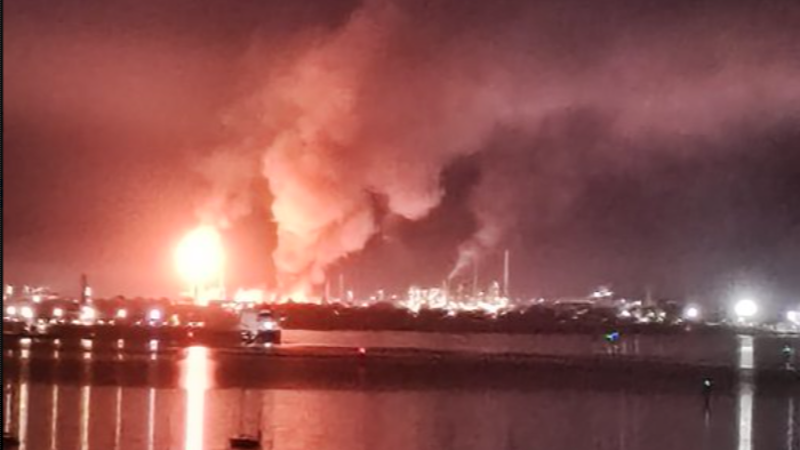
The blaze, sparked by an equipment fault at Viva Energy’s Geelong refinery on the shores of Corio Bay late on Wednesday, damaged two critical petrol-producing units that usually supply about 20 per cent of its output, the company said.
Since the outbreak of the war in Iran on February 28, the Geelong refinery has been operating at maximum output, pumping out as much as 50 per cent of the petrol, diesel and jet fuel used in Victoria each day, and 10 per cent of the national total.
However, despite the refinery now being forced to operate at reduced capacity in the weeks ahead, executives on Thursday assured authorities and consumers that they did not anticipate any overall drop-off in the volume of fuel delivered to the market.
“It’s a very challenging incident,” Viva chief executive Scott Wyatt said, but he stressed the company had a “high level of confidence” that it could make up for the shortfall by boosting imports.
“We would rather this not have happened, of course, but we’ve got cargoes arriving all the way through to the end of May. We will start to look for June cargoes soon and will start to roll those forward.”
The incident may raise the likelihood of the federal government having to move to the next stage of its fuel-saving strategy, including directing fuel to priority areas, promoting voluntary measures such as carpooling or working from home, and further releases from strategic reserves, global research firm Rystad Energy said.
Victorian Premier Jacinta Allan said it was possible that the fire could prompt state and federal governments to progress to the next stage of the national fuel security plan.
“We will need to? The answer to that question … lies in the assessments that Viva needs to undertake, once it’s safe to do so, on the impact that this fire has had on their production capacity going forward,” she said.
Allan said Victoria would move towards more forceful fuel conservation measures only in lockstep with all states and territories, as agreed in the national plan.
However, federal Energy Minister Chris Bowen rejected suggestions the Geelong fire could lead to more drastic measures.
“This is not a good development when it comes to what we’re managing,” Bowen said. “But … because Viva have told us that they’re very confident they can replace the petrol with imports, this – in and of itself – won’t lead to a change in the status of the four-point fuel plan.”
The Geelong refinery, which can process up to 120,000 barrels of crude oil a day to produce millions of litres of usable fuel, is the last oil refinery left in Victoria, and the second-last in the country, following a wave of closures over the past decade.
Other local refiners, including ExxonMobil and BP, have shut their plants as they struggled to compete with cheaper imports following the expansions of larger, lower-cost mega-refineries in South-East Asia.
Diesel and jet fuel production units were unaffected in the blaze, Viva Energy said, but the plant was now operating at “minimum rates” as damage assessments continued. Viva is expected to provide a detailed timeline for repairs and a production ramp-up on Monday.
In addition to supplying fuel from its refinery, Viva also brings in vast volumes of imported fuel via its network of shipping terminals scattered across the coastline, and can draw on its partnership with trading partner Vitol, one of the world’s biggest oil traders, to bolster deliveries. In total, Viva’s operations in Australia supply about 30 per cent of the nation’s fuel.
Wyatt said it was fortunate that the fire did not damage the refinery’s ability to continue producing diesel and jet fuel, both of which are in much tighter supply than petrol.
“From a regional perspective, petrol is an easier product to buy,” he said.
The fire comes as concerns grow over the state of Australia’s fuel security as the conflict in the Middle East continues without a clear timeline for resolution from US President Donald Trump.
With more than a month of fuel reserves stashed in storage facilities and dozens of tankers carrying crude oil and refined fuels still booked to arrive in the coming weeks, the fuel industry and federal government are confident that supplies remain steady. However, the longer the conflict in the Middle East drags on, the greater the threat of shortfalls eventually becomes.
The ongoing disruption to shipping in the Strait of Hormuz, a major thoroughfare for oil and gas tankers, has cut off significant volumes of global crude oil from the Persian Gulf that are usually delivered to the Asian refineries that account for the bulk of Australia’s imports, experts warn. This raises the threat of a regional supply crunch worsening and hitting Australia if and when they exhaust their inventories.
On Thursday, energy analysts warned the hit to the Geelong refinery marked a deterioration to Australia’s fuel security, given the nation has already limited capacity to produce its own fuels and relies on imports to fill 80 per cent of its needs in an increasingly volatile global market.
Fire Rescue Victoria said on Thursday the blaze had begun in some piping at the refinery, where there was a mechanical failure. Some flames were up to 60 metres heigh.
About 100 people – 50 firefighters and 50 from Viva’s workforce – tackled the blaze across 13 hours, extinguishing it just after midday and keeping the damage are to 50 square metres.
“They contained this fire really, really quickly to a small part of the refinery,” FRV deputy commissioner Michelle Cowling said. “A fantastic job was done. No firefighters were injured.”
Cowling said the blaze would have been worse had it started around one of the plant’s fuel storage tanks.
“This could have been a catastrophic fire,” she said.
Cowling later said firefighters would probably remain at the scene until at least Friday.
Refinery manager Bill Patterson said: “We’re still running at pretty decent rates at the moment, given that these units are relatively small in the scheme of things, but they are important units for the longer term.”
Patterson said the part of the refinery affected by fire hadn’t been running in “any sort of abnormal conditions” since the Middle East conflict roiled energy markets.
“The material that’s made from the unit that was impacted is an ingredient into petrol, but it’s not an … ingredient that we can’t do without,” he said. “So with the loss of that unit, we will lose a little bit of production capacity on that front, but not a very large amount.”
Tony Hynds, an organiser with the Australian Manufacturing Workers Union, said: “We’ve been told there were about 30 people on the site, most of them operators.
“When the first explosion happened, they had to take off and get out of there pretty quickly. I’ve been told there was a small explosion and then two large ones, and then a large fireball.”
Australian Workers Union secretary Ronnie Hayden described the scene as like a “war zone”.
“Some [workers] were pretty close to it, but they managed to run to get away from it,” he said. “They said it was like a ‘big bloody fireball coming straight for us’.”
Viva Energy’s plant in Geelong has been underwritten by significant government support to secure Australia’s two remaining refineries.
The federal government in March boosted its Fuel Security Services Payment, which kicks in during loss-making periods. Viva has said the scheme, introduced in 2021, allowed it to spend $500 million upgrading the Geelong refinery.
One resident near the Viva plant in Corio – who didn’t want to be identified – woke up to their house rattling and an ominous red glow on the horizon about 1am.
“I was in bed, and I was wondering why everything was rattling and shaking,” the resident said. “The whole backyard was lit up red.”
A warning was issued for dozens of suburbs just after 2am, when a wind change blew smoke from the blaze towards Geelong. It was downgraded shortly before 5.30am. FRV assistant chief fire officer Mick McGuiness said the warning was precautionary, and there were “no contaminants whatsoever” in the smoke.
On Monday, Bowen said Australia’s fuel reserves stood at 38 days of petrol, 28 days of jet fuel and 31 days of diesel.
With Reuters
Read more on the refinery fire:
 Nick Toscano is a business reporter for The Age and Sydney Morning Herald.Connect via X or email.
 Patrick Hatch is transport reporter at The Age and a former business reporter.Connect via X or email.
 Melissa Cunningham is a health reporter for The Age. She has previously covered crime and justice.Connect via X or email.
 Mike Foley is the climate and energy correspondent for The Age and The Sydney Morning Herald.Connect via email.