







Ask Joel McPhee why he moved to Brisbane and he replies bluntly: “Money and weather.”
But it’s more than that.
McPhee, 40, left his family’s farm in Invercargill on New Zealand’s South Island for the capital of the Sunshine State 18 years ago.
“As much as I liked the sports side of Melbourne, and the music and the culture … I hated how busy it was, and with the weather you may as well be in New Zealand. And then Sydney is just terrifyingly busy,” McPhee says.
“Brisbane is way more chilled … that’s what resonated with us.”
South-east Queensland is a magnet for New Zealanders moving across the ditch, chasing the sun and higher wages.
“We have fallen in love with Brisbane,” McPhee says.
“Queensland winters are to die for. It’s beautiful during the day. Obviously, the summer is pretty horrendous with the heat and humidity, but we still love it.”
More than 4 per cent of people in Brisbane were born in New Zealand – the most common country of birth after Australia.
In Sydney, the most common overseas country of birth is China. In Melbourne, it’s India.
“Everyone else in Australia teases Brisbane about being behind the times, or slow, and having that country, rural feel to it,” McPhee says.
“But that’s exactly what makes Brisbane better for Kiwis, because that’s what we’re used to.”
Despite its differences from other east-coast capitals, the latest census data confirms Brisbane is a multicultural, migrant city. Nearly 32 per cent of Brisbane’s residents were born overseas.
“Brisbane’s very different from what it was in the ’90s,” says University of Queensland population and migration expert Dr Elin Charles-Edwards.
The Kiwi story
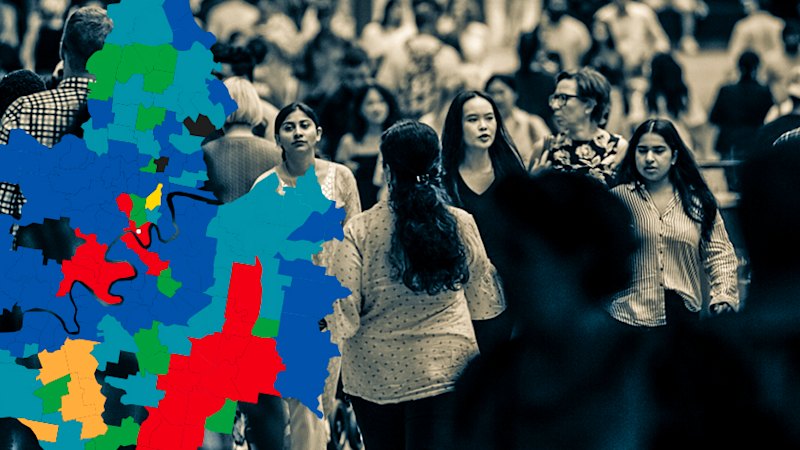
This masthead’s analysis of census data reveals distinctive patterns of settlement across the city.
Kiwis, for example, have clustered in south-eastern suburbs, including Mount Gravatt, Carina, Murarrie, Tingalpa and Wakerley.
North of the river, they have settled in Kedron, Stafford Heights, Banyo, Virginia, Geebung and Aspley.
“The New Zealand story is a bit more diverse,” Charles-Edwards says.
“It really depends if people are Pasifika, Maori, or if they are Pakeha (white) New Zealanders.
“In Brisbane, pushing out to the Redlands, you tend to have the white New Zealanders, but down in Logan, you have more of a Pasifika, Maori concentration.”
Analysis of Bureau of Statistics figures by KPMG urban economist Terry Rawnsley shows the most common country of birth for new arrivals in Queensland last financial year was New Zealand (9890).
In the same period, 3870 New Zealand migrants moved to NSW.
“That’s reflecting the job market,” Rawnsley says. “They’ll be coming over to Queensland to work on the big infrastructure projects, they’ll be working in hospitality and construction.
“They might be [doing fly-in fly-out] to the Bowen Basin.”
Meanwhile, the relatively new housing estates in Pallara and Heathwood have been drawcards for Indian migrants. Those estates were being built and sold during the arrival of a new wave of Indian migrants, who preferred to live in newly constructed suburban houses.
There has also been a surge in Indian migrants moving to Taigum, home to a Sikh temple, and nearby Fitzgibbon.
Charles-Edwards explains that the location of churches, temples and schools can contribute to “chain migration”, whereby migrants cluster together in certain areas with people who share their language, religion, food and cultural traditions.
There is comfort in familiarity, especially in a new country.
“Migrants are not received by government, per se, they are received by family and friends,” says Professor Kevin Dunn, deputy vice chancellor at Western Sydney University and an expert in human geography and urban studies.
Breaking the chain
However, this sort of settlement doesn’t tend to hold over time, Charles-Edwards says.
“We do tend to see migrants getting that initial foothold, but over time, we’ll see dispersion. And this is certainly what happened with the Greeks and the Italians,” she says.
In Brisbane, a wave of pre- and postwar Greek migrants dominated West End, opening delicatessens, fruit shops, tailors and building a large community around their Edmondstone Street church. But Greece no longer registers among the top-five overseas countries of birth in the inner-city suburb.
Lutwyche has the highest percentage of residents born in Italy, although it is just 2 per cent of the suburb’s population.
Charles-Edwards also points to how infrastructure – such as good public schools – shapes migration, noting the influx of families into apartments in South Brisbane, within the hugely sought-after catchment for Brisbane State High School.
“You see a lot of young families in those, and they are often migrant families who want to get their kids into a good school. So migration can actually change how we inhabit housing in the city as well.”
University suburbs, including St Lucia and Toowong around the University of Queensland, and Brisbane CBD, South Brisbane and Kelvin Grove near the Queensland University of Technology, have long attracted Chinese students.
In Bowen Hills, there is a unique cluster of Colombian-born migrants. “The Colombians are students, mostly,” Charles-Edwards says, adding that they live in apartments similar to their home country.
In the city’s south-west – home to Saigon Plaza – the neighbouring suburbs of Inala, Darra, Durack and Oxley are dominated by Vietnamese migrants, many of whom arrived as refugees in the late ’70s and early ’80s.
Nepal is the most common overseas country of birth in the suburbs of Northgate and Wooloowin.
‘The heart of the dragon’
Brisbane is also home to one of the country’s distinctive “ethnoburbs”: Sunnybank, Sunnybank Hills, Robertson and MacGregor, where at least a third of residents were born overseas.
In these suburbs, China is the most common overseas country of birth, followed (in varying order) by Taiwan, India, Korea, Hong Kong, New Zealand and the Philippines.
Brisbane is now home to Australia’s largest Taiwanese community, after a federal business incentive program brought Taiwanese migrants to Brisbane in the 1990s.
In one urban legend, Chinese migrants were drawn to the Sunnybank area because it appears as the “heart of a dragon” on a map of Brisbane, making it a place of good fortune and good luck.
“That’s a fabulous fable,” says Tony Ching, who has been conducting food tours in Sunnybank Plaza for the past decade.
“It would be nice to think that was true, but I would suggest it was the fertile soil. Sunnybank was flat and had good, fertile soil and was great for market gardens, which the Chinese were good at.
“At the end of the day, Sunnybank used to be a market garden area.”
Today, it is a bustling hub of Asian restaurants, shops, food grocers, meat markets and businesses.
Last year, Charles-Edwards took her nine-year-old daughter to Sunnybank to show her life beyond their western suburb of The Gap, where most migrants are English, New Zealander, South African or Scottish.
“It’s amazing. It’s like going on a holiday … it helps the kids realise how different places can be, and how the world is a bit bigger than The Gap,” she says.
Start the day with a summary of the day’s most important and interesting stories, analysis and insights. Sign up for our Morning Edition newsletter.


