





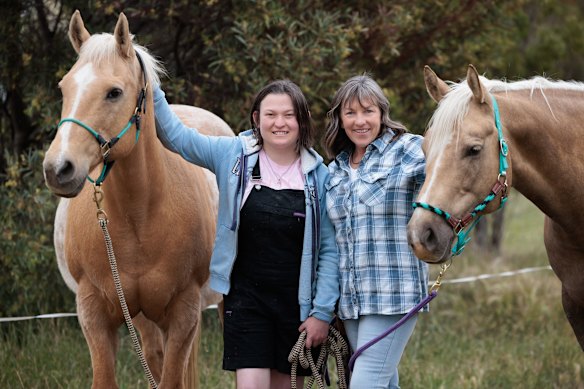
At her home on a small farm, 40 minutes out of Hobart, Rosie Treasure loves to paint. The 22-year-old’s intellectual disability and cerebral palsy have proven no barrier to her artistic passion. She sells paintings online through her own micro-business – one has made its way to a buyer in New York – and now has a job working with younger children at an art studio in town.
That Rosie can achieve some form of independence has always been important to her mum, Rachael, a single mother who writes novels and runs the farming business. Rachael makes sure Rosie’s weeks are full of activity. That schedule has involved hundreds of sessions over the last nine years – with support workers, occupational therapists, speech therapists and physios – that are funded by the National Disability Insurance Scheme.
“Rosie would never have reached the skill level and been given this opportunity without the system,” Rachael says. “She’s a happier person for it … the value has been phenomenal.”
But it hasn’t been smooth. Some days Rachael is brought to tears by the frustration of co-ordinating six different support organisations: while some workers have become like family, showing Rosie how to cook Greek meals and fold her laundry, others will come into their home and simply sit there, failing to assist her with basic tasks like getting dressed or brushing teeth.

When Rosie’s plan co-ordinator passed away, it took three months of unanswered emails before the family was notified. Rachael once hired a financial service provider to help manage Rosie’s complicated NDIS budget, only to find out one day that it had all been spent.
“It’s the most confusing and difficult-to-navigate system,” Rachael says. “It’s like having an extra full-time job. I’ve done three different surveys and come out as a red flag for high burnout.”
This is the story of the NDIS: at its best, it’s transformed the lives of people like Rosie, who in previous decades would have been marooned at home or institutions. Still, as a government system, it’s not working as it should. It is administratively complex, susceptible to fraud and misuse, has minimal oversight or regulation of providers, and complaints are on the rise.
The Albanese government has one eye on these issues, and how the scheme could be improved for the people it serves.
It has another eye on the federal budget. As the NDIS has become a fully fledged scheme, its costs have rocketed.
The Productivity Commission predicted in 2011 that the scheme would cater to 410,000 people and cost about $13.5 billion at maturity, then grow between 3 and 6 per cent each year. By 2017, it had revised these estimates, saying the scheme would cost $30 billion in 2025, and $40 billion by 2030.
But this year, it will cost $50 billion, with 760,000 participants. It’s still growing by 10 per cent annually.
The problem for the government is that the scheme hasn’t stabilised. Projections published in December show it will serve more than 1 million people in 2034, costing $96 billion. At 2.1 per cent of future GDP, this would be more than Australia now spends on defence.
Martin Laverty, who was on the first National Disability Insurance Agency board and now runs the large non-profit provider Aruma, says this challenge is urgent.
“I think this is the last budget in which the Australian government can save the NDIS,” he says.
“If we don’t chart a course to cost correction, it will spiral, and those that need the scheme the most will be those hardest hit when, inevitably, a future government needs to cut the scheme back.”
This is the task in front of Mark Butler: one of Anthony Albanese’s most trusted ministers, who took carriage of the NDIS after last year’s election, when he led Labor’s successful Medicare campaign. “I worked in disabilities in the early 1990s, when people who are now being supported by the NDIS were institutionalised for their entire life,” Butler told a forum last week.
“Having a system of supports like the NDIS truly is one of the great human rights advances. But the scheme is off track. It lacks those disciplined design features of a good social program, and we’re determined to get it back on track.”
Labor will make the NDIS a centrepiece of its savings package next month as it seeks to slow the scheme’s annual growth rate towards 5 to 6 per cent over the four-year forward estimates.
Some changes will seek to improve the participant experience and budget bottom line in tandem, but it’s no simple task. Butler must improve regulation and oversight without crushing the market or eroding the scheme’s principles of choice and control. He also needs to restore its purpose of serving people with the most profound disabilities – without leaving others in the lurch.
And he must ensure it keeps its broad social licence while retaining the faith of a disability community that fought hard for the scheme. That community has become increasingly anxious as conversations about costs dominate the public narrative.
Former NSW disability minister John Della Bosca has had a front-row seat watching Australia’s disability services evolve. He had seen just how badly a system geared towards institutionalisation was failing people. When he resigned in 2010, to lead the movement that championed a new scheme, he channelled this into optimism.
A group of service providers, families, carers and academics – who came together under the banner “Every Australian Counts” – won over the Gillard government with their campaign to transform disability services in Australia.
“The whole idea of the NDIS was that we would catch up and leapfrog the world in terms of disability supports,” Della Bosca says. But the former minister is much more circumspect when he talks about the NDIS now. “The campaign, in a way, was too successful too quickly.
“Someone once described it – unflatteringly – as a jumbo plane being built while it was in the air.”
It’s easier with hindsight to identify the design flaws.
Many of them were included in the 2011 Productivity Commission blueprint, intended to bolster choice and control in a system that had none. With time, however, these settings have distorted markets and opened the scheme to fraud. Providers have been allowed to operate without registering with the government; flat pricing structures don’t reflect specific skills or quality in certain services; the concept of “reasonable and necessary” supports is legislated but loosely defined.
One thing, though, tops the list for where things have gone wrong. The original proposal was for a tiered system of disability supports across the community. Tier one, individualised NDIS packages, were to be reserved for roughly 330,000 disabled people who had severely reduced functioning. Four million more people would access tier two supports, such as state services delivered in schools and hospitals.
That fuller ecosystem never materialised. Instead, state government services dried up and are only now being put back online. “The biggest mistake we made was that no one really envisioned the states would completely exit the disability sector,” Della Bosca says.
Call it the only lifeboat in the ocean, as former minister Bill Shorten did, or the oasis in the desert, as scheme architect Bruce Bonyhady put it: the NDIS became the only option for disability support in Australia. That’s clearest today in the statistics for participants with autism.
About 324,000 of the 761,000 NDIS participants – or more than two in every five – have a primary diagnosis of autism. While annual growth among the remainder of participants is relatively stable, the number of people with autism, mainly children, grew by 24 per cent last year. Australian academic studies have demonstrated an uptick in autism diagnoses followed the NDIS rollout, as people chased help, and the only way to get it was through the scheme.
Some of these participants have significant support needs that require around-the-clock care. The majority, however, have what the scheme classifies as mild or moderate support needs – these are the people that would have been catered to by the original design’s “tier two” supports, had they been developed.
Data supplied to this masthead by the NDIA puts the number of people in this category at about 310,000 people, or 40 per cent of the scheme. Their collective support costs came to about $5.4 billion last year – just over 10 per cent of spending.
A review of the NDIS at the end of 2023 recommended “foundational supports” be established to assist these people outside the NDIS, replacing individual packages with a broader system of services. It was shorthand for the original “tier two” concept. State and federal governments have since set aside a combined $10 billion over five years to develop these supports.
But they’re not yet up and running. Thriving Kids, a new system for children eight or younger, will be the first off the ground: $4 billion of that funding has been allocated to get it started in October, and fully implemented by 2028.
The director of the Grattan Institute’s disability program, Sam Bennett, says there’s still much more work to do. He thinks Thriving Kids should take in children all the way to age 18, and that foundational supports must be extended to people with disabilities caused by mental illness. At that point, there could be changes to NDIS eligibility criteria.
“The scope of foundational supports recommended by the review was a lot wider than development delay and autism. We haven’t seen movement on that aspect,” he says.
Bennett is sceptical of the government’s budget targets. He says Labor has already baked in savings from other changes – such as laws to make the scheme easier to administer, and a new standardised assessment and budget setting model – that haven’t been fully implemented yet.
“If you’re banking further savings, to get it down to 5 to 6 per cent, I would say that’s based on some fairly heroic assumptions at this point,” he says.
But there are stakeholders who think the government must try. Chief among them are some of the scheme’s biggest non-profit providers, who fear they have been squeezed in a market that rewards bad-faith actors.
They’re encouraging a robust debate about some of those other settings – registration, price and service quality – as Labor mulls major changes before next month’s federal budget.
“There is sufficient money in the scheme,” Michael Perusco, the head of peak body National Disability Services, wrote to his 1000 members this week. “The central question is how to get value for money from this investment.”
Fraud often dominates NDIS headlines. Stories of luxury cars and systemic rorting take hold online, and are referenced in parliament by politicians such as Pauline Hanson. Some of this veers into misinformation, although there are substantial integrity issues: an Australian National Audit Office report has estimated the level of leakage from broad noncompliance in the NDIS runs between 6 and 10 per cent. At current levels of funding, that’s up to $5 billion a year in waste.
But some of the problems are more complex than so-called dodgy providers. The agency that runs the NDIS has its own share of concerns about how it’s set up. One flaw raised by agency official John Dardo in Senate estimates earlier this year was the scheme’s payment systems.
“Back in 2022, if an individual came in online to make a claim, they could make a claim without providing an ABN, without providing a text description and without uploading any evidence,” he said. The agency often did not have eyes on those claims before they were processed and paid.
That’s now changed: text descriptions are required, analytics run on those items, and there are 24-hour payment delays. Dardo says about $13 million worth of claims are now rejected every month. More than 2500 providers have been stopped from claiming since June 2024 – a group that had historically claimed $5 billion.
But there’s more to be done. Dardo said the agency still can’t see, under law, whether the 270,000 NDIS providers have paid tax or not. He also said to expect reform around provider registration.
Just 6.5 per cent of the 277,000 providers who operate via the NDIS are registered with the government. The intent was to remove red tape between a person with disability and their service provider, in line with the scheme’s principles of choice and control.
Laverty, the former NDIA board member, thinks this was a mistake. “Ten years on, the absence of registration creates uncertainty about the safety and identity of the provider, and whether their services are legitimate,” he says.
“Taxpayers would be horrified to learn that anyone, this afternoon, could start their own business and then charge the taxpayer $70 per hour for a disability support – such as taking someone to the movies – with no training, no registration and no safety screening.”
The most likely way forward will be a tiered universal registration system, where the administrative requirements are proportionate to the service and its risk – a recommendation of the 2023 NDIS review.
The other push is for a tiered pricing regime. Perusco, chief executive of National Disability Services, describes the current settings as a one-size-fits-all approach, and gives this example: the current price limit for support workers is roughly $70 an hour.
In some parts of the scheme, staff are required to help feed people through tubes, ensuring they get nourishment and nutrients, while minimising the risk of infection. This requires skills, supervision, a clinical governance framework and higher overheads.
“You get paid the same amount whether you’re doing [that] complex work or whether you’re taking someone shopping,” he says.
It’s a good rate of pay for an individual with no qualifications. Not so much if you’re operating a home for several people with complex support needs. “The system incentivises low-cost, low-complexity work. It’s led to the providers doing the most complex work, acting with integrity in the scheme, doing it toughest,” he says.
These issues run through the NDIS. They’re felt most acutely in the most costly, and most complex, parts of the scheme: those that cater to the 5 per cent of participants who have the highest support needs, and require help with everyday functioning.
About 37,000 people on the scheme receive support for independent living. Their payments have grown by 26 per cent over the last two years, from $12.9 billion to $16.2 billion. The costs of supported disability accommodation – covering about 16,000 participants – are also growing fast. The average payment per participant has increased at 31 per cent a year, according to the NDIA’s latest report, due to a combination of indexed pricing and people moving into new-build dwellings.
Together, these areas make up about a third of the NDIS budget. Again, people and providers are begging for improvements. Laverty, for example, wants the government to step in and co-ordinate disability accommodation – an area of service he says has not delivered the improvement in quality that the NDIS promised.
Catherine McAlpine, the chief executive of Inclusion Australia – which represents people with intellectual disabilities – wants to see more innovation in supported independent living, the most expensive part of the scheme. “We’re not asking for more money, we’re asking to use people’s plans better, in a more innovative way,” she says.
McAlpine was also around when the NDIS got off the ground. She’s seen it make an enormous difference. “The people who got the biggest impact straight away were people for whom assistive technologies, or getting the right support to live a dignified life, was fairly straightforward,” she says.
“You got your tech, and instead of showering twice a week, you could shower every day. Your support worker could come any time to put you to bed, not just at 6pm.”
She says it’s been more complex for families and people with intellectual disabilities. It’s helped parents who once would have stopped work to become full-time carers after their child finished school.
But the full promise of inclusivity and independence is not yet realised. McAlpine says the current model has the wrong priorities: it is faster for an unskilled support worker to cook a meal for a participant than spend the time teaching that participant how to cook – even though it’s less expensive, over time, when people learn to do things themselves.
“We’re hearing about disengaged support workers taking people to a cafe and sitting playing on their phones. That’s not really community inclusion. Building community connections is skilled work that needs to be recognised and resourced,” she says.
McAlpine says there are big social questions about the NDIS that need to be asked. But she is sceptical of political debate that is centred on the scheme’s financial sustainability, because its benefits aren’t being counted.
“There have been flaws in the NDIA’s market stewardship. They didn’t have protective mechanisms against fraud and exploitation, and those things need to be resolved. But when there is so much focus on fraud and waste, there is risk that the message becomes: we can’t afford to provide the support people with a disability deserve. It’s really problematic,” she says.
“The promise of the scheme was an inclusive life, free from violence and abuse, where people are able to make their own choices. We need to measure those things, too, in defining its success.”
Rachael Treasure can see the situation from all sides. “It needs a really good prune,” she says of the scheme. “There are too many people with fingers in the whole NDIS pie.”
But, like thousands of other families, she fears blanket cuts and what’s around the corner. She hopes the scheme can offer more flexibility, rather than less, and that it becomes easier to navigate.
“We’ve always been above board and utilise the money really responsibly and well,” she says. “I worry we will bear the brunt for people who have been rorting the system.”
Cut through the noise of federal politics with news, views and expert analysis. Subscribers can sign up to our weekly Inside Politics newsletter.