


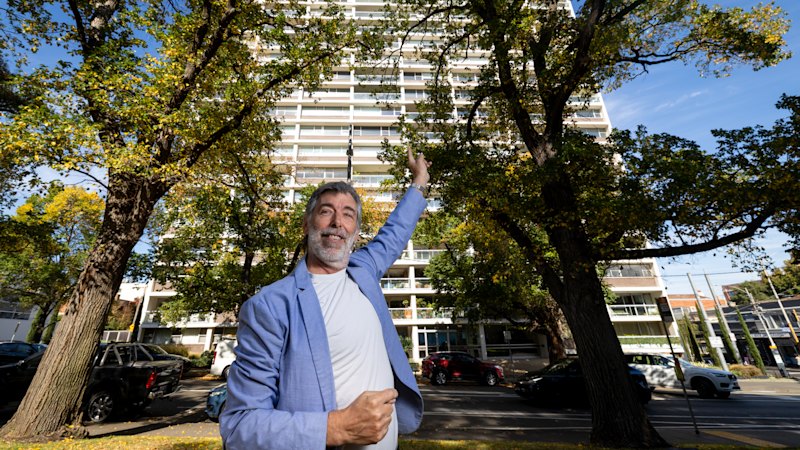

When renowned Australian architect Robin Boyd’s acclaimed Domain Park Flats were first built overlooking the Royal Botanic Gardens in South Yarra, there was an incredible outcry.
In 1962, the 20-storey flats were the tallest residential building in Melbourne, towering over the gardens, low-rise Victorian terraces and apartment blocks around them.
Some residents started an association to oppose further high-rises being built along the park front, while Boyd’s modernist design was also attacked, with artist and critic Arnold Shore describing the two lift towers protruding from the back of the building as “monstrous excrescences”.
Now, standing opposite the flats in the late autumn sunshine, resident and film producer turned tour guide Nick Heydon says the building was a response by Boyd to the at times “pastiche” architecture in South Yarra.
“It’s all about celebrating the materiality, not the decoration,” Heydon says. “It’s a somewhat austere kind of gridded structure”.
Each apartment in the building is north facing and Boyd included modern amenities like air-conditioning.
Heydon says the external lift towers are “really genius” as they protect the flats from the noise and activity of the lifts and create a sense of arrival entering the building.
The height of the building delivers some of Melbourne’s best views across the Botanic Gardens to the north and south to the bay.
It was also practical, enabling Boyd to fit in more apartments and take advantage of a government push at the time to build more housing by developing around parks – reminiscent of the Allan government’s focus on constructing high density housing in activity centres around train stations.
Apartments in the Domain Park Flats are now highly prized, selling for around $2 million for a two-bedroom apartment and $3 million for three bedrooms, with the building awarded the Victorian Chapter Enduring Architecture award in 2015.
“Locally, it’s called the stairway to heaven, because lots of old people live there,” Heydon says. “As people die higher up, they’ll sell theirs and the lower floors move up, so they kind of move up towards heaven.”
Heydon is one of a group of guides who run regular walking tours around South Yarra for the Robin Boyd foundation, celebrating the architect’s buildings in the area and those that both inspired and horrified him.
Boyd wrote about design for The Age after World War II, and his Small Homes Service sold affordable architectural drawings to builders and prospective homeowners.
“He hated this idea that we need to decorate, that we need to pull up these ancient styles, medieval revival particularly, and the mock Tudor,” Heydon says. “He wrote about the great Australian ugliness around Toorak Road. He really hated it.”
Around the corner from the Domain Park Flats on Marne Street is a “living museum” of architecture styles which Boyd’s work was often a response to, including the craftsman-style Garden Court and Moore Abbey, a block of six apartments designed by Robert Hamilton in mock Tudor style.
“It’s a fantastic example,” Heydon says pointing to the crazy brick work and stained-glass windows. “I always expect to see a knight in armour come riding out through that door.”
However, Heydon is pretty firm about Boyd’s thoughts on the architecture: “He hated Robert Hamilton”.
Back on Domain Road the elegant columned portico of Amesbury house, with a circular driveway “where a chauffeured car can drop you off”, also provided a counterpoint for Boyd’s work.
Despite the elegant facade Heydon says the apartments inside are impractical: “Pitch dark in the middle of the day and freezing cold”.
“It really illustrates where the modernists came in,” Heydon says. “One of the things they were looking at is this very showy architecture that had nothing to do with light and nothing to do with space other than to just have these big opulent decorative rooms everywhere.”
Boyd’s ultimate response was his house at 290 Walsh Street in South Yarra, which he designed in 1957 and served as a family home, and is now operated as a “living museum” by the foundation.
“Robin said that architects should always experiment on their own homes first rather than clients’ homes,” Jamie Paterson, operations manager at the Robin Boyd Foundation says.
The Boyds’ bed sits in a corner of the large living room which also served as an entertaining salon for the couple’s many cocktail parties.
“He was particularly good at conceiving of multipurpose spaces,” Paterson says.
The house opens up around a large glass enclosed courtyard with a “children’s pavilion” at the rear where the Boyds’ three children slept.
The other experimental feature of the Walsh Street house is the catenary roof, suspended from six steel cables, however Paterson says Boyd didn’t do his homework on the cables which have stretched over time giving the roof a “lovely tent-like, languid sag”.
The Robin Boyd Foundation runs regular walking tours around South Yarra and tours and events at Boyd’s Walsh Street homes.
