



Thomas John Hicks stood on the start line of the 1904 St Louis Olympic marathon with his chest proud and his left foot forward. Dressed in black running shoes, black shorts and his Cambridgeport Gymnasium uniform, the labourer from Massachusetts was a favourite to win the event at the third modern Olympic Games.
He had come second in the 1904 Boston marathon, but more remarkable than any previous athletic feat was the innovative concoction his coaches had created to combat dehydration in the Olympic race, which provided just one drinks stand along the 40km course.
Having collapsed mid-way, Hicks was instructed to drink a mix of strychnine (rat poison) and egg whites. He ran for another 15 kilometres before taking a shot of cognac to down a second dose of the potion. Although Hicks, who was incoherent and who received immediate medical treatment, had to be carried across the finish line (which was not yet a disqualifying act), he won. Hicks holds a 122-year record for the slowest marathon ever won at an Olympic Games: three hours, 28 minutes and 56 seconds over a course slightly shorter than it is today.
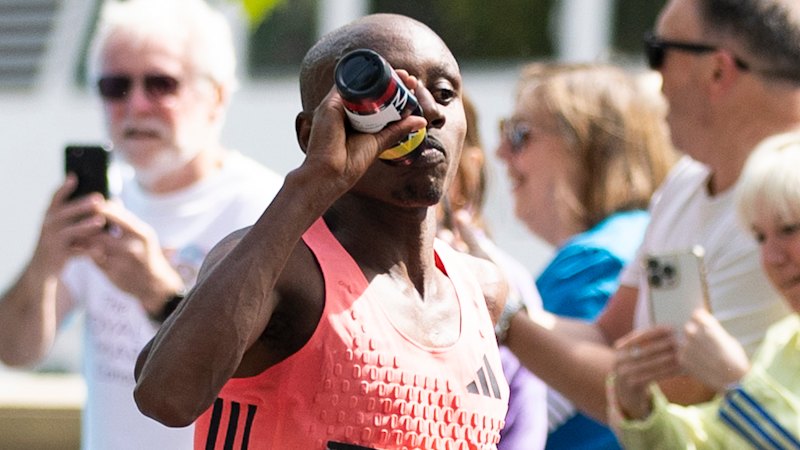
On Sunday April 26 at the London Marathon, 31-year-old Kenyan Sabastian Sawe became the first person to legally run a marathon under two hours. His time of 1:59:30 was a far cry from Hicks’ record and his methods for fuelling were even further.
In the aftermath of London, attention focused on a different technological advancement in marathon running: sneakers and the years-long contest between Nike and adidas to create footwear that would enable an athlete to run a sub-two hour marathon. Adidas finished first and finished twice. Just after Sawe crossed the finish line wearing its shoes, Yomif Kejelcha finished his first-ever marathon just 19 seconds under the two-hour mark in another pair from the company.
Yet, neither Nike nor adidas’ scientists were the first sports boffins to mount an assault on the two-hour mark. And a common thread between each of the super athletes who wore their shoes in pursuit of that incredible milestone was a Swedish energy drink company called Maurten.
Indeed, after Sawe had broken the record, his coach Claudio Berardelli, had this to say: “There is no doubt we are in the new era of marathon running because of the shoe, but I would say, also, because of proper fuelling. So we are super glad for adidas. And we are super glad for Maurten.”
The birth of Maurten and the sub-two hour project
A year before Nike launched its campaign to produce a record-breaking shoe in 2015, Australian-born researcher and sports scientist Yannis Pitsiladis launched his own effort to help athletes break the two-hour marathon mark. Pitsiladis’ research focused on understanding how genetics, physiology, biomechanics, training, technology and nutrition could contribute to achieving the milestone. He was vocal in his conviction that running a marathon under two hours would rely on athletes being able to consume more carbohydrates in an hour than was previously believed possible.
A body of research (although not all experts agree) shows that endurance athletes have more energy and can perform better when they have a combination of both stored carbohydrates (glycogen) and a higher intake of carbohydrates during an event. But for a long time, athletes, researchers and dieticians believed it wasn’t possible to consume more than 60 grams of carbohydrates an hour without succumbing to gastrointestinal issues (like vomiting) or without the body being able to actually absorb the additional carbohydrates.
“We used to think there was a limit of about 60 grams an hour that could be absorbed,” marathon runner and sports dietitian Louise Burke said. “But that was based on most of the carbohydrate sources we were using had a glucose base and the glucose molecule was tied to a particular transporter to get it across the intestinal wall. And this transporter maxes out at 60 grams an hour.
“But then work was done in the early 2000s to show there were other carbohydrates, fructose being another one, [which make use of] different transporter proteins. If you’ve got a drink that’s got a bit of both, then you can have [almost] double the amount of absorption.”
To run a marathon under two hours, Pitsiladis hypothesised that athletes would need between 90 and 100 grams of carbohydrates an hour. Around early 2016, the founders of Maurten contacted Pitsiladis believing their energy drinks and gels would allow athletes to do exactly that. They began to work together.
Maurten’s co-founder Mårten Fryknäs is an associate professor in cancer pharmacology and an Ironman triathlete (which includes a 3.8 kilometre swim, a 180km bike ride and a full 42km marathon in the final leg of each race).
He came up with the concepts behind his company’s products after suffering gastrointestinal issues while running. A trip to a dentist, who told him sports drinks were damaging his tooth enamel, also played a part.
Popularised in the 1980s, sports drinks have long been targeted at endurance athletes for hydration (fluid and electrolytes) and fuel (carbohydrates). As a complement to drinks, energy gels were invented as a way to provide athletes with a higher concentration of carbohydrates in a smaller and more portable dose. Usually sold in small sachets, their viscous goo-like liquids can make athletes sick when too many are consumed, commonly causing vomiting or diarrhoea, which is what Fryknäs suffered from.
Through his cancer research, Fryknäs was already familiar with how hydrogels – polymers that absorb and retain large amounts of water – were used in targeted drug disposal to minimise the side effects of certain medicines. Using the same technology in energy gels, he theorised, would allow athletes to absorb a greater amount of carbohydrates during a race, without suffering from the gastrointestinal side effects of doing so.
The now-patented Maurten hydrogel gels use a biopolymer made of extracts from seaweed and fruit to control the release of carbohydrates in the small intestine, Professor Greg Qiao, head of the Polymer Science Group at the University of Melbourne, told this masthead.
“When they’re going to your stomach … [they] slowly release these carbohydrates so they can provide the energy for the body to absorb and use,” he says.
The London Marathon
Pitsiladis eventually moved on from unlocking the scientific keys to elite marathon performance but Maurten didn’t. It began fuelling the Nike athletes for a 2017 sub-two hours attempt. When two-time Olympic gold medallist Eliud Kipchoge was successful in 2019 (though his time of 1:59:40.2 didn’t count because it was performed under unofficial race conditions), he ran the course drinking from unlabelled bottles containing the Maurten carbohydrate drink and the company’s gels.
And on April 26, when adidas athletes Sawe and Kejelcha did it legally, both again used a combination of the Maurten drinks and gels.
Sawe’s personalised carbohydrate regimen was developed over a month with Maurten’s researchers in Kenya. He was to drink two carb drink mixes two days out from the race to increase his muscle carbohydrate stores, a gel five minutes before the race and the drink mix again every five kilometres.
Another key part of Sawe’s pre-race routine was using Maurten’s sodium bicarbonate drink three hours before the race start. Bicarb soda (commonly known as baking soda) helps counter the build-up of acidity and fatigue but it can also make athletes sick.
Maurten’s patent, which uses a gut-friendly polymer to contain the baking soda, may have contributed to Sawe’s ability to run the second half of the race faster than the first.
“It takes about two hours for it to peak in the bloodstream,” Burke says. “So what he’s doing is setting it up so it’s going to be there and ready to tap into probably an hour into the event when he needs that.”
But, Burke says the evidence proving the efficacy of consuming sodium bicarbonate is iffy because of how difficult it is to mimic a race scenario – including the adrenaline from competitors and fans – in a laboratory environment.
In fact, high-performance nutrition lead at Australian Athletics Jessica Rothwell (whose athletes use energy gels) said the research into carbohydrate hydrogels in endurance sport is still in its infancy.
“We do need female athletes tested and more robust or larger study numbers to be truly confident that a hydrogel is enhancing performance more than any other [product],” Rothwell says.
Weekend runners eager to mimic Sawe’s sprint can buy Maurten products, but they won’t get the month-long personalised program that he had. Burke and Rothwell suggest that anyone using gels should do so only after trying them ahead of any races, as well as other sources of fuel, including the most simple. “I don’t have a problem with someone who’s a recreational runner who wants to run a marathon saying ‘well, I’m going to buy the Maurtens’,” Burke says. “Even though technically, I could just drink cordial and buy some lollies because that might be enough to fuel me.”
Be the first to know when major news happens. Sign up for breaking news alerts on email or turn on notifications in the app.
