



Disadvantaged students are worse off today than when NAPLAN was introduced, as the chasm between rich and poor students in Australia grows, new research shows.
A new analysis of 17 years of NAPLAN data conducted by Victoria University’s Mitchell Institute shows inequality has become a feature of schools across Australia, and that in almost all cases, learning gaps are widening as students progress through school, with “enduring and persistent” learning gaps becoming more entrenched.
The study, which included 2008-2022 data, and 2023-2025 data (after the way NAPLAN was measured changed in 2023), transformed NAPLAN scores into equivalent years of learning and compared it against parental occupation and education.
It found an average student in Year 3 who had one parent with a bachelor’s degree or higher was two years and three months ahead of an average student whose parents had not completed school. By Year 9, the gap had grown to four years and three months. The only exception was numeracy in Year 9, where the gap shrunk by 3.2 months based on parental occupation and 2.3 months based on parental education.
Mitchell Institute senior research fellow Andres Molina said the issue was system-wide and structural.
“In a country that is progressive, that takes equity seriously, in every single state and territory, to see that has not materialised in closing the gap from students in different backgrounds, those gaps are widening – it’s very problematic.”
He said increased competition between schools, a growing private school sector, inequitable funding and selective enrolment practices had contributed to a more segregated school system.
Among 50 OECD member and partner countries, Molina said Australia had experienced the largest increase in school socioeconomic segregation over the past 20 years, according to unpublished research.
The recent introduction of synthetic phonics in Victorian schools, explicit teaching, programs like free breakfast clubs, glasses, dental checks, affordable school uniforms and group tutoring had helped reduce barriers for disadvantaged students, as well as school mental health menus.
In Victoria, the gap in NAPLAN scores between advantaged and disadvantaged students for Year 3 reading closed between 2024 and 2025 from 90.5 to 88. But Molina said addressing the causes of concentrated disadvantage would have broader impacts.
A spokesperson for the Victorian government said that the state’s students were leading the nation in NAPLAN scores, with the lowest rates of additional support requirements. They also called the rollout of the VCE Vocational Major in 2023 a game-changer, saying it ensured more students than ever were completing senior secondary studies.
But the report recommends a more explicit policy focus on funding schools operating in areas with concentrated disadvantage and targeted intervention at early learning services.
It also says full-service schools or similar models can counter growing segregation where traditional schools aren’t equipped to meet the challenge.
Generally, full-service schools combine education, health, social and wellbeing supports for students and families in one place, allowing students to connect with services or resources needed to support better learning outcomes.
In the United States, California invested roughly $5.75 billion to expand the full-service schools model in disadvantaged communities, alongside a community schools strategy. A review of 300 community schools in New York, similar to full-service schools, showed strong outcomes including a drop in absenteeism, suspensions and an increase in graduation.
In Australia, a patchwork of schools across states and territories have implemented a range of initiatives, but Molina believes there needs to be a cohesive national approach.
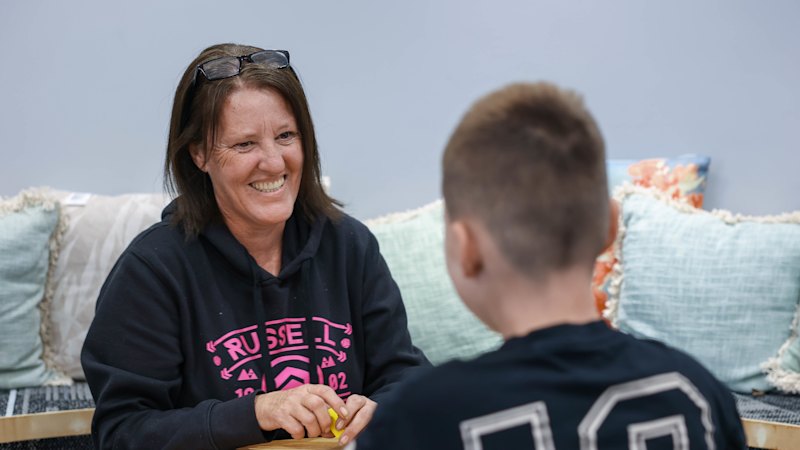
For 50-year-old Corio resident Kylie Thomas, who is a permanent carer for her three grandchildren, Azaiah, 12, Ravee, 11, and Ollie, 10, the holistic place-based approach to education at her grandchildren’s school has been life-changing.
The children attend Northern Bay P-12 College in Corio, which is connected to one of nine Our Place sites that works with Victorian schools.
Our Place acts as a glue between services, connecting students and families with community, council and state services.
Of the 1725 students at Northern Bay College, 76 per cent are in the bottom quarter of socio-educational advantage. Thomas said having so many services in the one space meant families were more confident to ask for help if and when they needed it.
“No one’s nervous or apprehensive to come and ask for the assistance because they know the people,” Thomas said. “If a child needs support, it’s here. I think it makes a huge difference. If this wasn’t like this, I don’t think we’d have the community effect that we’ve got.”
Thomas said parents could also get English lessons and parenting support, while students can access psychology and health appointments and integrate early years with school. “It’s a wide, diverse and very inclusive … It’s like a family.”
Our Place chief executive Sean Cory said the report confirmed what many Australians were experiencing.
“Educational inequality is not inevitable,” he said. “The Mitchell Institute report highlights the need to think differently about how schools and services work together if we want fairer outcomes for children.”
Cory said full-service schools helped with earlier identification of developmental concerns, built parent confidence to support learning at home, and improved access to services and family support.
“Too often families are left to navigate separate systems on their own while also dealing with challenges like insecure housing or putting food on the table. When services work together in a safe and welcoming environment, instead of in silos, support becomes easier to access and more effective.”
Cory said that at most Our Place sites, when compared to similar schools, there were early, encouraging signs in NAPLAN results, as well as improved attendance and engagement.
For Maryborough single mum Mary McManus, who is battling a terminal illness at 41, support from The Smith Family, including a family coordinator, had made a remarkable difference to her three children’s engagement in school.
“Before, they were shy kids … They didn’t shine like they do now and have the confidence they do now. It’s given them confidence to be themselves; people don’t realise how important that is.”
Doug Taylor, chief executive of The Smith Family said the number of schools with more than 50 per cent of students in the lowest socioeconomic groups had increased over recent years from 17 per cent in 2017 to 20 per cent in 2023.
“We need a stronger, coordinated system-level response that matches the scale of the challenge. That includes better targeting of resources to schools and communities with high levels of need.”
Federal Education Minister Jason Clare said the good news was that the average eight-year-old is now reading a year ahead of where they were 20 years ago, but “the bad news” is that the gap between the reading skills of eight-year-olds from wealthy families and those from poorer families had doubled.
“That’s what we have got to fix … That’s what the landmark agreement (Better Fairer Schools Agreement) we have struck with the states and territories is all about,” he said.
Clare said the agreement was tied to reforms to help kids catch up, keep up and finish school – including phonics checks, numeracy checks and small group tutoring.
The Mitchell Institute’s Molina acknowledged the agreement offered a good opportunity to make change.
“Everywhere gaps are large; there’s more inequality. If we continue doing the same thing that we’re doing, we’re not going to see this going the other way around,” he said.
Start the day with a summary of the day’s most important and interesting stories, analysis and insights. Sign up for our Morning Edition newsletter.
 Nicole Precel is an education reporter at The Age. She was previously an audio video producer. She is also a documentary maker. Get in touch at nicole.precel@theage.com.auConnect via X, Facebook or email.