


Opinion

This week, while war in the Middle East roiled the global economy and the federal government announced sweeping cuts to the NDIS, a debate was held in the NSW town of Griffith. The Monday debate was a chance for locals to meet the full spectrum of candidates in the Farrer byelection, which will be held on May 9, from the Greens to One Nation and everyone in between.
Hosted by the Griffith Business Chamber and led by local masthead Region Riverina’s Oliver Jacques, the debate mostly flew under the radar, other than in reporting by that publication and Crikey. But it’s worth taking a moment to digest it.
While there was some overlap between the issues being debated in Canberra and the issues that mattered to Farrer voters – immigration, tax reform and political donations were all discussed – it was a loose, contradictory and timely reminder that all politics is local.
Time and again during the debate, Liberal, National and One Nation candidates bucked their respective party lines on issues that mattered to locals. And that’s a good thing.
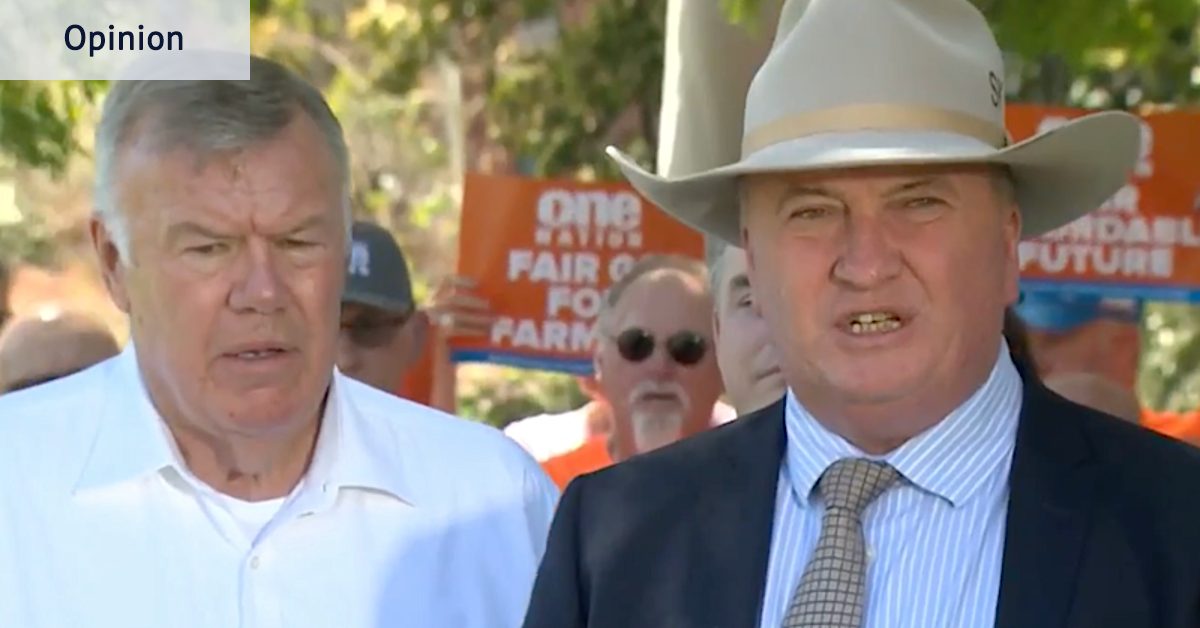
One Nation candidate David Farley, the front-runner to win the seat according to a handful of published polls, was asked twice if he fully supported One Nation’s policy of slashing immigration by 75 per cent. His answer went nowhere near endorsing the policy. Rather, he reflected the needs of the small towns and cities that make up the seat.
“An electorate like Farrer is the exemplar,” Farley said. “We have showed the nation that we can immigrate and assimilate people into our culture. One Nation is really focused on the quality of immigration, the need of immigration and the skills of immigration [sic].”
Farley said: “It’s the only party focused on Islamic extremism and trying to make sure that it doesn’t creep into our society. But the reality is if we want productive, healthy communities, immigration has got to play a big role, conditional on [that] it’s skilled immigration, it’s assimilation immigration, and it’s affordable immigration.”
Not exactly a ringing endorsement of One Nation policy.
“It is totally different, the picture for Farrer, to the problems we are having in our big cities, so we want to make sure they are not being confused,” Farley added.
Meanwhile, One Nation leader Pauline Hanson used social media to attack the Greens candidate in Farrer, Richard Hendrie, for having corflutes that explained, in Punjabi, why the local community should vote for him.
Farley also gave a less than convincing answer when he was asked whether mining magnate Gina Rinehart, a major donor to One Nation, had pitched in to fund his campaign. After arguing that most of his funds came from locals, when pressed on Rinehart, Farley said: “I couldn’t answer that question; it’s not at my pay grade.”
It wasn’t only Farley who was tripped up. Michelle Milthorpe is an independent who ran second to Sussan Ley at the 2025 general election, and who is running second in the current polls. Milthorpe was also on the defensive over donations. She said she had more than 1000 donors, most of them small, but eventually allowed that about 2 per cent of her funding had come from the city-based, teal-backing Climate 200 outfit led by Simon Holmes à Court. Milthorpe has been desperately fending off accusations from other candidates that she’s a left-leaning teal in disguise. It was not a good moment for her.
Then there was Liberal candidate Raissa Butkowski, who has the advantage of the No.1 spot on the ticket and who is desperate to retain the seat for Angus Taylor’s Liberal Party. She claimed, somewhat improbably, that she did not know whether her party would be preferencing Farley ahead of Milthorpe on how-to-vote cards.
“Our how-to-vote will be coming out in and around when pre-poll starts,” Butkowski said. Pressed on who she would preference, she added: “I cannot answer that.”
It was one of the least convincing answers of the night and odd, given the Liberal Party published on its website its how-to-vote recommendations the next day. It will preference One Nation’s Farley ahead of the independent, Milthorpe. And pre-poll voting starts next Tuesday.
Nationals candidate Brad Robertson bucked his party line on whether capital gains tax breaks should be wound back. Robertson, after first arguing people on low incomes used negative gearing to get into the property market – a questionable assertion – conceded some people used both tax breaks to game the system, which he didn’t like. Pressed on whether he would like to see the capital gains tax discount wound back, Robertson said: “I’m open to the idea of a consideration, for maybe people with lots of homes, but I think you can’t scrap it because there’s a lot of people out there [for whom] it’s the only way to get into the housing market.”
Yet again, it was an answer that broke from the party line in Canberra. And there was Sustainable Australia’s Lucas Ellis, who said he was all in favour of abolishing “negative gains”, before correcting himself.
There are two common threads to all these missteps and breaks from the party line: first, that the candidates were (mostly) trying to give honest answers that addressed what locals in Farrer need, rather than the diktats from head office.
The second is the growing disconnect between local politics and the kind of people usually selected by major parties to represent seats like Farrer in Canberra. That disconnect is one of the major reasons why the number of independent MPs in Canberra has grown so significantly at the last two elections, and why Farley and Milthorpe – both seen as outsiders – are the front-runners at this byelection.
Arguably, the most important issue during the debate, which is not much discussed in Canberra these days, was water. Many Farrer locals are fed up with water buybacks in the Murray-Darling basin. Every candidate bar a couple touched on the issue, signalling their concern for farming in the region. Also discussed was the poor quality of water in the small town of Narrandera, which comes out of the tap a delightful orangey-brown colour, though the local council insists it is safe to drink.
Both the Liberals and Nationals have promised $16 million towards a new water-treatment plant to fix the problem, but they are in no position to deliver on this promise as they are not in government. It’s a problem that Labor and Liberal governments at state and federal levels could have fixed, but locals put up with a situation that would never be accepted in Sydney or Melbourne.
The contest in Farrer looks nothing like the battle in Canberra, and that’s a good thing, as unpolished as the local candidates may be. Whoever wins this byelection, hopefully he or she brings a dose of Farrer to the capital.
James Massola is chief political commentator.
Get a weekly wrap of views that will challenge, champion and inform your own. Sign up for our Opinion newsletter.
 James Massola is chief political commentator. He was previously national affairs editor and South-East Asia correspondent. He has won Quill and Kennedy awards and been a Walkley finalist. Connect securely on Signal @jamesmassola.01Connect via X or email.