



A game-changing discovery by Australian researchers into one of life’s most critical and abundant molecules could lead to treatments that regulate the body’s sugar more directly than drugs such as Ozempic.
The molecule, ubiquitin, was so named because it is ubiquitous. It’s a tiny protein scientists have harnessed to attack cancer cells, and now it’s in the spotlight as a future avenue for treating obesity, diabetes and heart disease.
The research throws the door open to a raft of new-to-science biological actions powered by the underestimated molecule, which is rife in every complex organism from humans to yeast.
Ubiquitin is also called “the kiss of death”. It attaches itself as a tiny tag to damaged or unwanted proteins, signalling to the cell it’s time to destroy that protein.
What scientists couldn’t see, until now, was that the molecule may act on substances other than protein. That’s the part which could re-write biology textbooks, Professor David Komander, a researcher at Melbourne’s WEHI research institute said.
“It is so important that I know I will be working on this for the rest of my career. I’ve never said this before for any other discoveries,” he said of the new finding.
“We’ve known about ubiquitin as a tag for proteins for decades. But I’m still overwhelmed myself about what we have missed.”
A world-first detection tool
Scientists can image cellular proteins in great detail, but had no way to properly see or study ubiquitin’s interaction with other molecules such as sugars, fats or DNA.
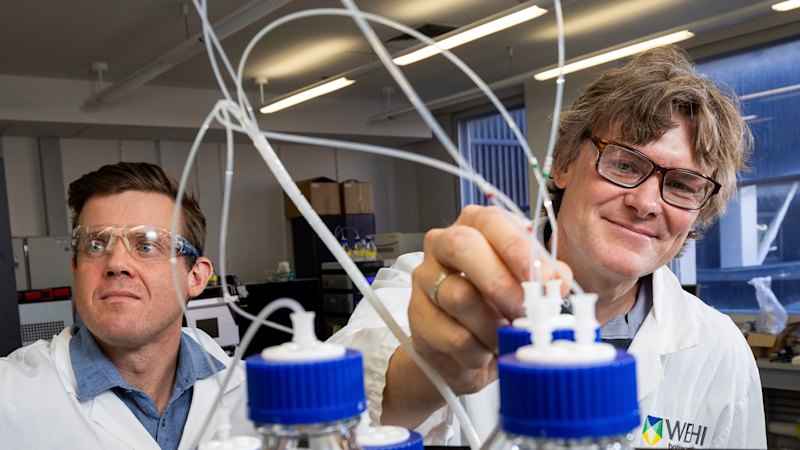
Acting on a make-or-break hunch, Komander’s colleagues, Dr Simon Cobbold and PhD student Marco Jochem, spent four years inventing a way to reveal the action.
The team borrowed an enzyme from bacteria that cleaves through ubiquitin, slicing it from whatever the molecule is attached to, but leaving a tiny fragment stuck to its target.
“This discovery is clearly much bigger than us here in our labs.”
Professor David Komander
To that remaining fragment, the scientists attached a peptide chain, which they could easily track.
The method, dubbed NoPro-clipping, allowed the researchers to repurpose advanced protein imaging technology to see if ubiquitin was interacting with other molecules.
It was a massive gamble. They’d either find nothing, or rewrite our knowledge of cellular life.
It was the latter. The tool began to reveal an unchartered realm of biological action. “That doesn’t happen very often in a scientific career, where every experiment you do turns to gold,” Cobbold said.
More direct than Ozempic
The researchers’ first big find, reported on Thursday in Nature, was that ubiquitin directly attaches to glycogen, a crucial sugar molecule which keeps our hearts beating and brains whirring.
“Glycogen regulation is one of the most fundamental processes that happens in our bodies every day, every night, because it is keeping our blood glucose in check,” Komander said. Glycogen is sugar stored in the liver and muscles, and it’s rapidly broken down into glucose to fuel the body when needed.
In Komander’s study, ubiquitin seemed to modify glycogen within the livers of mice and human muscle tissue. When mice fasted, their glycogen stores decreased, and the ubiquitin “tags” increased, suggesting ubiquitin regulates the body’s sugar.
“That is something that nobody else could have observed before because nobody had the technique to look at it,” Komander said. If ubiquitin really does help regulate blood sugar, that adds to half a century of knowledge about how metabolism works, and may lead to a way to directly attack excess glycogen.
Too much glycogen drives obesity, diabetes, liver and heart disease. Drugs such as Ozempic affect glycogen indirectly by suppressing the hormone glucagon, which triggers the breakdown of glycogen into useable sugar. The ability to directly control glycogen levels instead would be powerful.
“Ozempic is an interesting example – clearly regulating metabolism can have so many beneficial effects,” Komander said. His team is also focused on addressing difficult-to-treat diseases where people are unable to store glycogen properly.
A global call to arms
There have been previous claims that ubiquitin can act on sugars, but the new paper offers the first “quite conclusive evidence”, according to cell biology expert Professor Sharad Kumar from Adelaide University.
“This is a significant finding, and it will be exciting to see the physiological and genetic data that follow to fully understand the implications,” Kumar, who wasn’t involved with the study, said.
Many more studies are needed before the discovery could translate into a clinically useful treatment.
Ubiquitin has already been harnessed to destroy cancer-related proteins in new oncology treatments. The new study opens a whole new field of action, and its authors hope other global scientists will jump on board to help uncover ubiquitin’s secrets. The molecule could latch on to viruses and bacteria, for example, and sound a cellular alarm for invading diseases.
“What is beautiful is that we are really providing the first glimpse at a completely empty canvas,” Komander said. “This discovery is clearly much bigger than us here in our labs in Melbourne.”
The Examine newsletter explains and analyses science with a rigorous focus on the evidence. Sign up to get it each week.
 Angus Dalton is the science reporter for The Sydney Morning Herald.Connect via X or email.