









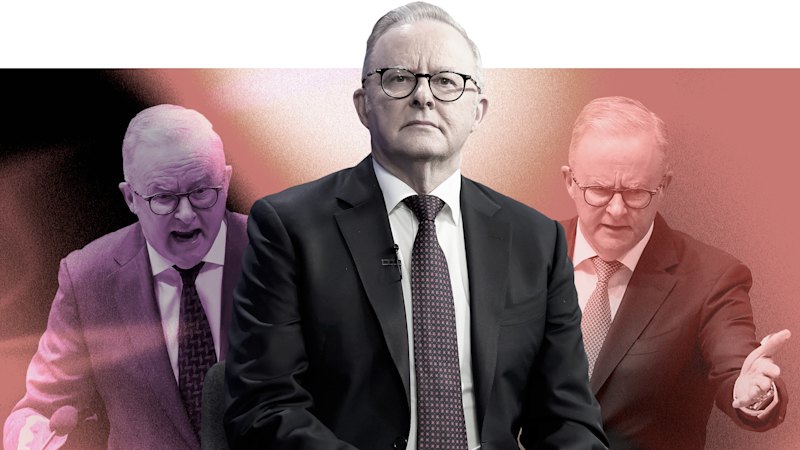
Lobbyists and business representatives who met with Labor figures at Parliament House on Wednesday delivered their feedback as succinctly as they could.
They were hearing, anecdotally, that punters were cancelling their Easter weekend bookings at restaurants and hotels, and rushing to refuel at petrol stations. This anxiety had been propelled by a revelation earlier that day: Prime Minister Anthony Albanese was planning to deliver a rare televised national address in the evening.
If the purpose was to instil calm in the community, the announcement of a primetime address wasn’t serving its purpose – it was adding to speculation. Industry leaders, satisfied by the government’s response to the global fuel crisis rattling the Australian economy, now worried people were bracing for a COVID-like crackdown.
Some ministers relayed the message higher up the chain.
Pandemic-era restrictions were not what Albanese’s office had in mind. Far from it, the month had been spent urging people not to panic. But the message wasn’t cutting through. That’s why they were pulling out all the stops for the prime minister to speak to the country, uninterrupted, for a few minutes on Wednesday night.
That’s also why, when Albanese finally hit the airwaves at 7pm, there were no surprises.


His words were mostly the same as they had been in recent days and weeks: The economic shocks caused by this war will be with us for months. Leaders from both sides of politics are working together to keep Australia moving. You should go about your life as normal.
But he also added a line: “Over coming weeks, if you can switch to catching the train or bus or tram to work, do so.” The shift in language was a meaningful concession that more could change if things overseas didn’t improve, as grim economic forecasts loom large over next month’s budget.
Cautious tone leads early response
In the month since the war in Iran broke out, the government has stressed fuel is flowing into the country.
Six of 81 shipments due to arrive in April were cancelled, only to be replaced and topped up with an additional three. Service stations have been running out of fuel, but this has been from a panicked jump in demand, not because there was any less of it in the country than there would be ordinarily.
Energy Minister Chris Bowen repeated this message as he fronted Labor’s response to the crisis. He gave daily updates about fuel stock and shortages to the parliament in question time. Behind the scenes, he met with state counterparts and pushed an at-times sceptical cabinet to lower fuel standards and release extra from the nation’s stockpile to meet the surge in demand.
Labor’s tone was deliberately cautious – panic buying was the biggest threat to fuel supply. So when the International Energy Agency sounded the alarm two weeks ago, recommending that countries encourage working from home, reducing speed limits or rationing fuel, its strategy was to tell people to go about their business as usual.
But that message wasn’t being heeded – particularly in the regions, where voters have less trust in Labor. Fuel prices were rocketing to record levels, and Bunnings was running low on jerry cans.

As bowsers were running out, government ministers were emphasising steady supply. Even if it was true, it created a disconnect. An impression started building of a prime minister reluctant to take charge. This was the narrative being pushed by the Coalition, which used question time each day to attack Albanese and Bowen for downplaying the crisis.
Albanese did not help that case when he sidestepped questions about his own responsibility. Asked about fuel rationing two weeks ago, days after a national cabinet meeting, he said: “That’s a decision for state and territory government, so it’s not a question for me.”
That answer alarmed the states, including NSW Premier Chris Minns and Victorian Premier Jacinta Allan, who feared a COVID-style breakdown in the federation. They pushed Albanese to lead a national response.
The comment also caught the ear of some in Albanese’s inner circle, who were concerned Albanese would shrink in the moment, as he was accused of doing after December’s Bondi terrorist attack. They privately and gently cajoled the prime minister into taking a firmer grip of the situation.
Ministers became frustrated when, last week, this masthead reported that Albanese had called a national cabinet meeting for the following Monday, to put together a national plan for fuel conservation.
The Australian Financial Review reported that Albanese’s leadership team questioned the secrecy surrounding the government’s communications. They didn’t understand why the timing and purpose of the meeting were publicised through a media leak, rather than just announced.
It was resolved that the government would be more forthcoming.
Albanese takes control of the crisis
Then Liberal leader Angus Taylor and Nationals leader Matt Canavan got first out the door last Friday with an announcement that the Coalition wanted to cut the fuel excise.
“Anthony Albanese is asleep at the wheel. He needs to stop watching and start acting. Australians are hurting,” Taylor said. “Families across the country are seeing their standard of living collapse, yet Labor does nothing.”
Albanese sprung to action. Hours after Taylor’s petrol station press conference, he and Bowen gave a press conference in Parliament’s blue room – a backdrop many people would recall most clearly as the site of Scott Morrison’s COVID-era addresses. The location added weight to their message.

“This war is real. This war is having an impact on Australians, like it’s having an impact right around the world. You can’t wish that away. What you can do is respond in an appropriate, orderly, adult way,” Albanese said.
“The government has been clear that the longer this war goes on, the greater the impact will be. But we continue to act to prepare and shield Australians from the worst of it.”
Last Saturday, Albanese fronted cameras again, announcing new powers that would allow the government to underwrite the private sector’s fuel purchases – another way of shoring up supply. And he emphasised there would be a national cabinet on the Monday. “A global crisis needs a national response, and that is what we are doing,” he said.
Two outcomes followed Monday’s meeting of state and territory leaders. The first was a national plan, which outlined how Australia would respond to the situation in stages: the first was preparation, the second was keeping things moving, the third involved targeted action and advice to reduce fuel use, and the fourth would require tougher measures such as fuel rationing. Australia was at level two, and the levels would escalate if there were significant disruptions to supply.
Sources familiar with conversations within the government say there are still live discussions about precisely what those emergency measures, such as rationing, would look like. But industry and government sources alike stress they are a last resort, and that any government recommendation to change behaviour – such as working from home – must be carefully calibrated with the economic consequences and demands for compensation that would follow.
The second announcement was cost-of-living relief: for three months, the federal government would cut 26 cents a litre from the fuel excise, and axe the heavy vehicle road user charge. The states also agreed to pass on the windfalls they were making in GST revenue from higher petrol prices (by the end of the week, this meant another 6 cents off a litre of fuel).
Taylor claimed credit for the policy, although government sources say they started considering a fuel excise cut the Tuesday beforehand. In the middle of last week, however, Labor backbenchers did not believe the policy was on the table, and ministers, including Treasurer Jim Chalmers, were talking it down.
The measure risked adding to inflation and forcing the Reserve Bank’s hand on another rate cut. But this was ultimately outweighed by a sense that Labor needed to show voters they understood households’ pain as other countries moved to slash similar taxes.
The case was also being pushed by state premiers over the weekend, and into the national cabinet on Monday, particularly by Victoria. With a parlous state budget, Allan initially contradicted Albanese’s wish for the states to pass on GST windfall to fund further petrol relief. But Albanese got on the phone to make sure Allan, as well as Queensland Premier David Crisafulli, who was also keen to use the money as he saw fit, fell into line.
PM’s chooses a direct line
Big decisions had been made on Monday, and the excise cut hit petrol pumps on Wednesday morning (fuel prices fell almost immediately).
Still, the government was not commanding public sentiment. The prime minister felt it needed to get its message out as widely as possible. He decided on the national address around the time of national cabinet on Monday, but it took a while to lock in the logistics.
Albanese told colleagues that misinformation was rife: One Nation and others were loudly declaring supply was drying up, even as the government helped to secure more oil shipments than normal. (Indeed, right-wing campaign group Advance on Thursday emailed its supporters warning about COVID-style fuel restrictions and dangerously low levels of fuel supply.)
Coalition talking points for the week, leaked to the Daily Telegraph and published on Wednesday afternoon, also showed that opposition MPs were being told to push the line that Labor “still has no plan to get fuel to where it is needed”, and that the government was not ruling out “heavy-handed mandates” – even though Albanese was strongly resisting such measures. Labor senators accused the Coalition of acting recklessly.
Albanese told his colleagues that, for many voters, a three-minute nationally televised spiel would be the first clear message they would have heard from the government that this crisis was not like COVID.
He would also use Thursday’s speech at the National Press Club, which had been delayed from its original January date because of the Bondi massacre, to reinforce the message. Albanese and Bowen briefed newspaper editors about their plans.
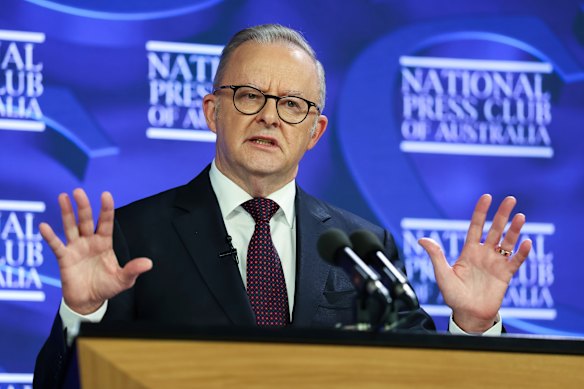
When journalists at Thursday’s Press Club suggested to Albanese that he had given an anticlimactic national address, the prime minister was unapologetic. He said social media was propagating misinformation and conspiracy theories, the opposition was playing up difficulties, and changing media habits meant it was hard to reach people in one place.
“I’m taking every opportunity to try to put out facts about where we’re at and to show people that we do have a plan,” he said. “There’s no need for people to go and fill up jerrycans and put them on the back of utes and go off and do that as well. And that’s why directly talking to people is an important opportunity and I think was worth 3 minutes and 17 seconds to do so.”
The fuel crisis is now central to Labor’s agenda. Tax reform, which was already being developed for next month’s budget, is being couched in language that pins it to the need to address anxiety stemming from the oil shock. Albanese will ramp up diplomatic efforts with Asian neighbours this week. Bowen on Friday said more than 50 ships are en route to Australia.
The prime minister has a more compliant set of premiers than Morrison did during the pandemic. Until he makes a mistake that parallels the former Coalition government’s vaccine bungles, more voters are likely to blame Trump for their woes. Albanese’s national address received mixed reviews, but Taylor is struggling to cut through the populist noise emanating from One Nation.
Still, it could all change quickly for Labor. Economists this week warned a recession was likely if conditions worsened. The longer the war goes, the greater the stakes will become.
With Shane Wright and Mike Foley


