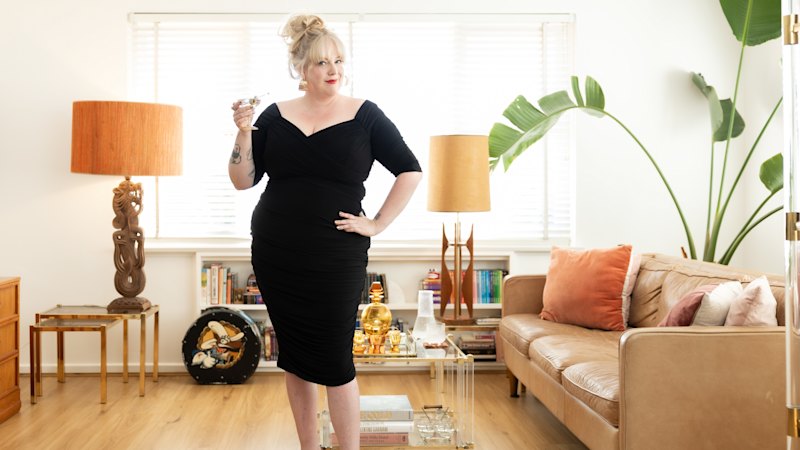




With respect to sprinter Usain Bolt and tarantula specialist Ann Webb, Gypsy Taylor truly is an excellent example of nominative determinism. The costume designer, who’s worked with the likes of Catherine Martin and Baz Luhrmann, Taika Waititi, James Cameron, Russell Crowe, J. J. Abrams and Ridley Scott, has a pair of feet so itchy Dr Scholl would turn in his grave. “My mother often jokes that she should have called me Stay At Home,” says the 47-year-old, whose family are all as creative as her.
Her father, Deane Taylor, has worked in the world of animation since the 1970s. Among his many credits, he was the art director on Tim Burton’s 1993 stop-motion hit, The Nightmare Before Christmas. Her mother, Joy, is a clothing designer. Her brother, Eddy, specialises in wardrobe and props. Her sister, Ginger, is a noted artist and signwriter. “With creative families, there’s two paths you can take,” she says. “Either carry the torch, or rebel and become a lawyer. I do wish someone in my family had been an accountant. Then we’d all have savings and know how to do our taxes.”
Growing up in the 1980s with dyslexia, Taylor struggled with school, disappearing into her sketchbooks instead. “I was the kook,” says the designer, who was recently nominated for an AACTA. “I was bullied and teased, and I had a very quiet childhood where mostly the teachers were my friends, because they felt sorry for me.”
Her early life was spent travelling around Asia and the US, where she would hang out on the sets of the movies her father was working on, playing blackjack with staff, learning how to paint and generally getting the education that school just couldn’t offer her. “My family knew how hard it was for me,” she says. “So when I was little, Mum and I would just sit and watch midday movies together: Singin’ in the Rain or Some Like It Hot. They were some of my more joyful moments.”
Perhaps it’s little surprise that Taylor fell into a job focused on bringing fantasy to life. From the moment she put that first VHS tape into the player, she was drawing whatever she saw on screen, and has never stopped.
The family was living in Sydney when 15-year-old Gypsy decided to quit school and get a job at an illustration agency. In the late ’90s, she moved on to assist her dad on an animated feature film he was directing called Carnivale, before working with London animation agency Passion Pictures as a production assistant in 1999. Among other things, she worked on the hand-drawn animation for Gorillaz video clips Tomorrow Comes Today and Clint Eastwood. “That really opened my eyes,” she says. “I wanted more [of that type of creative work].” She started attending prestigious London art school Central Saint Martins on the weekends to study fashion illustration. On her last day, her teacher pulled her aside and asked her if she’d thought about attending full-time, but it was too expensive. “I paid for electricity in my apartment with pound coins on a machine on the wall, and sometimes I ran out of pound coins.”
In 1999, she moved back to Australia, applied for the National Institute for Dramatic Art’s theatre design course and was accepted. NIDA is famous for its limited course spots and success of its graduates; it’s also infamous for its punishing schedules and military-style technique of stripping students down and rebuilding them from scratch. It was the hardest she’d ever worked. “It is exactly like the industry,” she says. “So it was incredible training for that.”

In her final year, the head of her course, Peter Cooke, lined up an interview with fellow NIDA -graduate and award-winning designer Catherine Martin (known at the time for Strictly Ballroom, Romeo + Juliet and Moulin Rouge!), who offered her weekend work. Martin and her partner, Baz Luhrmann, were developing Alexander the Great, set to star Leonardo DiCaprio. It was Taylor’s first exposure to the world of large-scale feature film and to the world of Bazmark, Martin’s and Luhrmann’s production company which operated out of their -mansion, Iona, in inner-Sydney’s Darlinghurst. “Baz and Catherine would be like, ‘OK, so today we’re having lunch on the balcony, and the Prince of Thailand will be joining us.’ Or, ‘Nicole Kidman’s coming around today for a cup of tea,’ ” says Taylor. “You know, you’d walk into the foyer, there’d be a bunch of flowers on the table and there’d be a card and it’d be like, ‘Love, Elton John.’ ”

Sadly, production on the film halted after Oliver Stone’s version, which would star Colin Farrell in a questionable blond wig, was announced. “It happens all the time in film,” she says. “It turns into a race. And we didn’t want to race because ours was such an incredible production. This thing was bigger than Ben Hur.” Taylor landed on The Chronicles of Narnia: The Lion, the Witch and the Wardrobe as a costume illustrator. It was here that she saw a world really come to life for film, working with fabric designers who would create textiles from scratch, and painting thousands of watercolour costume renderings for the characters.
After Narnia wrapped, Taylor came back to work on Bazmark’s sweeping mid-century epic, Australia. “We lived in the 1930s. It was the visuals. It was the fashion,” says Taylor. “I would do research at the R. M. Williams factory in Adelaide, and come back with information about how they created the very first moleskin and the very first boot, so that we could then re-create it for Hugh Jackman. Every day, it was a task like that.”
Taylor describes the working relationship of Luhrmann and Martin as the most collaborative she’s ever experienced. “When I came out and worked on other productions, I realised that wasn’t normal film-making. They live together. They’re both insomniacs. They’re immersed 24 hours a day, seven days a week.”
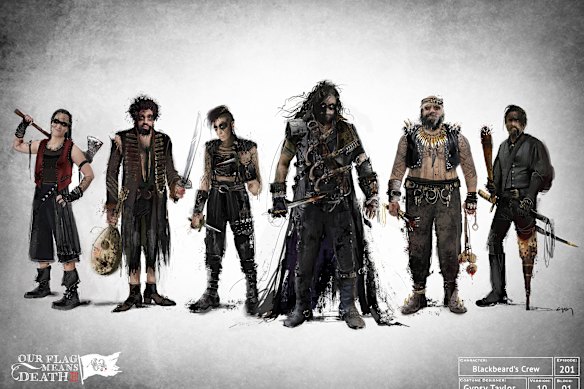
As a die-hard movie-lover, Taylor has always had a special place in her heart for Hollywood. She moved there in 2014 and spent the next decade building her résumé. Even when she was based in LA, she kept travelling, working in the Czech Republic on Amazon’s The Wheel of Time and in New Zealand with Taika Waititi on the second season of HBO Max’s Our Flag Means Death, a piratical romp which she describes as “her favourite job of all time”. “Taika really wanted to be at home, so he could be with his kids,” she says. “We had a giant extras department. I had a leather department. I had mermaid-tail makers. I had three tailors and a team of eight people whose job it was to add rum vomit and seagull shit to things. It tapped into a community of queerness that keeps giving me joy. The story we were telling was so full of love and acceptance and community.”

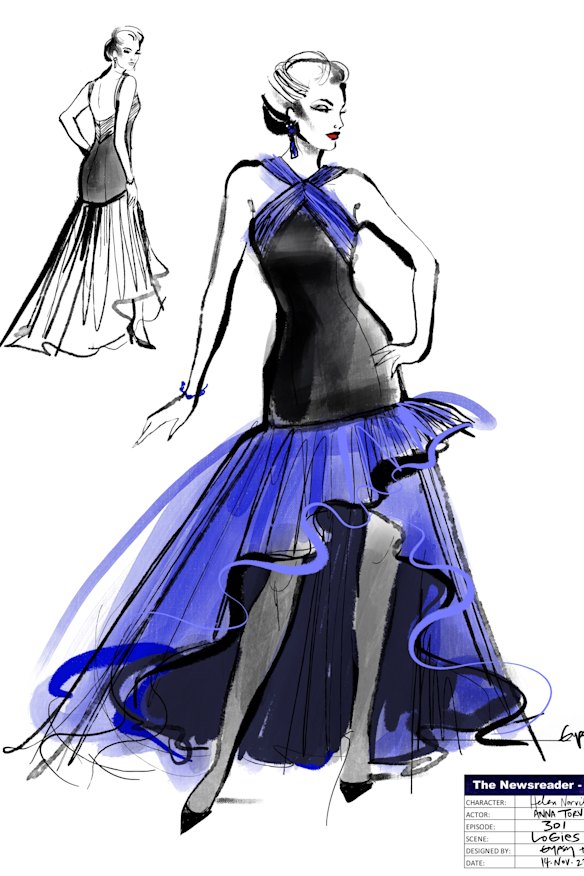
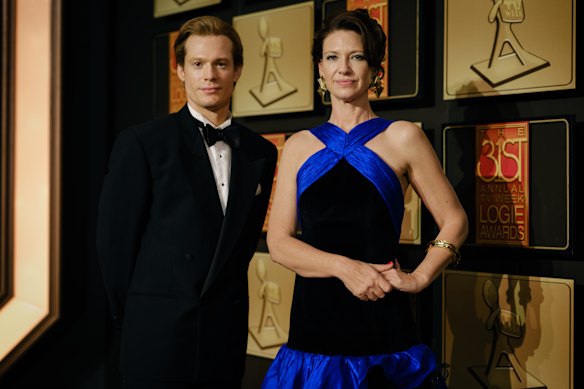
During the US writers’ strike of 2024, Taylor was out of work for seven months. But then a call came from her best friend, Aussie screenwriter and producer Michael Lucas (Offspring, Wentworth, The Newsreader). The pair first met at Iona when Lucas was Baz Lurhmann’s writing assistant. “He called me and said, ‘Look, this is a long shot. I’d love you to do season three of The Newsreader. It’s our last season and we want to go out with a bang. We can’t afford to fly you, but would you be here for it?’ So I came home.”
Designing The Newsreader was very much about reflecting the lives of a group of journalists working in free-to-air television through the 1980s. “It wasn’t about designer stuff; we’re talking journalists,” she says. “They don’t make a lot of money.” That meant sourcing original pieces from the ’80s from affordable Aussie brands such as Katies and Sussan. Much to Taylor’s delight, “going out with a bang” also meant designing a wedding dress to put Scott-and-Charlene-era Neighbours to shame. “We ended up taking the bodice of one dress, the sleeves off another, and the skirt off another. We added our own hoops, which meant we had to add more train to fit over the hoop skirt. Then we found deadstock shoulder frills and sprays of pearls. That was six elements to build it to be the biggest, best thing that I could.”
After Newsreader, she moved on to the 2025 mini-series All Her Fault, a thriller centred around a wealthy family and the loss of a child. It starred Sarah Snook, who had come from four seasons on the corporate dramedy Succession. She was, yet again, playing rich. “Everybody knew [Snook’s Succession character] Shiv’s wardrobe. I had to go back through her looks to make sure that I never reflected that same amount of wealth.”
Dressing famous actors isn’t anything special to Taylor. In fact, she tells me, she’s kind of numb to it. There are moments, such as fitting Shirley MacLaine for lingerie (“I’m in a change room, putting on her bra, thinking, ‘She got to dance with Gene Kelly!’ ”), and dressing Wolverine’s Hugh Jackman (“He was on a massive diet for X-Men: Origins, so he was all muscles and veiny”) but to her, actors are just another part of the production process. “I actually get really nervous when I meet musicians,” she says. “I worked on a film with Russell Crowe that RZA [member of ’90s rap outfit, Wu-Tang Clan] was in, and I was a hot mess.”
The relationship between a costume designer and performer is incredibly close. “Within the first five minutes of meeting an actor,” she says, “they’re naked.” Before there were intimacy co-ordinators, it was the job of the costume designer. “Intimacy co-ordinators are a new thing,” she says. “They have to talk to us, and they’re always surprised at how much we know because we’re like, ‘We’ve done this our whole lives. This is what we do, we look after people and make them feel comfortable.’ ” She describes that side of work as very delicate. “You’ve got to be gentle and loving and talk up front, but [the actor has also] agreed to do it as well,” she says. “So it’s an understanding. It’s just care and respect.” At the end of the day, Taylor is protecting her actor. “I don’t care what the director wants,” she says. “I don’t care what the DP [director of photography] wants, I care what my actor wants and I’ll stand up for that.”
Certain jobs in film have a history of being gender-skewed. Costume, for instance, has long been a position occupied by women. She’d love to see more men in her department for diversity. The lack of HR is also an issue in such a highly charged environment. “Women crying in the costume department is very common,” she says. Taylor chose to quit a more recent job – for the first time in her career – due to bullying and misogyny. “The film industry is very renowned for bad behaviour. That’s why there’s a whole movement called #MeToo.” She says production is diversifying, though, and areas such as camera-work, traditionally dominated by men, are now attracting women.
As she gets older, her priorities are changing. It’s not just about doing a great job any more. “At the end of the day, yes, I want to make a great film, but I want to have a good time doing it,” says Taylor. “We don’t see our family and friends. We work our tits off. We miss meals, we forget to go to the toilet. If we can have a beautiful team helping each other get through it then that, to me, is the dream – it used to be my name on the end credits, now it’s that.”
Get the best of Good Weekend delivered to your inbox every Saturday morning. Sign up for our newsletter.