


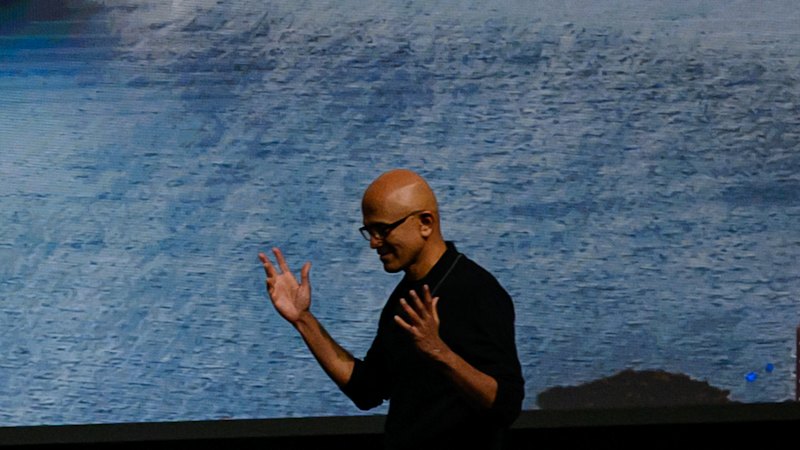

Tech executives love to get high on their own supply. And we hear Microsoft chief executive Satya Nadella put on an absolute clinic when he descended on Sydney as part of the company’s “AI Tour” on Thursday.
At the ICC in Darling Harbour, guests from across Australia’s tech community were treated to an appearance from the man himself as part of a special keynote that promised to share a “framework for success” to become “frontier companies through AI” and human ambition.
A large chunk of it, most of which would read like guff to those who don’t work in tech, was dedicated to “really exciting” announcements related to Microsoft’s suite of AI-powered products. Nadella also pumped up the company’s tyres over its AI data centre build-out which, he sounded thrilled to note, also includes Australia.
“And of course, when it comes to Australia, we have regions in Sydney, in Melbourne, Canberra, and it’s growing. One hundred per cent renewable energy, power. We’re very proud of it. We’re very committed to it, but also,” Nadella said, before being cut off by a rupture of applause, according to a recording of the event obtained by CBD.
For some Australian tech types, this sort of event is like World Youth Day. It’s not every day you get the chief executive of a Magnificent Seven company on Australian shores, and the house was packed out accordingly, we’re told. More often than not, though, the fanfare usually only arrives when these companies want something.
By Thursday morning, Nadella’s motive was clear: The $4.5 trillion company wants to walk the red carpet rolled out by the Albanese government in its light-touch approach to regulating AI, and is willing to stump up eye-watering amounts of money to make sure the government doesn’t tighten its grip.
Enter the announcement: Microsoft will invest $25 billion in data centres in Australia over the next three years. The figure could well be the largest ever investment by a global tech company in Australia.
No doubt Prime Minister Anthony Albanese, Treasurer Jim Chalmers and Assistant Minister for Technology Andrew Charlton will be juiced up. After all, this is the sort of action they’ve been hoping for with their hands-off approach to AI regulation.
For the world’s largest tech companies, the AI arms race has triggered a rush for land and infrastructure. This has already seen OpenAI, Anthropic and Amazon look at Australia with a view to ramping up spending in the market to build more data centres (read: computer sheds) to power their resource-intensive AI models.
But there’s upside for big corporates, too. Westpac chief executive Anthony Miller stepped up before the crowd to give it a taste of how the big four bank is using AI. Telstra chief executive Vicki Brady also said a few words. Then there was Craig Scroggie, the chief executive of the data centre operator NextDC, who appeared to have a front-row seat to the action, and was clearly loving it.
“Trust is engineered, not declared,” Scroggie later wrote in a post to LinkedIn, replete with a pic of the Seattle tech king. “Customer-owned IP. Customer-owned keys. Confidential computing. Private evaluation sets as the new IP. Cyber resilience and sovereignty in the same architecture.”
But part of us couldn’t help wondering how many of the engineers, product managers and other Silicon Valley aspirants who dotted the ICC on Thursday would be left without jobs in the next five to 10 years, given how quickly the large language models they champion have been able to undertake their daily tasks.
“Some jobs may have to change, but there may be some new jobs that get created,” Nadella told The Australian Financial Review. “Will there be turmoil and all of that? Yes, but at a global scale, we all will have to do our job to make sure that, quite frankly, we have social permission to do what we’re doing.”
Lots of maybes! Who knows, maybe Nadella and Co will drive an explosion of productivity that leaves us all leading wealthier, healthier, happier lives. Or maybe the technology will spur an oversupply of stuff there isn’t demand for. Or maybe worse.
When all is said and done, at least we’ll have the sheds.
Start the day with a summary of the day’s most important and interesting stories, analysis and insights. Sign up for our Morning Edition newsletter.
 John Buckley is a CBD columnist for The Sydney Morning Herald and The Age.Connect via email.