


Does it matter that Australia will now acquire three used nuclear-powered submarines instead of one new and two used boats? Not really. That’s because the real goal of the AUKUS project is to demonstrate Australia’s contribution to upholding US dominance of our region. And Australia can do that with second-hand boats, or no boats at all.
But there’s a deeper reason why the government keeps pouring Australian dollars into US shipyards. It is to lock in a structural, long-term commitment of the United States to Australia.
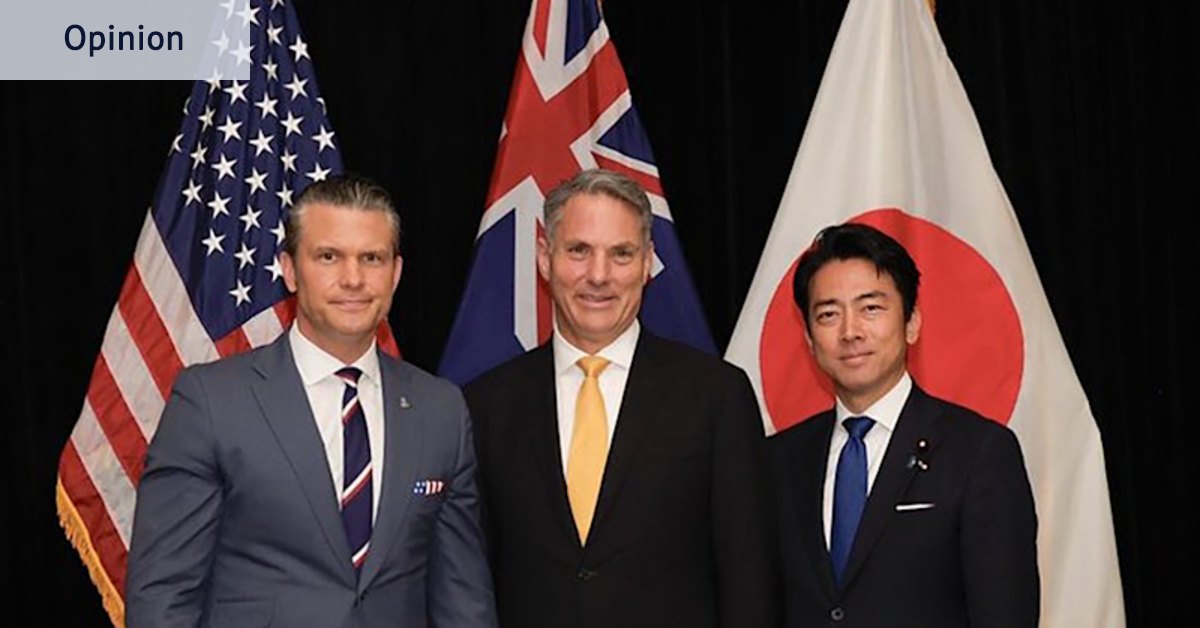
Under the original AUKUS plan, Australia would buy at least two second-hand Virginia-class boats and one new and improved Block VII Virginia-class boat in the 2030s. But last weekend, US Defence Secretary Pete Hegseth said that all three boats would be second-hand Block IV submarines, each possibly more than a decade old, compared with the 33-year lifespan of a new boat. The news has triggered debates about whether Australia is getting dudded – akin to forfeiting a deposit on a new French-made Renault because we were promised a brand-new Tesla, but receiving an old-model Tesla with 200,000 kilometres on the clock.
It’s important to understand the real, rather than declared, goal of the project. The declared goal is an “optimal pathway to deliver an enduring nuclear-powered submarine capability for Australia” to “deter an adversary from considering attacking Australia”. The real goal was stated candidly by US general Douglas MacArthur in his farewell speech to Congress in 1951: victory over Japan in World War II meant that the US “strategic frontier … shifted to embrace the entire Pacific Ocean … We control it to the shores of Asia by a chain of islands extending in an arc from the Aleutians to the Marianas held by us and our free allies. From this island chain, we can dominate with sea and air power every Asiatic port from Vladivostok to Singapore … and prevent any hostile movement into the Pacific.”
US strategists today call this “deterrence” rather than “dominance” because more benign language is preferred. They also speak of a “favourable balance of power” – a euphemism for military dominance, also known as preponderant power. Under AUKUS, Australia will join South Korea and Japan as the United States’ sentinel states, holding China’s naval assets at risk in its own semi-enclosed seas. Dispensing with euphemisms, it’s clear that the military logic of AUKUS is MacArthur’s: put your bases on the edge of enemy territory, and patrol as far forward as possible.
AUKUS is just one aspect of a fundamental transformation of Australia’s military posture. We are developing airfields, expanding and strengthening runways for US strategic bombers, building fuel depots, pre-positioning weapons stores and engaging in close co-operation with US airpower as part of an Enhanced Air Co-operation initiative.
We have committed at least $8 billion to upgrade wharves, maintenance facilities and logistics infrastructure near Fremantle to create Submarine Rotation Force-West. The spin doctors describe it as an “optimal pathway” for AUKUS. In fact, it is a forward-operational deployment of the US Navy, independent of AUKUS, not a down payment on Australia getting its own Virginia-class submarines. In the public’s mind, the two are erroneously believed to be the same thing. The boats may never arrive, but SRF-W will remain as a forward-operational deployment of the US Navy.
The aim is to increase the number of nuclear-powered attack submarines west of the international dateline. By the end of the next decade, there are expected to be 25 allied nuclear-powered attack submarines on permanent or rotational deployment in Fremantle, Guam and Hawaii. They give the US the potential, should President Donald Trump or his successors decide, to block and cripple China’s energy imports, which must pass through the choke point that is the Strait of Malacca after making the long transit across the Indian Ocean.
This wider transformation is exactly what former prime minister Scott Morrison said it would be – “a forever responsibility for a forever partnership”. He used the word “forever” 13 times when he made the announcement in September 2021.
The real debate isn’t about the cost of new versus old submarines but whether preserving a US-dominated region is in Australia’s interests. That is a question of politics, not technical expertise.
Australians may well support the real objective, and the government should explain AUKUS in those terms. If we really want to go there, a good second-hand car works just as well as a new one.
Professor Clinton Fernandes is in the Future Operations Research Group at the University of NSW. His latest book is Turbulence: Australian Foreign Policy in the Trump Era.
The Opinion newsletter is a weekly wrap of views that will challenge, champion and inform your own. Sign up here.
 Professor Clinton Fernandes is part of University of NSW’s Future Operations Research Group which analyses the threats, risks and opportunities that military forces will face in the future. He is a former intelligence officer in the Australian Army.