


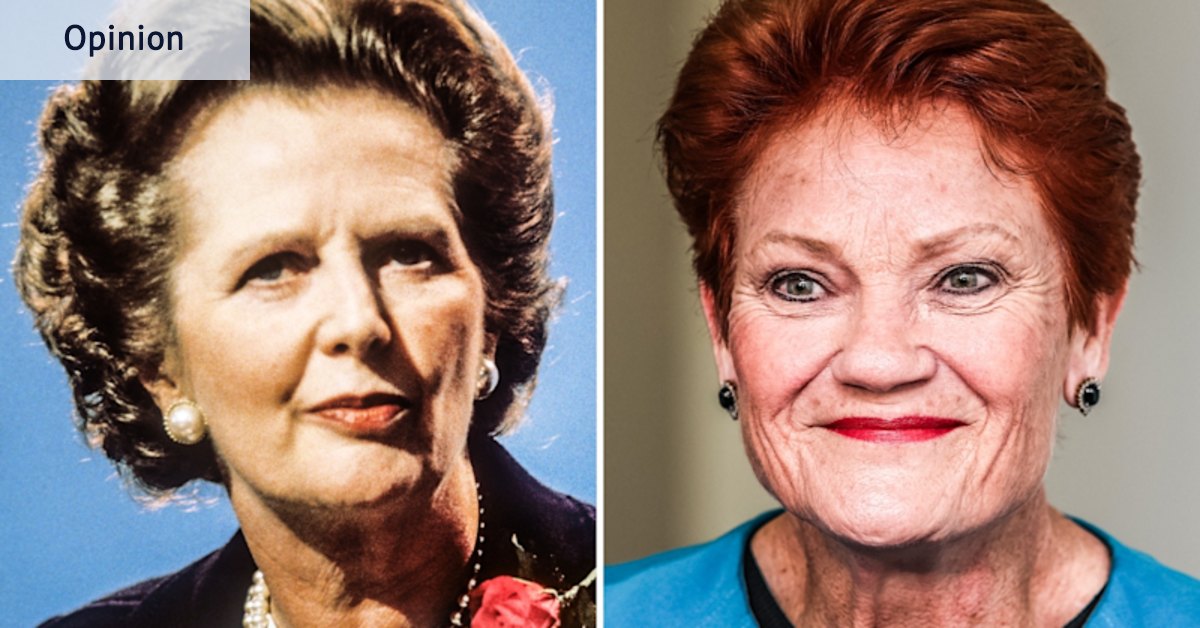
In 1973, when she was British education secretary, Margaret Thatcher said she didn’t think there would be a female prime minister in her lifetime. In 1979, she became Britain’s first female prime minister, but she made it clear she was no affirmative action pick.
“I owe nothing to women’s lib,” she said in an interview in 1982.
Thatcher, the original right-wing strongwoman, in whose court-shoe-shod footsteps many have followed, was a trailblazing woman who held feminism in contempt. According to her adviser Paul Johnson, she once said: “The feminists hate me, don’t they? And I don’t blame them. For I hate feminism. It is poison.”
Conservative female politicians often have trouble using the F-word in reference to themselves, but none more so than populist strongwomen, a particular breed of female politician for which Thatcher is the original model.
In contemporary Italy we have Giorgia Meloni, in France we have Marine Le Pen, in Germany there are Frauke Petry and Alice Weidel (who is not just a woman but a non-heterosexual one), and in Japan, Sanae Takaichi. In Australia, we have One Nation leader Pauline Hanson, who we learnt this week is a possible prime ministerial aspirant.
All these women are pieces in what the International Journal of Public Leadership calls “the apparent puzzle of the presence of successful right-wing-populist women” who are “competing for power in movements that prioritise the performance of aggressive masculinity”.
Right-wing populism relies on family-first values that pitch back to an allegedly better time, when gender roles were clear and the nuclear family was provided for by a male breadwinner. In its more insidious presentations, it prioritises the repression of women, and even their literal disenfranchisement. American MAGA-controlled conservatism includes prominent, powerful male leaders who advocate for a return to male-only suffrage.
Thatcher was not a populist as the contemporary batch of right-wing female leaders are; unlike Hanson, whose policy platform is a shambles, and whose credo relies on racist division, Thatcher was the most credible of political forces. But Thatcher was firmly of, and for, the middle class, and this made her an object of snobbery from both sides of politics.
On one side there were the upper crust establishment conservative types, the cardiganed Tory fogeys who thought she was terribly common. On the other side, left-wing urban elites sneered at her non-cosmopolitanism. She was dreadfully provincial; she shopped at Marks & Spencer.
As the late conservative Sunday Telegraph columnist Peregrine Worsthorne once put it: “Listening to Mrs Thatcher, one might be forgiven for supposing that the civilised governing class is part of the enemy which she, with the help of the people, is determined to eradicate”.
Anti-elitism, aimed at both left and right, is also the central engine of Pauline Hanson’s widening appeal – despite her acceptance of the largesse of mining billionaire Gina Rinehart, a person whose wealth and power couldn’t be any more elite.
Hanson is now the most popular politician of the most popular party in Australia, according to a shock Redbridge poll published this week.
Thatcher worked in her parents’ grocer’s shop; Hanson used to run a fish’n’chip shop. Hanson shows her contempt for the governing class by not showing up for the tedious business of government – according to Labor, Hanson has attended only 12 per cent of Senate estimates hearings over the past decade. In response to this, Hanson called her critics “bastards” and said her time was better used talking to Queenslanders, rather than probing a bunch of bureaucrats who “have been told not to answer the questions”.
Will voters care? On the contrary, her supporters would cheer her for it. Hanson’s appeal lies in her refusal to play within the strict and suited boundaries of parliamentary institutions such as Senate estimates.
Thatcher’s official biographer, Charles Moore, said the Iron Lady’s femininity emphasised her outsider appeal. “It’s easier for a woman to rise in a party which doesn’t have strong feminist views than one that does, actually,” Moore told The Atlantic’s David Frum in conversation last year.
Moore reasoned that in a progressive party, “there’s [a] tremendously violent ideological contest about what that means” when a woman is made leader. But with the British Conservatives, it was simpler.
“They all mostly had prejudices against a woman, but they were very vague prejudices. They weren’t very political. They were just sort of old-fashioned,” Moore said. “And when a woman comes along who is nice to them and impressive, and they believe brave … they admired courage, and they thought she had it – they didn’t really have an ideological objection.”
According to Moore, Thatcher used to say that “the cocks may crow, but the hen lays the eggs”, as a sort of parable of female efficacy.
Hanson has been surrounded by plenty of cocks, so to speak, in her political career, and she remains the hen – not exactly unruffled, but profoundly in control.
Her femininity is the primary marker of her difference, and this difference is central to her appeal, especially now, when so many Australians seem to be catching the global disillusionment with politics-as-usual from men in suits.
According to an analysis of the Herald/Age’s Resolve polling over the past year, support for Hanson has surged among women – a year ago, 6 per cent of women said they would vote for One Nation; now the figure is 24 per cent. That compares with 22 per cent of men who now say they will vote One Nation.
Last week, Hanson explained her appeal to women to the Herald/Age’s James Massola. “Women voters are seeing what I’ve warned about,” she said. “These woke ideologies being taught in classrooms, boys in girls’ toilets, men in women’s sport, the late-term abortion changes.
“The uni parties [major parties] have gone too far and are breaking the spirit of Australian households,” she said.
The reliance on “anti-woke” trans culture wars is a predictable turn for Hanson, who seems to be cribbing as much as possible from the MAGA playbook. It is also true that the Venn diagram of people who have previously expressed any interest in women’s rights, and those who now talk about “protecting” women from trans people, is a very slim sliver indeed.
One Nation’s policies on the Family Court and domestic violence are retrograde, anti-women rubbish. But perhaps that’s missing the point. Hanson’s appeal is not in the nuance of her policy platform. It is in her recalcitrance against the political establishment, and in her no-frills presentation as a working woman from the regions.
To her supporters, she has a uniquely female authority that stands in contrast to the media-trained slickness of the male politicians of Sydney and Melbourne. You can imagine her yelling at a bunch of schoolboys on the train to get their feet off the seats – a standard-bearer for an older set of moral standards some people yearn for. And the schoolboys would listen.
Jacqueline Maley is a senior writer and columnist.
Get a weekly wrap of views that will challenge, champion and inform your own. Sign up for our Opinion newsletter.
