


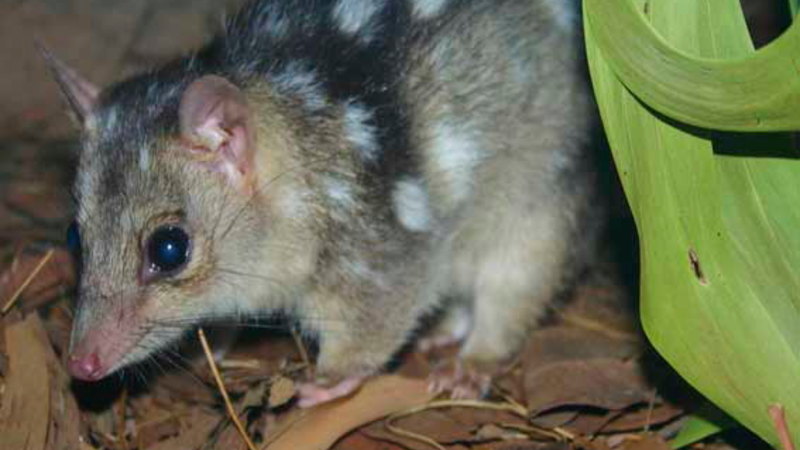

A biotechnology company aiming to bring back extinct animals such as Tasmanian tigers and woolly mammoths says it is about a year away from breeding the first litter of northern quolls genetically modified to withstand cane toad toxin.
Colossal Biosciences, in partnership with the University of Melbourne, has isolated the gene that makes many South American mammals naturally resistant to cane toad toxin and plans to introduce it to quolls to fast-track evolution.
“It turns out it’s just one single letter of code in the entire genome that means you’re either completely resistant to cane toads, and you’re fine, you can eat them – or you’re dead when you eat a cane toad,” said Andrew Pask, chief biology officer at Colossal Biosciences and a professor in genetics and developmental biology at the University of Melbourne.
“That’s incredible because the quoll genome is 3 billion letters of code, and it’s one single change that you have to make in that 3 billion. You’re still definitely a quoll, but that single nucleotide has the power to make you completely resistant. It makes you a super quoll.”
Northern quolls or Dasyurus hallucatus are small marsupial carnivores that eat frogs, reptiles, mammals and insects – but will die if they eat a cane toad. The species ranged across northern Australia from Western Australia to south-east Queensland, but is now endangered and locally extinct in many places mainly because of toads.
Pask said northern quolls would probably evolve resistance in 10,000 years, but without intervention they would be extinct in about a decade. If cane toads became a viable food source for quolls, any reduction in the population of the invasive amphibians would help other native species vulnerable to toad poisoning, such as snakes, lizards, freshwater crocodiles and birds.
Pask said previous projects to train quolls not to eat cane toads and pass that knowledge onto their offspring had largely failed, and would have needed to succeed at vast scale to make any difference.
Despite various efforts to eliminate cane toads, they continued to spread across the Top End. They were also marching south, Pask said, as the climate warmed and the toads simultaneously adapted to colder weather.
Pask said the team had proven in the laboratory that they could tweak the genes in quoll cells using prime editing – a more precise successor to CRISPR editing – to make them resistant to cane toad toxin. While unaltered quoll cells died from contact with the poison, those with the edited gene did not.
The end goal was to make the edit to quoll eggs and then implant embryos into an adult female to pass on the resistance to her offspring, Pask said.
The team was now testing IVF technology in a close relative of the northern quoll – the fat-tailed dunnart. Several pregnant fat-tailed dunnarts at the university lab will give birth within weeks. The team would then try implanting gene-edited embryos before moving on to quolls, Pask said.
“It’s the same process that was used for Dolly the sheep,” Pask said. “You get the quoll to produce an oocyte or an egg. From that we suck out the nucleus which has got the mum’s DNA in it, and we replace it with our engineered nucleus that’s got [the mother’s DNA with] that single change.”
Pask said Colossal would partner with conservation organisations that run captive breeding programs and start testing IVF procedures in northern quolls within months. The first genetically edited joeys were about a year away, and any release into the wild would need regulatory approval.
“We’re pushing this timeline as quickly as we possibly can because the longer we wait, the more tiny these populations of quolls are becoming in the landscape, and the more genetic diversity that’s lost, the more difficult it is for the quolls to ever recover back to their full population and size again.”
Colossal Biosciences is a venture capital-backed company with a “moon shot” goal of reviving extinct species, including the Tasmanian tiger or thylacine, woolly mammoth, dodo and moa, and a business model to commercialise the technology it developed along the way. The quoll project was funded by the charitable arm, Colossal Foundation.
The de-extinction concept is controversial, and some scientists are sceptical of the feasibility or concerned about the ethics. Among them is Yassine Souilmi, group leader at the Australian Centre for Ancient DNA at Adelaide University, who said concerns included degraded DNA in dead cells, and altered habitats and ecosystems.
Gene editing with endangered animals was “significantly different” because it used living cells and this was proven technology, Souilmi said.
“However, it raises the question around unintended consequences of introducing this mutation into other quolls,” Souilmi said. “The genome works in really weird ways – some that we understand, some we don’t.”
Professor Mike Archer at the University of NSW, who founded an earlier effort to revive the thylacine when he was director at the Australian Museum, said he was delighted by the quoll project both professionally and personally.
In 1975, Archer moved from Western Australia to Brisbane with his pet western quoll. He let it out into the backyard, where it bit a cane toad and died 20 minutes later. This prompted Archer to co-author a paper on the threat that cane toads posed to native fauna.
“I see it as a long overdue use of this technology to do something important to save quolls,” Archer said. “Dunnarts are obviously not normally going to be eating cane toads, but quolls do. And having had my quoll die in my arms from that, I’m very, very keen on any efforts that will protect quolls from these horrible animals.”
Archer said he hoped the gene-editing project for quolls – and a similar project to help frogs develop resistance to the deadly chytrid fungus – would attract wider support for the role of genetic technology in conservation.
“It is important that we embrace the fact that we can, in fact, improve things,” Archer said. “We can make things better if we let science give us the tools. We don’t have to accept the steadily degrading world that we’re currently confronted with now because of human activities.”
Get to the heart of what’s happening with climate change and the environment. Sign up for our fortnightly Environment newsletter.
 Caitlin Fitzsimmons is the environment and climate reporter for The Sydney Morning Herald. She was previously the social affairs reporter and the Money editor.Connect via email.