









Washington: In 2003, at a Pentagon news conference about the war in Iraq, then US defence secretary Donald Rumsfeld was asked whether the operation to remove Saddam Hussein risked turning into another quagmire.
“No, that’s someone else’s business, quagmires,” a smiling Rumsfeld said to laughter. “I don’t do quagmires.”
The quote has gone down in history, alongside others from the time denying any similarities between the Iraq and Afghanistan campaigns and the US’s failed intervention in Vietnam.


This week, standing in the same Pentagon press briefing room, Defence Secretary Pete Hegseth made a similar declaration about the operation in Iran. “This is not Iraq,” he said. “This is not endless. I was there for both. Our generation knows better, and so does this president.”
But for foreign policy analysts in Washington who were around at the time, this week’s rhetoric has felt eerily familiar. Another US president has launched a military offensive against a Middle Eastern adversary, ostensibly on the basis it was harbouring or developing dangerous weapons, but with a broader remit of regime change either explicitly or implicitly in tow.
When US President Donald Trump announced the joint US-Israeli strikes in a video message last weekend, he laid out many reasons for attacking the Islamic Republic. It had killed Americans for 47 years. It was still developing nuclear weapons; it was funding terrorist proxies in the region; and it was a fundamentally evil regime that had killed thousands of its own people. He urged protesting Iranians to “take over” their government once the bombing was done.
It was a “dim sum menu of reasons”, said Mara Karlin, who was an assistant defence secretary in the Biden administration, and who is now at Johns Hopkins University’s School of Advanced International Studies.
Trump’s far-reaching ambitions inevitably contrasted with later reassurances from others that it would be a limited and reasonably quick mission. “No nation-building quagmire, no democracy-building exercise, no politically correct war,” Hegseth said. There would also be “no stupid rules of engagement”. The military objectives were clear, he said: destroy Iran’s missiles, obliterate its navy and prevent it from developing nukes.
But another goal was achieved first. Iran’s supreme leader, the theocratic dictator Ali Khamenei, who ruled for 36 years, was killed in an initial strike. While that doesn’t equate to regime change, it certainly brings it closer.
Amid confusion over the war’s rationale, journalists demanded to know what had sparked it, how long it would last, whether American troops might be deployed on the ground, and what the president would regard as “mission accomplished”. Few clear answers were forthcoming.
“The administration has really struggled to provide a clear and consistent message about what this is all about,” said Philip Gordon, former national security adviser to then vice president Kamala Harris, at a Brookings Institution event in Washington this week.
“It’s been a moving target. There have been times when this was almost exclusively about Iran’s nuclear program. But then at other moments, even a comprehensive nuclear deal wouldn’t be enough – it would have to also cover ballistic missiles, terrorism, support for proxies, the navy.”
On regime change, “they’ve been all over the place”, Gordon said. The idea came to be seriously discussed only when Iranian protesters marched through the streets en masse in the early days of this year, prompting Trump to promise that “help is on its way” – and perhaps sealing his own fate.
Shift to ‘Gulf-centred conflict’
The war that has now raged for nearly a week has badly damaged the already weak Iranian regime, and further isolated it from its neighbours. As well as Khamenei, dozens of senior leaders have been killed; key military and civilian compounds have been blown up; and the country’s array of missile launchers has been neutralised. Trump, in characteristic fashion, says the US is “totally demolishing the enemy far ahead of schedule”. The US-based Human Rights Activists News Agency has reported nearly 1200 civilian deaths in Iran so far.
Firas Maksad, managing director for the Middle East at consultancy Eurasia Group, says most analysts believe Iran had about 2000 long-range ballistic missiles at the start of the conflict, and probably has only about 800 or so left. Best estimates put the regime’s stockpile of cheap drones at 80,000.
“Increasingly, this is going to be a drone rather than a ballistic missile conflict, and the centre of gravity is going to shift from Israel and the eastern Mediterranean to being a [Gulf]-centred conflict,” Maksad said at an event hosted by Foreign Policy magazine on Thursday.
Iran has tried to splinter the US’s Gulf allies from the mothership, with no success. It has fired more than 1000 drones at the United Arab Emirates alone, and others have been aimed at Bahrain, Saudi Arabia, Qatar, Kuwait and Oman – but only a handful have actually got through. Most have been intercepted.
“The Iranian attempt to try and play on any divisions, any possible gap that might emerge between the US and its [Gulf] partners is simply not working,” Maksad said. “It’s actually pushing them to close ranks with the United States.”
Gulf states are yet to go on the offensive against Iran, but the risk of a dramatic regional escalation remains. In Lebanon, members of Iran-backed terrorist group Hezbollah launched rockets and drones into Israel to show support for the regime in Tehran, and Israel sent troops into southern Lebanon.
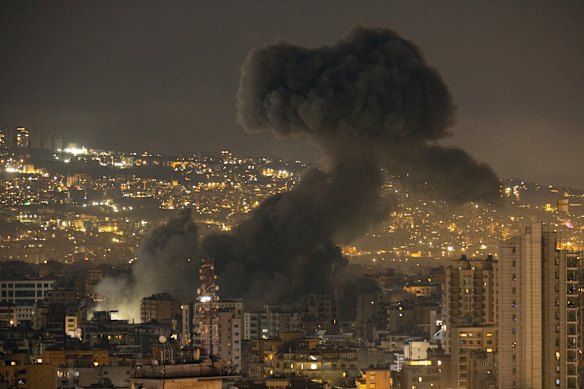
In the early hours of Friday morning (Beirut time), Israel subjected the Dahiyeh area of southern Beirut, a Hezbollah stronghold, to intense air strikes. Many families fled late on Thursday after Israel warned of the impending attack.
The bombing prompted French President Emmanuel Macron to warn Israeli Prime Minister Benjamin Netanyahu not to expand the war into Lebanon; he also urged Iran not to involve Lebanon in the war. Macron’s intervention underscores the fear in Europe and elsewhere that the US-Israeli campaign against Iran is poised to spill into a broader and more dangerous regional conflict.
In Australia, Prime Minister Anthony Albanese and visiting Canadian Prime Minister Mark Carney sang from the same song sheet: the world wanted to see de-escalation, even if it also wanted to see an end to the danger posed by the Iranian regime.
Vali Nasr, a professor of Middle East studies at Johns Hopkins University and a leading Iran expert, said on X: “Israel’s campaign to destroy south Beirut and force its population to leave is the most clear and dangerous escalation of the ongoing war with Iran. Its implications will be grave and long-term.”
A spiralling war would also deepen the worldwide economic impact. Shipping in the critical Strait of Hormuz, which sits between Iran and the Arabian Peninsula, has ground to a halt, and the price of crude oil has jumped from $US65 to nearly $US80 a barrel. Trump was unfazed about the impact on petrol prices. “I don’t have any concern about it,” he told Reuters. “They’ll drop very rapidly when this is over, and if they rise, they rise.”
Still, on Thursday, the US announced it was lifting, for 30 days, some sanctions on Russian oil, allowing India to purchase oil already loaded on a tanker before March 6.
‘Very little opposition’

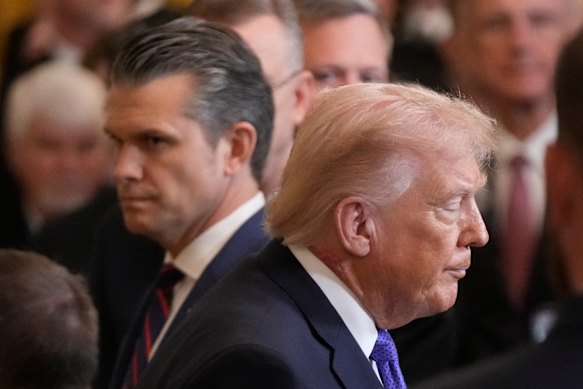
The Iran intervention made for a lively week for Elbridge Colby, the Pentagon’s most senior policy official and a former AUKUS bete noire. He was on a roadshow unpacking his new National Defence Strategy: the guiding light for US military policy under the Trump administration, published last month.
The document outlines a shift towards dominating and protecting the Western hemisphere, as well as denying China the ability to become a hegemonic power. “No longer will [we] be distracted by interventionism, endless wars, regime change, and nation building,” it says. “We will put our people’s practical, concrete interests first.”
In separate appearances before the US Congress, and at a live event at the Council on Foreign Relations, Colby was grilled about Trump’s apparent diversion from that declaration.
In response, he said the strategy does countenance the ongoing threat posed by Iran, including its intent to reconstitute its nuclear program. He also said the objectives given to the US military did not include regime change in Iran: they were strictly about degrading Iran’s ability to pose a threat.
And while new leadership in Tehran may factor in Trump’s political considerations, Colby said, the president never identified regime change as an explicit goal of the mission. Rather, Trump told the Iranian people they have an opportunity to “take the situation into their own hands”.
Speaking at the CFR in Washington, Colby said regime change would nevertheless be welcomed by the global community, and cited support for the US operation from leaders including Albanese.
“It’s been pretty striking to see,” Colby said. “The chancellor of Germany yesterday, the French actions over the last day or two, the prime minister of Australia. [There is] lots of support for what we’re doing, and very, very little opposition – real, credible opposition.”
That does not quite encompass the entirety of the global response. British Prime Minister Keir Starmer, who is sparring with Trump over the use of British bases in the war, implied he believed the US action was unlawful, saying in parliament he was not prepared to join the war “unless I was satisfied there was a lawful basis and a viable thought-through plan”. The US president has turned quickly against Starmer, telling reporters: “This is not Winston Churchill we’re dealing with.”
And Carney, while on his visit to Australia, said support for US operations did not come with a “blank cheque”. He has, in his own way, put a level of distance between Canada and Trump’s actions – more so than Australia – though he and Albanese agreed it was too early to call for a ceasefire.
US, Israel in lock-step, for now
Trump has thus far shown little appetite for finding an off-ramp to the conflict, despite grumblings from some isolationist, anti-war sections of his “America First” base. On Thursday, he said Iranian leaders were calling and asking to make a deal. “I said, ‘You’re being a little bit late’. We want to fight now more than they do.”
For now, the US and Israel are operating in lock-step, praising what they call the most formidable joint force ever unleashed. Netanyahu, who has for decades wanted to see off the Iranian regime, will not be reaching for the stop button any time soon.
When US officials speak about the length of the war, they talk in weeks. When Netanyahu spoke to Fox News, he said it could take some time but “not years”. Trump has equivocated on regime change – it is more a bonus than core business – while for Netanyahu, it is mission-critical. Therein lies a divergence in their aims, and the source of a possible future rupture.
Trump has enthused about making a deal with someone in the Iranian regime to become leader. “I have to be involved in the appointment, like with Delcy [Rodriguez] in Venezuela,” he told US news site Axios, referring to the vice president who took over after the US captured former president Nicolás Maduro. Ali Khamenei’s son Motjaba, the favourite to replace his father as supreme leader, would not be acceptable, Trump also said.
Many doubt that a suitable person exists in the Iranian regime, including former US ambassador to Israel Dan Shapiro, who said so on the Chicago Council of Global Affairs podcast. But he also said that when Trump took the off-ramp, that would be it. “If President Trump decides that he’s reached the end of this operation before Netanyahu wants it to end, he’s still going to end it,” Shapiro said.
One option is for Trump to simply declare victory when he is satisfied Iran’s navy, missile stocks and weapons facilities have been sufficiently destroyed. He has repeatedly said it will be up to the Iranian people to lead any revolution and overthrow what remains of the regime. [On Friday, he wrote on social media that Iran’s only option was “unconditional surrender”.]
Trump has not ruled out putting American boots on the ground, though it is his usual practice never to rule out a military option. Most analysts consider it highly unlikely, given the administration’s staunch position against so-called “forever wars”.
Brookings Institution director of foreign policy research Michael O’Hanlon says if a ground operation were to happen, it would be by circumstance, not design.
“I don’t think Trump would make a conscious decision to invade all in one fell swoop like Bush did [in Iraq],” he says. “But he may wind up trying to protect enclaves for the resistance to form up, and/or protecting shoreline near the Strait of Hormuz – and once that happens, who knows what happens next?” O’Hanlon said.
CNN was the first to report during the week that the Central Intelligence Agency was working to arm Kurdish forces along the Iran-Iraq border, hoping they would help bring down the regime. Trump has spoken to leaders of the ethnic minority group and told Reuters: “I think it’s wonderful that they want to do that.”
Meanwhile, Iran is projecting confidence, even as its stocks diminish. Foreign Minister Abbas Araghchi used an American TV appearance on Thursday to say a ground invasion would be a “big disaster” for the US.
Deploying Rumsfeld’s old term, he warned Iran’s army would ensure the war “becomes a quagmire for whomever chooses to pursue it”.
Trump began the week denying he would get bored with the Iran campaign and move on to something else. But by Thursday evening, he was telling a ceremony for the Inter Miami football club that intervention in Cuba would be his next move.
“Your next one is gonna be … we want to do that, special, Cuba,” he said. “We could do them all at the same time, but bad things happen.”
Get a note directly from our foreign correspondents on what’s making headlines around the world. Sign up for our weekly What in the World newsletter.


