

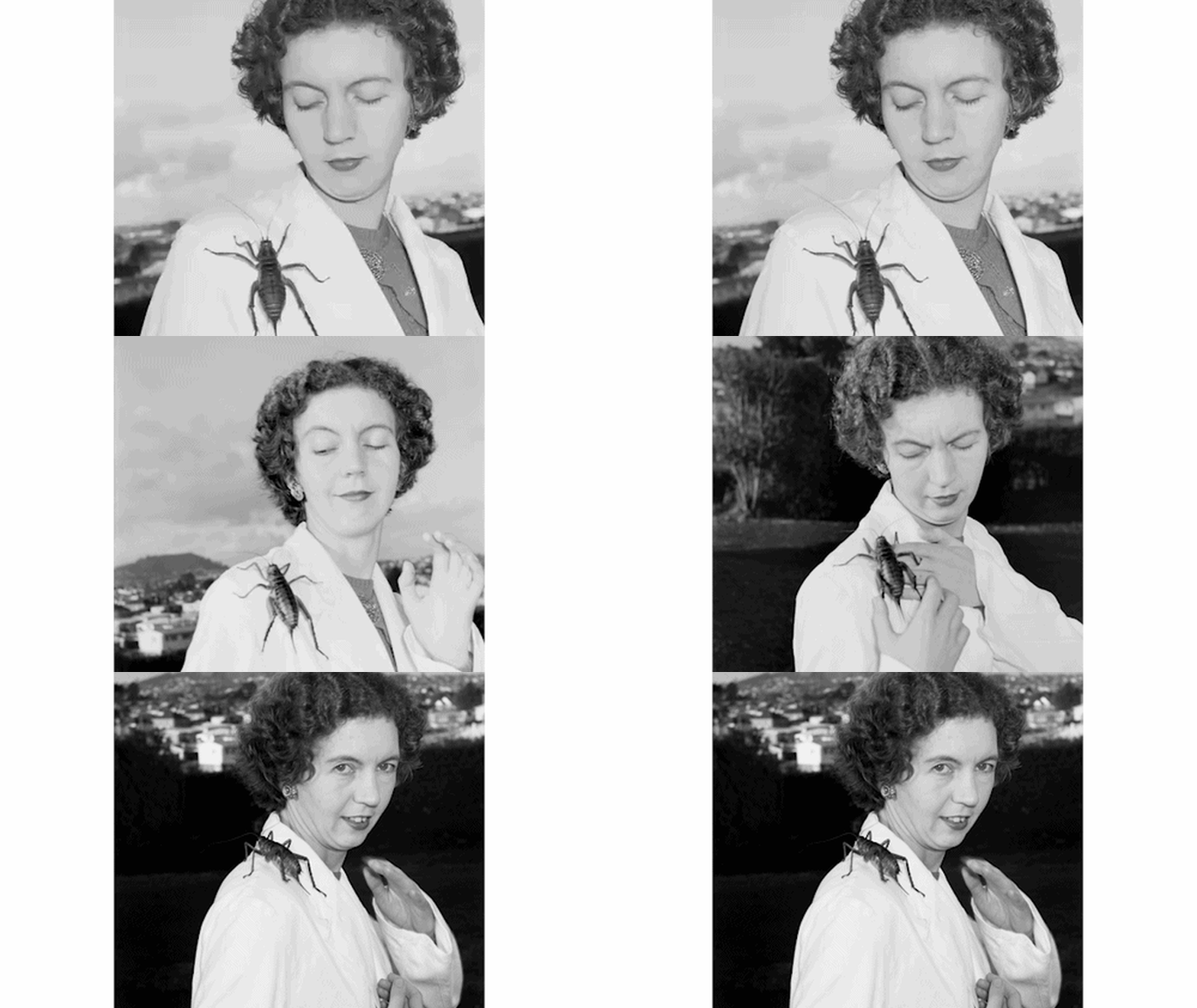




What’s not to like about cave crickets the size of a small puppy that snack on their own limbs?
For an entomologist, this ticks all the boxes from weird to strange, and from creepy to crawly.
Funded by a £27 grant in the 1950s (about $1100 in today’s money), the late entomologist Dr Aola Richards spent seven weeks in New Zealand’s Waitomo caves. Then described as a “girl research student”, she worked mostly in the dark because the wētā (Maori for cave crickets) did not like light, she told a local newspaper at the time.
That research earned her the nickname the “wētā woman”; a doctorate, the first for a female entomologist in New Zealand; and launched a groundbreaking career requiring more time in Australian caves, beneath the Nullarbor Plain and in Tasmania.
Richards reported that there were things in the Waitomo caves that a tourist “had never dreamt about”, including water rats as big as a cat and giant spiders.
Considering how much the average entomologist is paid, nobody dreamt that when Richards died aged 93 in 2021 she would leave three bequests, totalling about $40 million, to encourage the next generation of insect lovers.
Though she worked for 33 years at the University of NSW, she left $12.6 million to its rival, the University of Sydney, which will fund the creation of the Aola Richards Sydney Insect Hub.
Asked why Richards was fascinated by the wētā, the inaugural chair of the new research facility, Associate Professor Thomas White, said: “You are asking an entomologist. All insects are wonderful and beautiful.”
He said Richards described 20 new species of wētā – one named for her – and also specialised in Australian ladybird beetles, glow and velvet worms, and published 80 papers.
White said before Richards’ research, nobody knew much about cave crickets, which were iconic to New Zealanders.
They are among the oldest species of insects on the planet and among the heaviest. Weighing about 60 to 70 grams, some giant wētā measure more than 30cm from the top of their antennae to the bottom of their very long legs.
“It is like having a puppy-sized insect,” White said.
White suspected Richards was like most entomologists and fascinated by these insects because they were “cool and weird and interesting”.
Richards also discovered how Australian ladybird beetles avoid plant toxins by chewing through the stalk of their food source.
Her bequest was general, White said. “She loved all entomology and just said, as long as people are working on insects and how they interact with the world, go for it.”
Richards’ generosity will support researchers like Dr Braxton Jones, the only Australian scientist dedicated to studying stick insects, and Dr Zhuzhi Zhang, who works on cockroach phylogenetics (evolutionary relationships between organisms).
The University of Sydney vice chancellor Mark Scott said it would include critical funding for early and mid-career researchers.
“Insects sit at the centre of most terrestrial ecosystems and hold a deep fascination for the general public,” he said. The hub would continue Richards’ mission by contributing to urgent matters in biodiversity, conservation and sustainability across Australia and globally.
Writing from experience about the wētā in the caves, Richards explained the crickets were nocturnal, usually found on the walls or ceiling of caves hanging head down.
“If touched, however, or if they feel the slightest air current caused by breathing or an approaching hand, they jump wildly away, sometimes covering distances of three or four feet in one jump. Such acrobatics are often successful in effecting escape.”
Their bite was harmless, and they were solitary and silent creatures.
She wrote that cannibalism was common during or at the end of the mating season. So was auto cannibalism where the crickets would eat their own limbs.
“On one occasion when four males and four females shared the same container, two of the females were killed and eaten except for the legs, ovipositors, and part of one head.
“On some occasions when alone with a plentiful supply of food these insects have even broken off and eaten their own hind legs.”
Richards’ estate included two other bequests: establishing an Aola Richards Fund at the Department of Zoology at the University of Cambridge in the United Kingdom, and the School of Biological Sciences at Te Herenga Waka – Victoria University of Wellington, where she studied as an undergraduate. She gave most of her insect collection to the CSIRO.
Professor Tanya Latty, from the Faculty of Science and Sydney Insect Hub, said Richards achieved excellence when the field was heavily male-dominated: “She is truly one of the giants of Australian entomology and her legacy of excellence will now also live on through her generous bequest.”
Start the day with a summary of the day’s most important and interesting stories, analysis and insights. Sign up for our Morning Edition newsletter.