


The idea of building glamping resorts for private profit on public land under national park management was always going to be contentious.
But the proposal for the Gardens of Stone near Lithgow, an area of outstanding natural beauty with internationally significant conical rock formations called pagodas, is controversial beyond the usual concern about commercialisation of national parks.
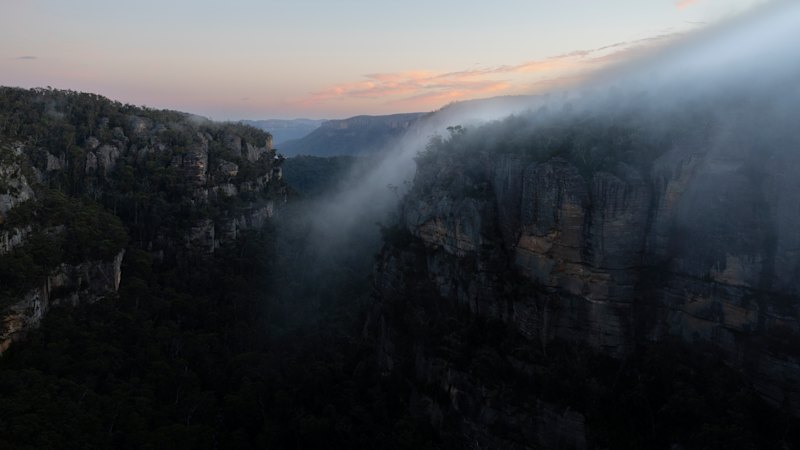
Unlike other national park cabins tucked away in bushland, the three development sites would be located among the attractions themselves – perched atop cliffs overlooking an immense gorge and built in and around the rare and fragile sandstone pagodas.
It would be impossible to see those pagodas without also seeing the resorts. Conservationists fear the accommodation will attract swarms of visitors who will climb the sandstone and risk breaking the delicate protruding plates.
“If it can be done here, it can be done anywhere,” says Keith Muir, honorary projects officer at Wilderness Australia, part of the Gardens of Stone Alliance that has fought to protect the area for decades.
“This is a national precedent of degrading outstanding, the best-of-the-best, top-shelf values in a park with a resort. You always put the resort away from the value, and that’s just common sense. Otherwise, you ruin the thing that is the attraction.”
It’s not a done deal yet – the proposal comes from the NSW National Parks and Wildlife Service (NPWS), but NSW Environment Minister Penny Sharpe is the final decision-maker. She is waiting on a departmental summary of feedback from a public consultation process.
Her Labor colleague Trish Doyle, the NSW parliamentary secretary for the environment and Blue Mountains MP, made a submission to the consultation process opposing the proposal, and voted with her community to object to the development at a public meeting in Katoomba earlier in April.
Doyle’s submission says the proposal sets a “dangerous and unacceptable precedent” for commercialisation and development of national parks, and objects to the procedural propriety of NPWS being both proponent and decision-maker.


“These proposed developments will be inappropriately located by the rare pagoda landscapes of the Gardens of Stone – a wholly unique and internationally significant set of formations,” Doyle’s submission says. “Development on the proposed sites will destroy the ‘undisturbed’ quality which makes these sites valuable.”
Doyle confirmed her position to this masthead, adding that she had made her views and those of her community known both formally and informally to the minister.
The Gardens of Stone National Park was created in the 1990s, but many of the fragile pagoda landscapes remained in 30,000 hectares of state forest subject to mining and logging. Muir says hundreds of pagodas were destroyed or cracked by mining over the decades.
In 2021, the former Coalition government created the Gardens of Stone State Conservation Area, which transferred the land into the national park estate under the management of NPWS, while allowing underground mining to continue.
In 2022, the government released the draft master plan and plan of management for the reserve, which notes that the “striking landscape of rocky landforms, including massive beehives, domes and plates known as pagoda” are nationally significant. It further notes that the Newnes Plateau section of the park contains globally rare “platy” pagodas, which have protruding ridged profiles formed by harder ironstone interspersed with eroded sandstone.


The 2022 plans introduced the idea of eco-accommodation as part of a $50 million package for visitor infrastructure and the development of a multi-day walk. After an expression-of-interest process, Wild Bush Luxury was selected as the preferred developer and operator.
In May 2024, under the Minns Labor government, NPWS issued a notice of intent to grant a lease to Wild Bush Luxury for three accommodation sites. This is when the community first learnt that the cabins would be built on ridgelines and near fragile pagodas.
Then in February, NPWS released the Draft Review of Environmental Factors for the three resort sites, showing the location and scale of the buildings, solar arrays and wastewater systems. The buildings will be built from hardwood with a roof of canvas for the cabins and Colorbond sheet metal roof for the communal buildings, while soil will be added to the rock plate to treat grey water on site, and sewage will be removed by helicopter.


Muir admits that, as a wilderness conservationist, he does not want any cabin development in national parks and reserves. He would prefer any accommodation beyond basic camping facilities to be off-site, preserving the conservation values of the bushland and providing an economic lifeline to Lithgow as it transitions out of the coal industry.
The counter-argument from NPWS is that experiences such as this make national parks more accessible and appealing to a wider range of people, fostering appreciation for nature in the broader community.
“Guided walks with low-impact bush camps are being proposed to make the new 35-kilometre Gardens of Stone Pagoda Walk accessible to more people,” an NPWS spokesperson says. “Some people prefer self-guided walks. Others prefer guided walks, which need to be run by a nature-based tourism company. These are common right across Australia and the world.”
NPWS suggests comparable examples include the Three Capes Walk, Overland Track and Maria Island Walk in Tasmania. Yet these cabins, which can cost about $1000 a night, are generally amid bushland rather than at a scenic attraction or lookout.
Muir says expensive glamping resorts replace a fitness barrier with a wealth barrier, but his bigger complaint is that he does not believe NPWS has followed its own policy, which is that where possible, infrastructure should be built on sites that are already disturbed. He believes the sites were selected to create a premium experience for resort guests, and the analysis of site disturbance was applied retrospectively.
It is true that the sites were selected before the lease announcement in May 2024, while the site disturbance analysis was released in February 2026 and finalised only the month before that. However, NPWS is emphatic that the sites were chosen to align with the route of the pagoda walk, and delivery of a luxury experience was not part of the criteria. The initial strategic site assessment occurred in 2022 as part of the plan of management, NPWS says.


NPWS has assessed the sites as being in a “partially modified nature and cultural heritage condition” due to existing roads, campfires and other human impacts visible at each location.
This masthead has visited site 2 and saw no evidence of human disturbance, except for the distant track marks of a 4WD access road several kilometres away on the far side of a giant gorge. NPWS says this counts because site characteristics are those that a person would observe by taking a 360-degree view of the surroundings.
The site analysis also claims there is a road to the site, but this is not evident in person. If there was ever a road, it is now completely covered in heathland scrub and mossy rocks. NPWS explains this is a mapped former 4WD trail and acknowledges it is heavily revegetated.
Madi Maclean from the Blue Mountains Conservation Society, which is part of the Gardens of Stone Alliance, says the key problem is that NPWS is not following its own guidelines to put infrastructure where it will have minimal impact.
“The rock pagodas have been recognised by academic research that they have global significance … in terms of their geology, so that is something that is a heritage that we should be protecting in a national park like this,” Maclean says.

“The other thing with the pagodas is you can see when you get up close that they are very fragile – the plates come to a very fragile end, and they would be so easy to break and deface if you had a lot of people swarming over them.”
NPWS says suitably qualified ecologists have concluded that significant impacts to pagodas are unlikely to occur, and visitors will be accompanied by guides with a strong understanding of and commitment to landscape protection. NPWS emphasises it is not proposing to build on the rock pagodas.
In December 2025, Intrepid Travel agreed to buy Wild Bush Luxury, which includes its interest in the potential Gardens of Stone development. Wild Bush Luxury also runs the eco-cabins on Maria Island, as well as accommodation on private property in the Flinders Ranges of South Australia and near Kakadu in the Northern Territory.
Intrepid Travel promotes itself as a responsible tourism operator and has BCorp status, an international certification that allows a for-profit company to prove its social and environmental credentials. It specialises in small group travel and is not a luxury resort operator.

Brett Mitchell, Australia and New Zealand managing director for Intrepid Travel, says the acquisition is awaiting regulatory approval, and the timing is not connected to the upcoming Gardens of Stone decision.
Mitchell says Intrepid respects the role of the NPWS public consultation process in determining outcomes and environmental conditions. Once the acquisition is complete, he says Intrepid will “take the time to carefully assess the proposal … before making any decisions”.
“We believe tourism can play a positive role in conservation when it’s done responsibly, helping to advocate, fund and support conservation efforts and Australia’s national parks,” Mitchell says. “This means taking a low-impact approach and advocating for the long-term protection and conservation of places we operate in.”
How the unique platy pagodas were formed
Pagoda country covers 600 square kilometres in the north-western Blue Mountains, especially between the Newnes Plateau and Capertee Valley.
The main geological ingredient of the conical rock formations is the same Triassic-era sandstone found throughout the Sydney Basin. The secret sauce for the platy pagodas is iron.
The pagodas are formed by differential weathering and erosion. Smooth pagodas are relatively regular rock domes, while platy pagodas are formed because there are ring-like layers of ironstone interspersed with the sandstone. While the soft sandstone is easily eroded, the ironstone is more resistant.
The protruding ridges or fins of remnant ironstone can project laterally from the domes for tens of centimetres.
Smooth pagodas are unusual but not unique. Platy pagodas are believed to be a distinct and significant geological feature not found elsewhere in Australia or the world.
“Geodiversity – unlike biodiversity – is not alive, but it may be unique and significant and can be easily destroyed,” Dr Haydn Washington and Dr Robert Wray write in Proceedings of the Linnean Society of NSW.
Get to the heart of what’s happening with climate change and the environment. Sign up for our fortnightly Environment newsletter.
