








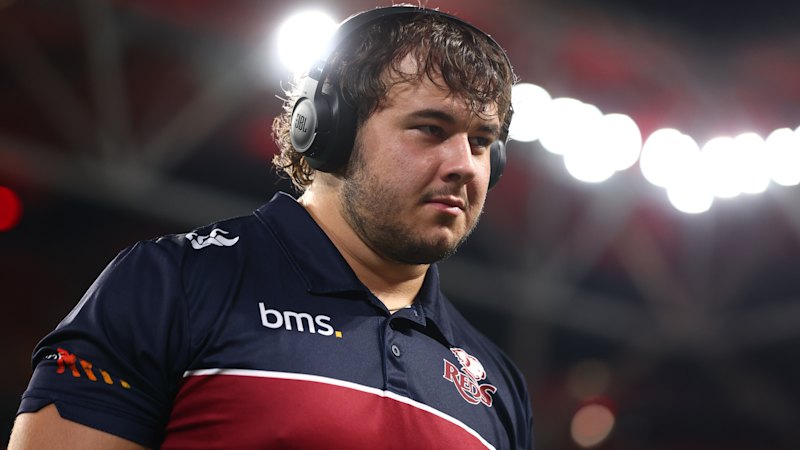


The threat of Massimo De Lutiis being poached by Ulster and Ireland has been snuffed out, with the 22-year-old tighthead prop set to re-sign with Rugby Australia and Queensland.
But while the De Lutiis saga appears to have ended as swiftly as it began, an Australia-led push for reform to World Rugby’s transfer system – which would have seen Ulster incur a fee of just $48,000 for a professional front rower on the cusp of Test rugby – is gathering steam.
De Luttis, the 126-kilogram Reds strongman, chose to reject an offer from Ulster and the IRFU and stay in Brisbane. He gave serious consideration to the move last month, but a beefed-up offer from RA was enough to get a deal done – thus avoiding the embarrassment for RA of De Lutiis one day returning in an Irish jersey, for whom he qualifies via his maternal grandfather.
The De Lutiis skirmish was shortlived but it has served to highlight the issue of World Rugby’s transfer system, which many nations – including Australia – believe is dated and in need of a major overhaul.
Unlike the robust transfer system in world soccer, rugby’s equivalent is limited in size and scale; to the point many in the game don’t even know it exists despite it being 16 years old.
Compensation for player movement is covered under World Rugby regulation 4.7, which seeks to acknowledge the cost incurred in developing a contracted player between the age of 17-23. Unlike the soccer system, there are usually no club-to-club transfer fees. But the figure was set at £5000 pounds ($9623) per year in 2010 and hasn’t increased since. Under the six-year limit, it is capped at $57,778.
“If you think about the economics of the game, it’s a reasonably nominal fee,” Rugby Australia chief executive Phil Waugh said this week. “So we’re very keen to get the right balance between recognition for development, but also how do you ensure that there are barriers to deliberately poaching players from different countries, to deliberately overlook local talent, to then bring in offshore talent that’s got no affiliation with the country.”
Waugh and RA chairman Daniel Herbert have been strong advocates of change in the transfer system, and the chief executive raised the issue again at World Rugby meetings in London last month. A working group was established to look at options ahead of the next meetings in the middle of the year.
Former Rebels coach Dave Wessels, who is now general manager of high performance in South African rugby, took to X this week to comment on the De Lutiis case.
“This is crazy stuff. Rugby needs a better model to compensate countries that are exporters of talent – similar to what FIFA has. At the moment the farmer who has spent years fattening the cow doesn’t get a cent when the cow goes to the abattoir … doesn’t work for farming. Can’t work for rugby,” Wessels wrote.
A more substantial transfer fee would disrupt tactical recruiting by nations like Ireland and Scotland, who target eligible players from Australia, New Zealand and South Africa. And it would help Pacific Island nations, who have been lost talent for decades to multiple nations, including Australia. It’d either help them keep players, or earn much-needed revenue.
RA have also expressed their dissatisfaction at World Rugby level about clubs, in France and in particular, signing teenage players while still at school. There are concerns about the welfare of youngsters who are moving across the world to join club academies, often with no family nearby. There are currently 30 Australian players aged between 17 and 23 in French academies, including star rookie Heinz Lemoto.
FIFA prohibits any international transfers for players under the age of 18, with a handful of exceptions, and also starts the development clock at 12. FIFA’s transfer fee structures see more substantial “training compensation” fees paid until the age of 23, and a “solidarity” mechanism, which sees five per cent of the players’ transfer fee (at all ages) distributed to all clubs that trained them between 12 and 23.
‘This is crazy stuff. Rugby needs a better model’
Former Rebels coach Dave Wessels
Rugby doesn’t prohibit the recruitment of under 18s, and though there are loosely worded guidelines on not “poaching” young players, the recruitment of young Queenslander Sio Kite by French club La Rochelle at the age of 16 was controversial last year.
“We’re seeing it come through the school systems now where French clubs come in and poach our best young talent that we’ve brought through the system to take into their academies,” Waugh said.
“We’re very conscious of that. It’s just about getting the balance right with World Rugby and then just the governance layers that we need to work through to get to the right outcome for player welfare.”
Reform of regulation four is not straightforward, however. The richest club competitions in France and Japan are opposed to bigger transfer fees and have in the past threatened to wind back support for regulation nine in response.
Regulation nine covers the release of players from clubs for Test match windows, but it is all largely based on gentleman’s agreements. The regulation has never been tested legally and given the immense value of Test rugby in the game, World Rugby are keen for that to continue.


