






But Maduro, who took office in 2013 after the death of Hugo Chávez, is expected to challenge the legality of his arrest and the Trump administration’s refusal to recognise him as a legitimate head of state.
A lawyer for Maduro, Barry Pollack, said at the hearing on Monday (Tuesday AEDT) that he might file motions concerning Maduro’s role as the head of a sovereign government, adding that there were also “questions about the legality of his military abduction”.

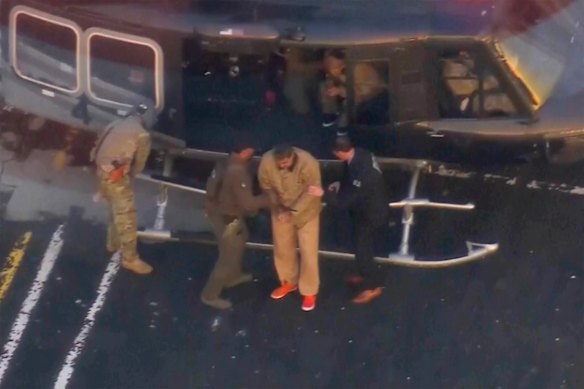
Maduro gets off a helicopter on his way to court.Credit: AP
Leaders of foreign countries are typically granted immunity under international law, a norm that the United States has long observed. But Maduro has been accused by Venezuelans and many in the international community of having stolen the 2019 election that kept him in power. The United States refused to recognise him as the country’s legitimate leader after that election, or the July 2024 elections that he again purported to have won.
Maduro entered the courtroom promptly at noon local time, escorted by US marshals, his black hair streaked with grey. He took slow, deliberate steps as he walked in, smiling slightly and surveying a sea of roughly six dozen lawyers, reporters and spectators packed into the gallery.
“Buenos dias,” he told the crowd.
He was seated two chairs away from Flores, the couple separated by one of her lawyers, Mark Donnelly. Flores, whose face was bruised and bandaged, spoke less frequently than her husband, but echoed his defiance.
“I am the first lady of the Republic of Venezuela,” she said, when asked by Hellerstein to identify herself. She also pleaded not guilty.
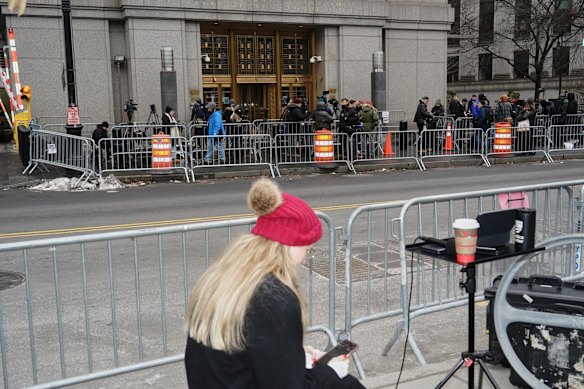
Members of the media gather outside the New York federal court before Maduro’s appearance.Credit: Bloomberg
Federal prosecutors from the Southern District of New York had long targeted Maduro. Along with the charges of narco-terrorism conspiracy and conspiracy to import cocaine, he pleaded not guilty to charges of possessing and conspiring to possess machine guns. The combination of the machine gun counts with drug trafficking charges can result in lengthy prison sentences and prosecutors often pair them.
As the hearing drew on, Maduro began to test the limits on his speech. He told Hellerstein, that he “would like to ask that my notes be respected, and that I be allowed to keep them”.
“I believe you are entitled to keep them,” Hellerstein said, sounding surprised.
At one point, Hellerstein asked a rudimentary, housekeeping question that is typically raised at such hearings: the date and time of the arrests. The prosecutor, Kyle Wirshba, responded precisely: The defendants entered law enforcement custody at 11.30am on January 3. He did not mention the military raid on foreign soil that led to their apprehension.
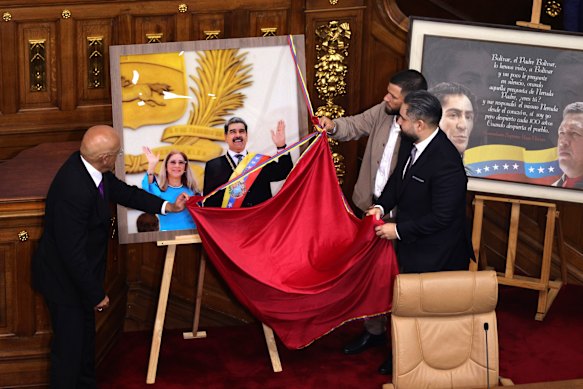
Nicolás Maduro Guerra and Yosser Gavidia Flores, son of Cilia Flores, unveil a picture of their parents at the National Assembly in Caracas on Monday.Credit: Getty Images
The indictment names six defendants, including Maduro’s son, Nicolás Maduro Guerra, known as Nicolásito; former minister of the interior and justice Ramón Rodríguez Chacín; minister of interior, justice and peace Diosdado Cabello Rondón; and Tren de Aragua leader Héctor Guerrero Flores. The Trump administration has designated Tren de Aragua as a foreign terrorist organisation linked to Maduro.
Shortly before the arraignment began, Maduro’s son delivered a fiery speech during a closely watched meeting of the Venezuelan National Assembly, saying that his father and “second mother” were kidnapped by the United States and that the world was facing a “dangerous regression” to imperialism.
Loading
The inclusion of Guerrero Flores, who was also indicted in a different case in December and remains at large, reflects the White House’s repeated assertion that Maduro worked with narco-terrorists, including Tren de Aragua. The indictment does not tie Guerrero Flores directly to Maduro. Instead, it said Guerrero Flores co-operated with “members of the Venezuelan regime.”
The indictment says Flores, her husband and other defendants “partnered with narcotics traffickers and narco-terrorist groups” that were sending cocaine from Venezuela to the United States through countries like Honduras, Guatemala and Mexico. She is charged in the trafficking conspiracy but not in the narco-terrorism conspiracy.
The indictment also says Flores attended a meeting in 2007 where she “accepted hundreds of thousands of dollars in bribes to broker a meeting between a large-scale drug trafficker and the director of Venezuela’s national antidrug office, Néstor Reverol Torres.”
On Monday morning, while Maduro’s arraignment proceeded on the 26th floor of the federal courthouse, the global debate over the US intervention in Venezuela played out in miniature on the street.
Hundreds of protesters gathered at the mouth of a park across from the courthouse, chanting in English and Spanish and waving signs that said “USA Hands Off Venezuela” and “US Out of Latin America”. A few wore kaffiyehs. Soon, another group with hats and caps with the Venezuelan flag arrived to chant in response.
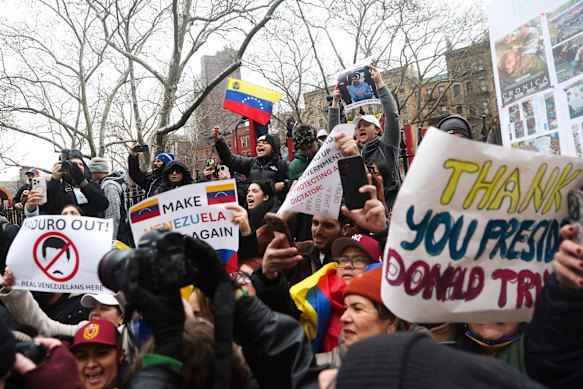
People protest outside Manhattan Federal Court on Monday.Credit: AP
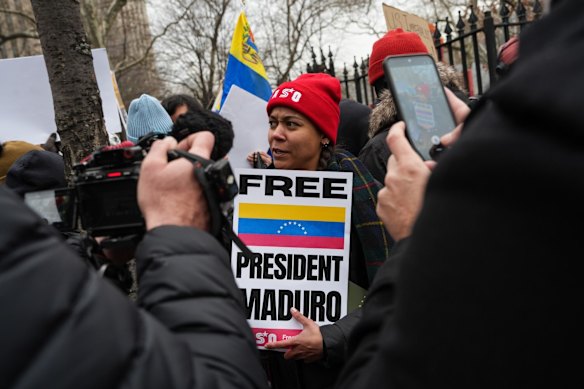
Supporters of Maduro gather outside the federal court on Monday.Credit: Bloomberg
They cheered “Libertad!” and chanted, in Spanish, “It already fell; it already fell; this dictatorship already fell.” They were joined by several supporters of Trump, one of whom carried a giant red flag that said “Trump for King” and bore a crowned image of the president.
Among them was Pedro Reyes, 39, who stood outside the courtroom for hours. He held a poster with pictures of his own body studded with ugly wounds and the words: “Twelve years of waiting, pain and silence. Today, my aggressor is captured.”
Reyes said in an interview that as a protester in Venezuela he was imprisoned for three days. “They urinated on me. They abused me. They stripped me naked and poured cold water on me,” Reyes, who now lives in Brooklyn and works in a restaurant, said.
He said he was happy to see Maduro in federal court, no matter how long a trial takes. “It’s a small justice for many of my friends who lost their lives,” he said.
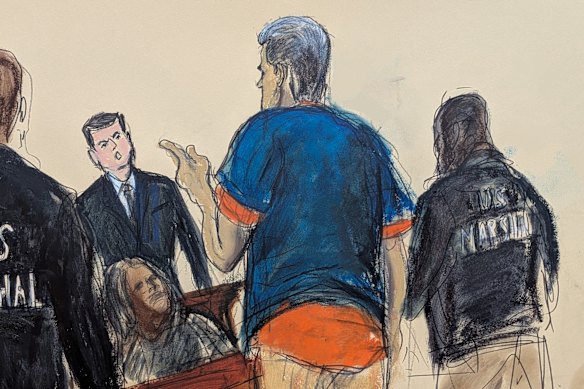
A court sketch of Maduro reacting to a spectator in court.Credit: AP
The protest energy carried into the courtroom. As the hearing ended and Maduro was being escorted to a side door, a man in the gallery dressed in a white shirt and black coat rose and addressed Maduro.
Loading
The man, who later identified himself as Pedro Rojas, 33, another former political prisoner in Venezuela, spoke to Maduro in the otherwise silent courtroom. He said in Spanish that Maduro would pay for his crimes.
Maduro responded in Spanish that he would win his freedom. Then, loud enough that it carried through the room, he added: “I am a prisoner of war.”
This article originally appeared in The New York Times.
Get a note directly from our foreign correspondents on what’s making headlines around the world. Sign up for our weekly What in the World newsletter.


