










It was mid-2001 and Mat Rogers had recently signed with the Waratahs and what was then the Australian Rugby Union for the following season. The story goes that Rogers was invited into the NSW sheds after a game and was taken around the room by coach Bob Dwyer and introduced to his future teammates.
“Well there goes my f—ing job,” one back muttered to his locker neighbour after the greeting party had moved on.
It was dark humour, and ultimately misguided. Rogers didn’t end up playing in his position.
But it’s fair to say the recruitment of NRL stars to rugby at the turn of the century caused a stir inside and outside the game.
Ahead of the 2003 Rugby World Cup in Australia, the ARU infamously poached three big stars from the 13-man code: Rogers went to the Waratahs in 2002 and Wendell Sailor moved from the Brisbane Broncos to the Queensland Reds. A year later young NRL superstar Lote Tuqiri joined them in rugby.
The trio – now often referred as the singular “Tuqiri-Rogers-Sailor” – all became dual internationals and all went on to start in the 2003 World Cup final for the Wallabies in Sydney.
Rugby’s most famous poaching raid has returned as a reference point this week after Rugby Australia, with another World Cup on home soil around the corner, announced the signing of a third high-profile NRL player.
Ex-Eel and Blues winger Zac Lomax has made a move to the Force, just a few months after another incumbent Kangaroo, Angus Crichton, also made the switch back to rugby for a tilt at the World Cup.


The 2003 NRL converts – Mat Rogers, Lote Tuqiri and Wendell Sailor – and the 2027 equivalents, Angus Crichton, Zac Lomax and Joseph-Aukuso Suaalii.Credit: Artwork: Stephen Kiprillis
With rising NRL star Joseph-Aukuso Suaalii having also jumped to rugby in 2024 and Kangaroos winger Mark Nawaqanitawase also exiting league this year to try and return to the Wallabies, the similarities between 2003 and 2027 are difficult to escape.
Phil Waugh, who was a teammate of Tuqiri-Rogers-Sailor in the 2003 Wallabies, is now the RA chief executive signing up the new batch of converts.
“When you go back to those early 2000s years, leading into 2003, the intent was to do everything you possibly could to win the World Cup in 2003, and we’ve got the same intention here,” Waugh said.
“The more world-class international athletes that we can put into that system, the more chance we have of going deep into that tournament. So we’re reasonably optimistic as to how the next 12 to 18 months plays out.”
But ahead of the 2027 World Cup campaign, are there lessons learnt from 2003 that can be carried forward, for all concerned? The league recruits, the coaches and the existing Australian rugby players who may be worried about their f—ing jobs?
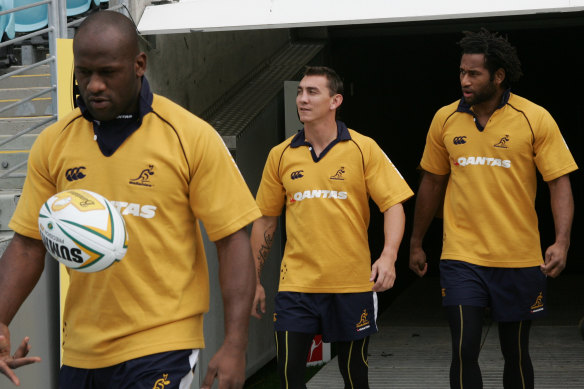
Code hoppers Wendell Sailor, Mat Rogers and Lote Tuqiri.Credit: Tim Clayton
DEPTH CHARGE
While success in rugby can usually be linked directly to the blessing of depth, success at a World Cup is probably more aligned to the agony of depth.
To win a World Cup (or go within a rotten drop goal of victory at least) one often overlooked factor is the outrageous quality of squad members who will likely be sitting in a team suit in the grandstand, having been unable to crack a spot in the match-day squad.
Incredibly, on the night of the 2003 final, the Wallabies had future World Rugby Hall of Famer Matt Burke in the stands, and so too the brilliant Chris Latham. Legendary winger Joe Roff, who was still only 28 at the time, was on the bench.
All three had been regular Wallabies starters, while Burke and Roff were also stars of Australia’s win at the 1999 World Cup. But with the arrival of Tuqiri-Rogers-Sailor, the fierce competition resulted in agonising selection calls for then-Wallabies coach Eddie Jones.
The comparison between 2003 and the 2027 campaign isn’t apples with apples, of course, but the injection of more elite Kangaroos-grade talent should bring the same consequence for Australian rugby: the benefit of competition.
“It creates that competition in the provincial level, which then feeds into a better rugby from all the guys, which then feeds into a harder job for the selectors of the Australian team,” Rogers says.

Matt Burke kicking at Homebush during training in 2003.Credit: Steve Christo
“It creates a sense of urgency among players to work hard. I think that’s what we created in 2002-03 when we came over. It added to the pool of good players. There were no promises.
“We’d signed deals to come over and play, but we were never promised a Wallabies jersey, that’s for sure. And it frustrated me a bit. People would say ‘He signed with the Wallabies’, and I am like ‘I didn’t sign with the Wallabies, I signed with Rugby Australia and the Waratahs’.
“And I had to make the Waratahs before I could make the Wallabies, and I was in for the battle, you know? I wanted that.
“But the Wallabies jersey, to me, was this sacrosanct thing that I desperately wanted to earn. I had Matt Burke there, Chris Latham there, there were a number of great players in front of me. I knew I had to work hard to try and get up to pace and to get a jersey. And it didn’t come easily.”
PLAYER RESPONSE
Rogers said he occasionally sensed mild resentment among existing Australian rugby players at the time, but he understood it – he was a threat.
“There was some narkiness, but I always tried to be a good teammate and work hard and help, and encourage all the players around me,” Rogers says.

Mat Rogers celebrates Australia’s Bledisloe Cup win in Sydney in 2002.Credit: Penny Bradfield
“I certainly didn’t walk in arrogantly and have my head up my arse and think it was all about me. I just wanted to make the team better. And I mean, if someone can’t handle the competition, then maybe they shouldn’t have been there, you know?”
As it was in 2003, how today’s players respond to the challenge of new players and increased competition will be telling about their talent and character.
Rogers said the “grace” and team-first attitude of Burke has always stuck with him.
“Burkey was the best fullback in the world when I came along, and he put his hand up and was willing to move to 13 [at the Waratahs in 2002] for the betterment of the team,” Rogers recalls.
“I have more respect for Burkey than any player that I’ve played with. What he did for me at the Waratahs, which then in turn helped with the Wallabies, was phenomenal. That grace to be able to do that, to put the team first over himself, that sort of stuff’s critical.
“And he missed out [in the 2003 World Cup final], which is crazy, absolutely crazy. And I know it hurt him. But we’re still great mates to this day. I have never forgotten how much he did for me.”
Rogers played fullback in the 2003 World Cup final. Burke, who had mostly played outside centre for the previous two seasons, says he has no bitterness and echoes Rogers’ views on the benefit of increased competition in an already talent-laden Wallabies backline.
Suaalii is now established, but Lomax and Crichton will have their work cut out making the side, with up to a dozen strong contenders for a handful of positions.
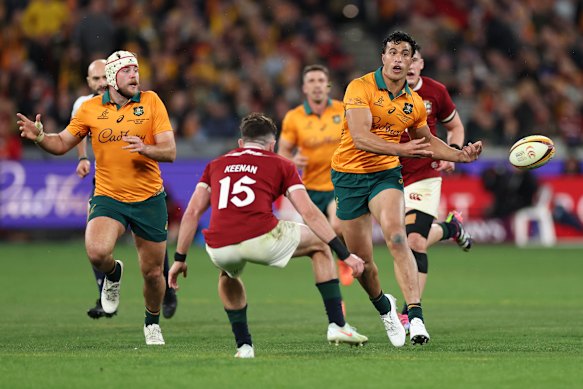
Joseph-Aukuso Suaalii switched codes in 2024, with the goal of playing against the Lions and at the 2027 Rugby World Cup.Credit: Getty Images
“Competition is such a good thing, it reinvigorates you,” Burke says. “You can take it as a bit of a slap in the face, and all their mates will be going, ‘Oh mate this is ridiculous for these blokes to come here, you’re good enough’.
“But you’ve got to literally take that look in the mirror and go, OK, well how can I respond to this? How do I lift? If I am an older player, how do I reinvent myself and pick up that spark?”
Astutely, however, Burke also stresses that existing Aussie players should not be the only ones to lift their game – coaches and selectors must, too. If an existing or fringe Wallabies back responds as asked and outplays the high-profile NRL recruit during the next year, they should be picked ahead of them. Form trumps salary. No free rides.
Loading
“Just because they’ve been guaranteed a certain amount of money doesn’t guarantee them a spot, they’ve got to work for that spot,” Burke says.
“They need to prove themselves as well, in that role, to justify coming across.
“It’s a challenge for them. It’s the same rectangular field, but it’s just a completely different game, so they’ve got to get up to speed with the contest of a rugby game and positionally etcetera.
“It’s all about creating competition for spots, and building more of a base to choose from. Yes, the sad part about that is good players are going to miss out, but that’s all part of it.
“That’s the place you have to be.”


