







Elizabeth is a worn-around-the-edges working-class suburb in Adelaide’s northern sprawl, about 30 kilometres up Main North Road from the city.
Brick public housing blocks, tyre shops, Centrelink queues, mobility scooters outside the shopping centre, teenagers vaping at the bus interchange with nowhere much to go.
Once, everything here revolved around the giant Holden factory. It stamped out Commodores and pay packets in equal measure. Three generations worked the line. Then the gates shut in 2017 and Australia’s last car plant went with it.
It never quite became a ghost town, though it flirted with the idea. The factory site has been rebadged as an industrial precinct of warehouses, training centres and the promise of “advanced manufacturing” which hasn’t yet replaced the old kind.
Parts of the suburb sit among the lowest incomes in metropolitan Adelaide. Welfare dependence is high. Life expectancy is lower than suburbs only half an hour away, but a world apart.


You may never have heard of Elizabeth, nor care why it still exists. But as 1.3 million South Australians prepare to go to the polls this week, election analysts do.
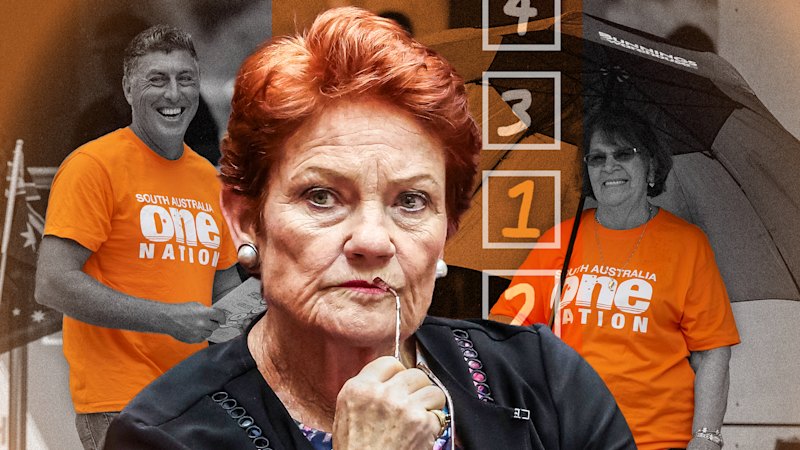
It’s in places like this across the country that Pauline Hanson’s party is riding a lift in support. While public polling in South Australia suggests One Nation has around 24 per cent statewide share of the vote, ahead of the Liberals, the geography of that vote tells a deeper story.
At the federal election last May in South Australia, two of One Nation’s strongest showings came in the rural seats of Barker and Grey — the Liberal Party’s last remaining federal strongholds in the state. But a third pocket of strength sat closer to Adelaide, in the seat of Spence: a safe, working-class Labor seat covering much of the outer northern suburbs including Elizabeth, with 9.55 per cent of the vote.
Standing here for One Nation in Saturday’s state election is local candidate Kym Hanton, a former police officer and army reservist who grew up in Elizabeth, kicking a football on cracked bitumen. He says the suburb shaped his view of community and resilience.
“I learned very quickly how stacked the system is,” he says. “Too often Labor, Liberal, and the Greens argue loudly but deliver very similar outcomes — and communities like Elizabeth keep getting left behind.
“I think people have had a gutful, to be honest. That’s what they keep telling me.”
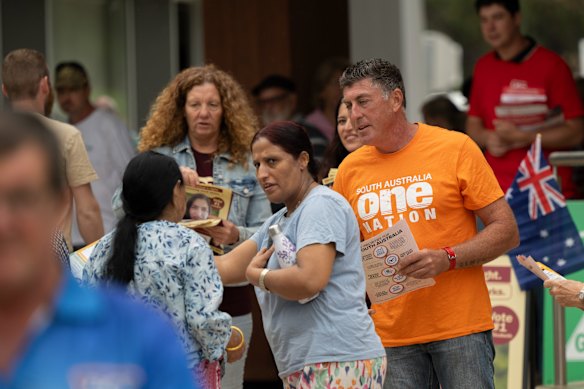
Despite a retiring incumbent, Labor remains a hot favourite here. But just how much One Nation can eat into its vote will offer a glimpse at whether Hanson’s party can cut through demographics, like Trump’s MAGA movement or Nigel Farage’s Reform party. Hanton is convinced he can give them a scare.
“I’ve voted Labor all my life, but they’re really taking us for granted,” says Grant Smith, who lined up to vote last Saturday, a week before polling day.
“I’ve been a tradie all my life and I think One Nation is talking about the things affecting us all.”
Others in high-vis have also joined the line, some remain believers in the Labor cause, others, however, say they are happy to join the orange wave.
“It’s clear it’s now socially acceptable to many to be seen taking One Nation cards,” one long-time Liberal volunteer on pre-poll observed. “We have crossed that threshold now.”
Labor Premier Peter Malinauskas remains acutely aware of the One Nation threat. In his opening statement during last Friday’s leaders’ debate, he addressed the concerns of people in places like Elizabeth directly.
He recalled an interaction with a voter who’d lost his Holden job a decade ago.
“He said ‘mate, the problem is not the money – I got a redundancy … the problem is I don’t want to feel like a loser’. He explained that he missed his mates at work,” the premier said.
“And it struck me because it was a plain and clear example of just how important the dignity of work is to people’s identity, their sense of self-worth, their character.”
In recent days, Malinauskas has turned his attention to One Nation policies, particularly on the housing crisis.

“Identifying problems in politics, that’s really easy,” he said. “But the job is to actually provide solutions, and that’s why we’ve got a housing policy which stands in stark contrast to One Nation, which seems to be a policy-free zone at large.”
South Australia has become an unexpected testing ground for the One Nation ambitions. Hanson hasn’t had much luck in the state, including once losing her wedding ring at Glenelg Beach in 1971.
Rob Manwaring, an associate professor at Flinders University, says the state could serve as a template if the party manages to organise an effective campaign. Until recently, he says, One Nation had not been a “significant presence” in the state and had been “quite disorganised”.
That began to shift at the 2022 state election, when Sarah Game was elected to the Legislative Council on a One Nation ticket before quitting the party last year to sit as an independent.
“We can argue on what success will look like, but you can’t argue with the trajectory,” he says, pointing out the party secured just 2.63 per cent of the vote that year, albeit contesting just 19 of the 47 seats in SA parliament.
“It’s clear their vote is on the rise, but I suspect it is not going to materialise into anything beyond perhaps two seats in the upper house.”
Manwaring says the party’s strategy is less about peeling away Labor voters and more about exploiting fractures on the conservative side of politics, with the seat of Narungga on the York Peninsula, and Mount Gambier and MacKillop in the state’s south-east, the best hopes.
“The One Nation strategy there actually is to win Liberal votes,” he said, adding the state lacked a strong National Party presence, leaving space for One Nation to appeal to voters who might otherwise lean conservative.
On Friday evening, about 60 locals gathered in the Williamstown Memorial Hall in the Barossa Valley to hear from One Nation candidate Bruce Preece. This is the state seat of Schubert, held by Liberal leader Ashton Hurn, who has avoided tackling Hanson’s party full on and instead reminded voters that by supporting One Nation, they’ll simply be entrenching Labor.
There are sandwiches and party pies and cups of tea and coffee laid out for everyone who turns up. The main focus is to ensure there are enough people to hand out how-to-vote cards when the polls open.
The crowd is a cross-section of country South Australia: young kids tagging along with their parents, young men in their 20s, retirees, and John Tate, the meeting’s MC, wearing an Australian flag bucket hat, orange T-shirt, tracksuit pants and thongs.
Preece himself comes to politics with an interesting record. Last year, the Barossa councillor was called on by colleagues to resign after he was accused of walking out during an Acknowledgement of Country and turning his back on a smoking ceremony at a Welcome to Country.
But he appears unbothered by the controversies, welcoming a handful of reporters into the hall and setting out why One Nation needs to win the seat.

He’s desperate for a new hospital for the region, promising the party would secure the funding if it wins the election.
“It’ll be a training hospital where doctors and nurses become trained, you’ll have some special suites, major operations, and we’ll be able to have babies again, which we can’t do now,” he says.
Moments later, the audience is asked to stand, face the two flags at the front and sing the national anthem to open the meeting. Everyone rises and belts it out. They even go into the second verse.
Also speaking is One Nation’s state president Carlos Quaremba, also a Victor Harbor councillor, who is running for the Legislative Council.
A straight-talking builder, Quaremba promises to hold the government accountable, tackle the cost-of-living and housing crises and dismantle net zero policies that he says are punishing everyday South Australians.
“People are still struggling to find affordable, secure homes. Electricity bills are rising with no end in sight,” he says.
At one point he addresses critics who dismiss the party’s rise as grievance politics.
“I’ve heard a lot about One Nation being described as a grievance party. Has everybody heard that they’re saying that? You know, doesn’t make a difference. I’m trying to understand why a grievance vote would be any different than any other vote?”
At the top of the South Australian ticket is former Liberal senator Cory Bernardi, who is playing down expectations, saying votes alone will not define success for the party. The controversial culture warrior had hit headlines again lately over historical remarks about same-sex marriage and has been forced to defend Hanson’s comments about Muslims.
But at a pre-polling station in West Beach, he is on message, talking about cost-of-living issues and telling voters the major parties are not listening to them.

“A good result is representation in the parliament – that’s my benchmark,” Bernardi says, conceding, the country is “watching what happens in South Australia”.
“Whether we have one voice or two voices or five voices, we want to make sure it is the strongest voice for South Australians.”
He says preference flows from Labor and the Liberals — whom he regularly refers to collectively as the “uni party” — could shape the party’s fortunes.
“We can still do very, very well and poll very highly, but if the uni party decide they don’t want One Nation representatives — and they direct their people to preference against it — that can work against us too.”
Hanson herself says the party is encountering new voters everywhere she travels. She hit the campaign trail this week with Bernardi in Mount Gambier and Narungga, where the candidate is Chantelle Thomas, a 30-year-old photographer and makeup artist.
Travelling in a light aircraft provided to the party by S Kidman and Co, the beef business owned by mining magnate Gina Rinehart, Hanson told local reporters she was being mobbed “over the country”.
“It doesn’t matter where I’m going,” she said. “Staunch Liberal [voters], but not only that, even staunch Labor Party [voters] have said, ’No, we’re voting One Nation now’.”
Hanson is playing down success in South Australia and points to the upcoming May byelection Farrer, the NSW seat vacated by deposed Liberal leader Sussan Ley, as the real litmus test.
Resolve pollster Jim Reed says One Nation is now acting much like Reform in the UK, first taking vote share from the right and then the left.
“They are taking votes from those who feel ill served, ignored or rejected by the major parties, and they’re voting for change, any change,” he says.
But he thinks the South Australian poll will be a better barometer than the upcoming byelection, which is complicated by Labor not contesting, both Coalition parties running, plus a high-profile independent.
“South Australia is more akin to a lot of other contests around Australia,” he says. “A dominant Labor government, a wounded Liberal Party in retreat and an ascending One Nation that’s yet to be tested.”
Which brings the story back to Elizabeth. A suburb built around a factory that no longer exists. A place where wages disappeared faster than frustrations.
And while the biggest One Nation swings may be happening in rural seats at country halls, it is suburbs like Elizabeth – watching politics from the edges of the economy – that tell you where the next shift might come from.
Cut through the noise of federal politics with news, views and expert analysis. Subscribers can sign up to our weekly Inside Politics newsletter.


