







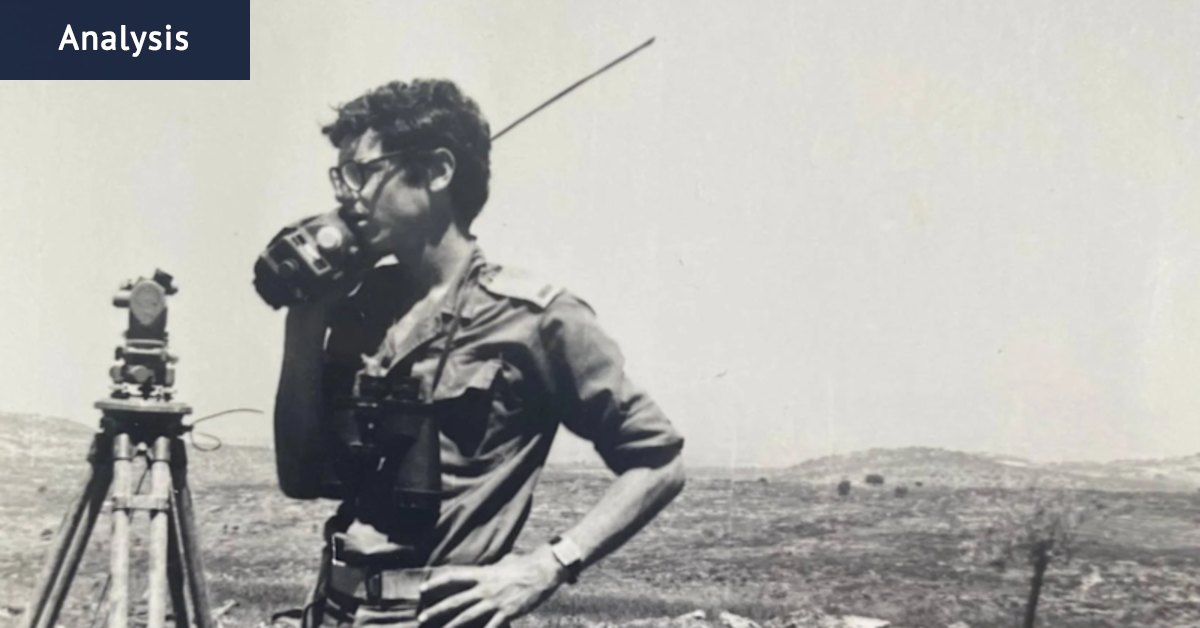


London: When Ahron Bregman sees coverage of airstrikes in Lebanon, he remembers his six years in the Israel Defence Forces.
Bregman crossed into Lebanon as an artillery officer during the 1982 invasion that promised to bring peace to the country, only to see it end in a long occupation that deepened hatreds.
“Whenever the Israelis go into Lebanon, it ends in tears,” he says.
Bregman, now a senior teaching fellow at King’s College London, remembers the stench of dead soldiers in southern Lebanon and the relief of surviving an attack on his convoy when he drove north to Beirut on his second incursion into the country.
Based in the capital, he witnessed a brief moment of optimism when Lebanon elected a young president and former military commander, Bachir Gemayel, and opened the way for a peace deal. He saw disaster unfold when Syrians assassinated Gemayel three weeks later. The occupation lasted 18 years.
Now, as more than 1 million people flee their homes, Bregman believes Israel is repeating the mistakes of the past with its move to clear and control large parts of southern Lebanon. And he thinks it will fail to achieve its stated goal of eliminating Hezbollah, the Shiite Muslim militia that sends rockets into civilian communities in Israel.
There are two main goals in this operation, he says. The first is to drive people north and create a refugee crisis that places pressure on the Lebanese government to disarm Hezbollah. The second is to turn the people of Lebanon against Hezbollah. That is why the IDF bombs towns and villages and tells their residents to flee north.
The difference this time, says Bregman, is that the IDF is bombing bridges across the Litani River, the northern marker of the “secure zone” that is being evacuated inside Lebanon. The river is about 30km north of the border with Israel.
“In the past, the refugees were allowed to return to their villages,” he says. “Now, for the next weeks and months, and maybe years, they will not be allowed to return. This is why it is ethnic cleansing.
“The Israelis blew up five bridges over the Litani River – and that’s the signal that people will not be allowed to return.”
Bregman dismisses the IDF claim that the bridges were destroyed to prevent Hezbollah from crossing south towards Israel. “The river is not the Amazon,” he says. Hezbollah forces will find a way to cross, but civilians will be prevented from getting home.
Bregman reaches this conclusion as a long-time analyst of Middle East conflict. He is the author of several books, including Israel’s Wars: A History Since 1947, and he wrote a memoir, The Spy Who Fell to Earth, about his friendship with a suspected Mossad spy. This led to a Netflix documentary of the same name.
The war in Lebanon grows worse each day. Hezbollah sparked the most recent conflict by firing on Israeli civilian communities on March 2 in a show of support for Iran after the US and Israel launched their strikes on February 28. On Tuesday, the Lebanese government said the war had left 1268 people dead and 3750 injured.
Israeli Defence Minister Israel Katz set out plans on Tuesday that drew a direct link between the territorial plan in Lebanon and the approach in Gaza.
Katz said residents would not be allowed to return to their homes in southern Lebanon “until the safety and security of residents of northern Israel” was guaranteed.
“All houses in villages near the Lebanese border will be destroyed, in accordance with the model used in Rafah and Beit Hanoun in Gaza, in order to permanently remove the threats near the border to northern residents,” he said.
Those killed in the Israeli attacks have included families gathered in their homes in civilian communities, as well as university professors and paramedics.
Israel says 10 of its soldiers have been killed in the fighting with Hezbollah, part of a toll of more than 20 people killed in Israel since the broader war began. More than 6000 have been wounded from Iranian and Hezbollah attacks.
When this masthead spoke to medical staff in the town of Nabatiyeh in southern Lebanon, they spoke of children being killed. One nurse told of seeing civilians suffering burns from phosphorus bombs, which are illegal under international law if used over civilian homes. The Israeli military says it is unaware of, and cannot confirm, the use of shells that contain white phosphorus in Lebanon.
On Saturday, the IDF killed three journalists in a car on a road near Jezzine, east of Nabatiyeh. Reporter Fatima Ftouni and her brother, camera operator Mohamed Ftouni, were reporting for the Al Mayadeen television channel. They were with Ali Shoeib, a reporter for Al-Manar, which is affiliated with Hezbollah.
The IDF released a photo of Shoeib wearing a Hezbollah uniform, but later admitted to Fox News that it was photoshopped. The original photo shows Shoeib wearing a vest with a large “press” label on the front.
The Israeli attacks have also killed United Nations peacekeepers at the UNIFIL operations meant to keep the IDF and Hezbollah apart in southern Lebanon. Three Indonesian peacekeepers have been killed in recent days, while others have been wounded, according to the Lebanese government news agency. The IDF blames Hezbollah for the deaths.
Crucially, Bregman doubts the IDF military operations will achieve lasting success for Israel.
He doesn’t believe the occupation of the south will stop the Hezbollah rockets, many of which come from outside the occupation zone, and suspects the goal of the operation is to mollify Israeli civilians so they will not evacuate and place pressure on safer communities in the south.
“By invading southern Lebanon, in fact, the Israelis give Hezbollah the excuse not to disarm,” he says. While the stated purpose is to pressure the Lebanese government into forcing Hezbollah to give up its weapons, the effect is to convince Lebanon it needs Hezbollah to defend its southern border.
“What you will see in coming weeks and months is what we saw between 1985 and 2000 in the so-called security zone in southern Lebanon: Hezbollah will just do guerrilla war against the Israelis, and it will be bloody.”
The Lebanese government cannot force Hezbollah to disarm, he says, because that leads to civil war. The IDF, in turn, cannot disarm Hezbollah, and the outcome is a guerrilla war. While the IDF may be able to eliminate Hezbollah by destroying the group’s sponsors in Iran, it has not achieved this goal after four weeks of airstrikes.
“Israel cannot solve its disagreements with its neighbours by dropping bombs on them – it just doesn’t work,” says
“They fight against Iran, they fight against Hezbollah, they fight against the Palestinians, but they must have a diplomatic leg to their strategy to solve it.
“What you see in Lebanon, in fact, is an escalation of the situation because occupying south Lebanon is just playing into the hands of Hezbollah – it gives them the reason to continue.”
This is fundamental to Bregman’s view of the war in Lebanon and the broader policy of Israel under Prime Minister Benjamin Netanyahu since the Hamas attack in October 2023 that set off the war in Gaza. He does not believe it will bring lasting peace to Israel.
“The Israelis, and the Americans, have gained many tactical achievements in Iran and in Lebanon,” he says. “But if you don’t translate these achievements into some sort of a diplomatic and political solution, then what? What’s the point of a military operation in itself? This is, I think, the weakness of the Israeli behaviour in the Middle East since 2023, since that disaster.”
“Militarily, they are doing very well, the Israelis, but their weakness is translating that into a political solution.”
Get a note directly from our foreign correspondents on what’s making headlines around the world. Sign up for our weekly What in the World newsletter.


