


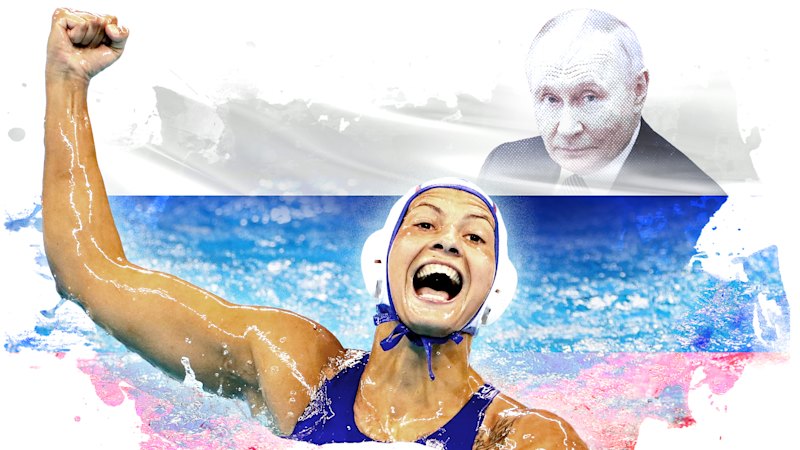

Russian athletes set to controversially compete in Australia within weeks have direct links to sanctioned organisations and oligarchs, which threatens to pose legal and diplomatic dilemmas for the federal government under its sanctions laws.
The Russian women’s national water polo team is due to appear under its flag, anthem and national colours at the World Cup at Sydney Olympic Park Aquatic Centre in July after World Aquatics overturned a ban on Moscow in April. The decision marks one of the most significant returns of Russian national representation to international sport since the Kremlin’s full-scale invasion of Ukraine in 2022. It has triggered a boycott of hosting events by several European countries.
The Australian Federation of Ukrainian Organisations, which is fiercely opposed to the move, is now calling for intensive visa and security scrutiny for all Russian athletes, officials and support personnel travelling to Sydney. It is asking whether they are connected to entities already targeted under sanctions.
AFUO chair Kateryna Argyrou said Russia’s participation could not be separated from its war against Ukraine, nor from the documented use of elite sport by Vladimir Putin’s regime as a “tool of propaganda, prestige and international legitimisation”.
The team that qualified for Sydney at the Division II World Cup tournament in Malta earlier this year included captain Ekaterina Prokofyeva, along with several players drawn from KINEF-Surgutneftegas, a dominant force in Russian women’s water polo.
The club is financially backed by Surgutneftegas, one of Russia’s largest oil producers. Surgutneftegas appears on Australia’s sanctions list, as does its long-time director-general, oil tycoon Vladimir Bogdanov.
Ukraine and Estonia have urged Australia to follow the European Union by imposing stricter restrictions on Russian oil, known as “blood oil”, entering the nation via third countries as a parliamentary inquiry probes ways to toughen Australia’s sanctions regime against Russia.
At the national level, Russia’s water polo program sits within the Russian Aquatics Federation, headed by Dmitry Mazepin, another individual sanctioned under Australia’s measures.
Mazepin, a Belarusian-Russian oligarch who amassed wealth in the chemical and fertiliser sectors, is not expected to travel to Sydney and there is no suggestion any athlete is personally designated under Australian sanctions.
But a leading sanctions expert says Australia’s broad regime could also extend to athletes who are employed by teams owned or run by entities or individuals. Under Australia’s sanctions regulations, often referred to as Magnitsky laws, it is a criminal offence to directly or indirectly make an asset available to, or for the benefit of, a sanctioned individual or entity.
Anton Moiseienko, an associate professor of law at the Australian National University, said sanctions questions depended on facts including ownership, control and who benefits.
“These sanctions implications should be considered by the Australian government,” he said.
“There’s a group of foreign citizens coming in, presumably applying for visas. There is some public resonance around this case, and there seem to be issues around sanctions that are necessary to consider.”
Moiseienko said a recent High Court judgment in the case of Oleg Deripaska, a Russian national and an oligarch sanctioned by Australia, accepted broad interpretations of restrictions on dealing with controlled assets and highlighted how sanctions provisions reached well beyond straightforward financial transactions.
He said the definition of an asset extended beyond money and included property, equipment, documents and intangible material. Moiseienko said that could include whether equipment, team services, media production, accommodation arrangements or prize money could amount to assets being used, provided or generating benefit.
Another scenario to be canvassed, he said, was whether any financial benefit generated through participation could flow to athletes employed by structures linked to sanctioned entities or back through governing bodies headed by sanctioned individuals. The World Cup finals carry prize money of almost $1 million.
The Department of Foreign Affairs and Trade declined to comment on any potential sanctions compliance action, but the government made clear it opposed the sporting decision.
“We are disappointed by the recent decision by World Aquatics to allow Russian and Belarusian athletes to compete under their national flags, while Russia continues its brutal invasion of Ukraine,” a DFAT spokesperson said.
Officials said final athlete and support staff lists had not yet been submitted.
Putin’s ambassador to Canberra, Mikhail Petrakov, was hauled into DFAT on Wednesday over Moscow’s vow to launch strikes across the Ukrainian capital of Kyiv.
The government has said Water Polo Australia was required to host qualified teams under World Aquatics rules and that international sporting federations operated independently of government. DFAT said all entrants remained subject to Australia’s sanctions and border controls.
Former Olympian Andrei Kovalenko, who was born in Ukraine, competed professionally in Moscow and later represented Australia in water polo at the Sydney games, said Western sporting bodies misunderstood the relationship between Russian sport and the state.
“When someone’s saying sport is out of politics, I’m laughing because it’s such a lie,” Kovalenko said. “The Russian government and Russian soldiers, they are killing Ukrainians. [Russian athletes] physically cannot be neutral athletes. They represent the current government. We, as a sport, become part of the propaganda.”
World Aquatics president Husain Al Musallam has defended the move, saying the organisation was determined to ensure that “pools and open water remain places where athletes from all nations can come together in peaceful competition”.
Russia’s return to the Sydney tournament is viewed by some as a sign that athletes could be fully reintegrated into future Olympic competition, including the 2028 Los Angeles Olympics or potentially the 2032 Brisbane games.
The International Olympic Committee recently recommended lifting restrictions on Belarusian athletes, while continuing to maintain sanctions against Russia linked to anti-doping concerns. But it has said that “athletes’ participation in international competition should not be limited by the actions of their governments, including involvement in a war or conflict”.
Argyrou said the Russian national water polo system drew heavily from clubs historically and institutionally linked to the armed forces and the state security apparatus.
“How could Russian national teams be allowed back into international competition when nothing has changed since the start of the full-scale Russian invasion?” she said.
“Every day, Russia continued to commit war crimes, perpetrate systematic human rights violations in occupied territories and conduct attacks on civilians.”
She said having Russians play also risked undermining the principled support Australia has shown for Ukraine. The federal government has sanctioned more than 1300 individuals and hundreds of entities connected to Russia and it has repeatedly framed support for Ukraine as a defence of international law.
Since the invasion, Australia has committed about $1.7 billion in assistance to Ukraine.
Water Polo Australia said the Sydney event had been secured before Russia’s reinstatement and any questions of its involvement should be directed to World Aquatics.
Cut through the noise of federal politics with news, views and expert analysis. Subscribers can sign up to our weekly Inside Politics newsletter.
 Rob Harris is the national correspondent for The Sydney Morning Herald and The Age based in Canberra. He is a former Europe correspondent.Connect via email.