


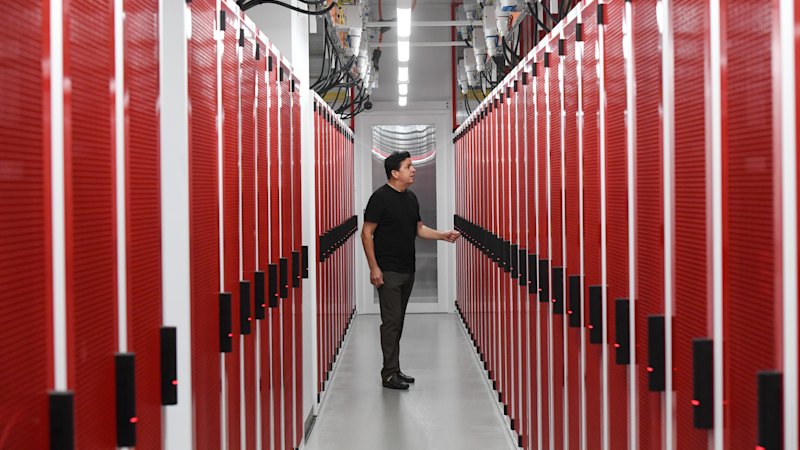
Australia’s fast-growing data centre sector is attempting to reframe its massive power requirements as an asset for the grid, arguing its deep corporate pockets can fund and accelerate the nation’s multibillion-dollar energy transition rather than destabilise it.
Plans to build dozens of new data centres – buildings filled with racks of servers that store and transmit online data – are coming under intensifying scrutiny across Australia as crossbench MPs, climate groups and community campaigners raise alarm over the unprecedented strain they threaten to place on the electricity system.
Because data centres need vast amounts of power for their high-intensity computing and cooling systems, critics fear the rush to build more facilities could drive up greenhouse gas emissions and saddle households with bigger power bills to fund costly grid upgrades.
Australia is home to 162 operating data centres, which consume about 2 per cent of total electricity demand on the eastern seaboard. By 2030, the sector’s demand could triple to 6 per cent, the energy market operator says.
In response, the Albanese government is considering imposing strict new obligations, such as requiring data centre owners to invest in new energy projects before they are allowed to build. As talks between the government and industry continue, major operators are seeking to shift the way policymakers and the wider energy industry view their sector.
Rather than being treated as passive drains on the grid, data centres should be seen as active “grid participants” capable of bringing long-term demand signals and injecting vital private capital into electricity generation, storage and infrastructure at a critical time, says Sabooh Whitelaw, associate vice president of energy and utility at AirTrunk, which has data centres in Melbourne and Sydney.
“Growth should pay for growth,” she said. “Our objective is to help strengthen the grid – that means investing in the infrastructure, partnerships and innovations that can support reliability, accelerate renewable integration and deliver benefits across the wider energy system.”
Whitelaw pointed to analysis by distribution network operators suggesting that large, stable power users could put downward pressure on network charges – costs for the construction and upkeep of power poles and wires that can account for up to 40 per cent of a typical power bill – by spreading the costs across a larger volume of energy consumption. AirTrunk said it had already funded connection infrastructure, paid for network upgrades and signed long-term renewable contracts for its facilities.
Concerns about data centres’ power demand are reverberating across the Asia-Pacific. Governments are increasingly responding with new requirements for reliability, flexibility and clean energy procurement. Analysts at global research firm Wood Mackenzie say Australia is leading the charge.
“Australia is among the first markets in the region to require large data centres to actively support grid stability,” it said.
Federal Energy Minister Chris Bowen said ministers from all states, except Queensland, had agreed data centres should invest in additional renewables and firming projects in their state of operation to fully compensate for their power demand, and were due to decide on the new rules at a meeting in July.
“Data centres are one of the biggest drivers of new energy demand – we’re acting to make them an asset to the energy grid, not a strain,” Bowen said. “If data centres want to benefit from Australia’s energy grid, we think they should do their bit to strengthen it – and it’s clear that the overwhelming majority of states agree.”
Australia ranked second in the world for data centre investment inflows in 2025, and a Westpac analysis has put the local pipeline at more than $155 billion. Microsoft has committed $25 billion to Australian data centres, and Amazon Web Services another $20 billion – money the government has welcomed at a time of sluggish growth even as community opposition builds.
Community campaigners and crossbench MPs have questioned how much benefit will flow to consumers rather than to the global technology giants that lease the buildings, and warned that promises of cheaper bills and local jobs should be tested against the strain on water and power.
Independent ACT senator David Pocock last week called for a levy on hyperscale data centres, drawing a direct parallel to his earlier push for a 25 per cent gas-export tax and warning Australia risked repeating the mistakes of the resources boom with AI infrastructure.
AirTrunk, which offers more than 755 megawatts of capacity across its Sydney and Melbourne campuses, is owned by a consortium led by US asset manager Blackstone and the Canada Pension Plan Investment Board, which bought it for $24 billion in late 2024.
Founder Robin Khuda, who predicts AirTrunk will become a $100 billion company, has spent months pressing the federal government to speed up planning and approvals, claiming Australia is at risk of squandering the boom.
Khuda, who unveiled a $US30 billion ($42 billion) data centre investment in India this month, has cast speed and power supply as the deciding factors in where global technology money lands.
“When you’re investing at this scale, speed and certainty matter,” he said in a statement this month. “Investors need confidence that power, land, approvals and infrastructure can be aligned around long-term projects.”
He has also warned that the capital chasing AI infrastructure is mobile and will flow to whichever country moves fastest. “Global capital has choices,” Khuda said. “It will naturally gravitate towards jurisdictions that are open for investment, can make decisions quickly and understand the strategic importance of digital infrastructure.”
The company has begun pointing to projects it says show data centres can give back to the system. At its SYD3 site in Western Sydney, AirTrunk has announced plans to integrate a large-scale battery storage system, while a 25-megawatt solar farm it backed at Mulwala in the NSW Riverina, alongside Google and European Energy Australia, is about to start feeding the grid.
The Business Briefing newsletter delivers major stories, exclusive coverage and expert opinion. Sign up to get it every weekday morning.
 Nick Toscano is a business reporter for The Age and Sydney Morning Herald.Connect via X or email.
 David Swan is the technology editor for The Age and The Sydney Morning Herald. He was previously technology editor for The Australian newspaper.Connect via X or email.