







When Donald Trump announced his second-term cabinet just over a year ago, there were more than a few quirky picks in the mix. Not least Robert F. Kennedy Jr, the vaccine sceptic, for health secretary; Peter Navarro, recently released from jail, having served several months for contempt of Congress, as senior counsellor for trade and manufacturing; and Linda McMahon as education secretary, previously best known as the co-founder of a professional wrestling organisation.
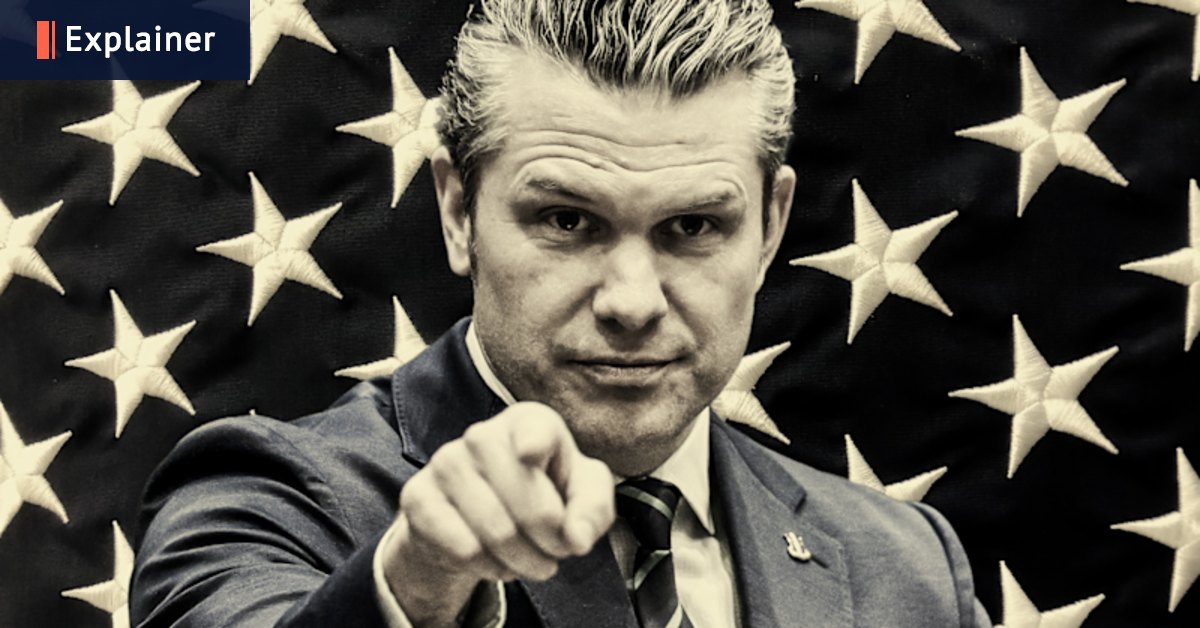
Possibly Trump’s most contentious call of the lot, however, was Pete Hegseth for secretary of defence (a role that would be renamed secretary of war). Hegseth, a decorated veteran and right-wing author whose most recent career reinvention had been as a host on conservative TV channel Fox News, had no previous expertise in government and what little experience he’d had in leadership roles, in not-for-profits, had been tarnished by claims of mismanagement and unprofessional behaviour.
This and other dirty linen was aired during his Senate confirmation hearings, where his personal life, including a history of infidelity, was judged fair game in the context of whether or not he could be trusted to make life-or-death decisions.
Then, two months into the job, came “Signalgate”, the now-infamous group chat in which national security leaders, Hegseth included, blithely discussed classified information, unaware that the editor-in-chief of The Atlantic was also in the conversation. Surely, said his critics, this would be the last straw.
Flash forward a year, though, and Hegseth, 45, is not only still in the job but appears to be flourishing, both as Trump’s wingman in the current war in Iran and in Trump’s war on diversity and “woke” beliefs.
A devout Christian heavily tattooed with religious and war-fighting iconography, Hegseth says there is no place for “toxic ideological garbage” in the military. “No more identity months, DEI offices [diversity, equity and inclusion], or dudes in dresses. No more climate-change worship. No more division, distraction or gender delusions. No more debris. As I’ve said before and will say again, we are done with that shit.”
He has criticised generals for being “fat”, cracked down on facial hair and said women in combat roles should be subject to the same fitness criteria as men. His messaging can be crude, even gleeful. “Death and destruction from the sky all day long,” he bragged to reporters about the strikes on Iran. “We are punching them while they’re down, which is exactly how it should be.”
Yet despite his inexperience and naivety, he is putting runs on the board for Trump’s administration: the operation to remove Venezuelan leader Nicolas Maduro, whatever you make of its motivation, was a tactical success; Iran, so far, has proved to be a largely one-sided contest, even if the ultimate outcome is yet to be determined. Is Hegseth proving his naysayers wrong?


What is Hegseth’s story so far?
Born on June 6, 1980 in Minneapolis, Minnesota, Hegseth was the first child of middle-class parents Brian, who coached high-school basketball, and Penelope, an executive business coach. He has two younger siblings, Nathaniel and Phil; the latter now works at the Pentagon.
Hegseth was both a strong basketball player and an accomplished student, graduating top of his class and winning a place at Ivy League university Princeton, where he majored in politics. Outside his studies, he published a right-wing journal, The Princeton Tory (which ran articles opposing gay marriage and called diversity programs a “distraction”), and enrolled in the university’s Reserve Officers’ Training Corps, a pathway to leadership roles in the armed forces. As a graduate, he worked briefly for the investment bank Bear Stearns then served with the New Jersey National Guard at Guantanamo Bay in Cuba, overseeing detainees, before returning to Wall Street only to sign up for a tour in Iraq as an infantry officer, for which he received the first of two Bronze Star medals.
Above: Hegseth, left, in a 2005 photo posted on his social media account in December, captioned, “Our platoon. 20 years ago, today. Baghdad, Iraq. Pre-air assault raid. These men. Our mission. The brotherhood. It’s always top of mind. Every day. At @deptofwar we serve warriors like these – and will do right by them, especially when it’s hard.”
Back in the States, he became involved in a small not-for-profit veterans advocacy service called Vets for Freedom, becoming its chief executive officer in 2008, but the organisation ran up debts it could not pay and he stepped down. He would also later part ways with another advocacy group, Concerned Veterans for America. He briefly toyed with running for the Senate, from Minnesota, but instead deployed to Afghanistan to teach counterinsurgency.

His TV career started after he came home: on Fox News, first as an occasional contributor and then, in 2017, as a co-host of the show Fox & Friends, on which he would frequently interview Trump. In 2019, after a long-running campaign by Hegseth who was reported to have personally lobbied the president, Trump pardoned two troops who had been accused of war crimes and reversed a demotion of a third.
By then, Hegseth had finished a master’s degree in public policy from Harvard and published the first of several books, a 2016 part-memoir, In the Arena: Good Citizens, a Great Republic, and How One Speech Can Reinvigorate America. His most recent, The War on Warriors: Behind the Betrayal of the Men Who Keep Us Free, was praised by Trump for exposing “the leftwing betrayal” of America’s military.

Meanwhile, Hegseth’s personal life was complicated. His first marriage, in his early 20s to high-school sweetheart Meredith Schwarz, ended in 2009 after he admitted to infidelity. The following year he married Samantha Deering, a co-worker he met at Vets for Freedom, and with whom he has three sons, but they divorced in 2017 after he fathered a daughter with Jennifer Rauchet, a producer at Fox and mother of three from a previous marriage, who he married in 2019.
Around the time of his split from Deering, it later emerged, his mother sent him an email calling him “an abuser of women” who “belittles, lies, cheats, sleeps around, and uses women for his own power and ego.” She later publicly apologised to him for writing it, saying she had sent it in haste. There have been multiple claims over the years that Hegseth drank heavily. In 2024, The New Yorker revealed a whistle-blower report filed during Hegseth’s tenure as the president of Concerned Veterans for America, which claimed he had been “repeatedly intoxicated while acting in his official capacity” and once had to be restrained by colleagues from joining the dancers on stage at a strip club. Asked about some of the claims in his confirmation hearing, Hegseth denied them, calling them “anonymous smears”.

During the Senate hearings to confirm his appointment as defence secretary, his former sister-in-law Danielle, who was married to his brother Nathaniel for eight years, provided a sworn statement detailing what she claimed were Hegseth’s abuses: that Hegseth’s ex-wife Deering had told her she feared for her personal safety; that Hegseth had made disparaging remarks about women and Muslims; and that he had once “drunkenly yelled” in her face. Hegseth’s lawyer denied all the allegations.
For his part, Hegseth has said that he drank on his return from active duty when he found the transition to civilian life challenging. He was also accused of sexually assaulting a woman at a hotel during a conference in 2017, which he denied, saying the encounter had been consensual. Police investigated but did not charge him. In 2020, he paid the woman a financial settlement as part of a non-disclosure agreement.

What’s with the tattoos?
Hegseth likes his ink. Some of his many tattoos are military, such as a US flag combined with an assault rifle and the patch from his regiment. Some are patriotic, such as the US Constitution’s opening phrase “We the People” on his right forearm. And some are overtly religious.
A cross and sword tattooed on his arm represents the New Testament verse Matthew 10:34, which reads, “Do not think that I have come to bring peace to the earth; I have not come to bring peace, but a sword.” He also has “Deus Vult”, Latin for “God wills it”, on his bicep, a phrase associated with the Crusades. Most prominently, a large Jerusalem cross features on his right chest, a symbol that was also used in the Crusades and that has been tied more recently to far-right nationalist Christianity.
Above: A 2019 photo from Pete Hegseth’s social media with the caption, “It was time… JOIN, or DIE.” The design is derived from a 1754 woodcut attributed to Benjamin Franklin, encouraging American colonies to unite.
In 2019, Hegseth volunteered for the National Guard for the District of Columbia (a part-time role) and in 2021 was rostered to be part of a security detachment for Joe Biden’s inauguration, until a fellow guardsman flagged concerns that his ink might represent right-wing Christian extremism. Hegseth was taken off the detail and, he says, he resigned from the National Guard soon after in disgust.
He told Fox News in 2024: “Ultimately, members of my unit in leadership deemed that I was an extremist or a white nationalist because of a tattoo I have, which is a religious tattoo. It’s a Jerusalem cross. Everybody can look it up, but it was used as a premise to revoke my orders to guard the inauguration.” On the cover of his 2024 book The War on Warriors, he states: “I joined the Army to fight extremists in 2001. Twenty years later, that same Army labelled me one.”
He later credited ‘those two Js’ – Jennifer and Jesus – for putting his life back together.
He is very open about his religious beliefs, which he says were sparked around 2018, when he and Jennifer Rauchet, during his divorce, began attending a community church in New Jersey (his family, growing up, had not been notably religious). He later credited “those two Js” – Jennifer and Jesus – for putting his life back together. Today, he regularly leads prayer sessions at the Pentagon, posts religious messages on social media and attends the Pilgrim Hill Reformed Fellowship church outside Nashville, Tennessee, and Christ Church DC in Washington, DC, both part of a federation called the Communion of Reformed Evangelical Churches, or CREC. The CREC forbids women from holding leadership roles and tells married women at its churches to submit to their husbands.

What does a US secretary of war do?
Secretary of defence, now renamed secretary of war, is one of the most important roles in the US government. Reporting to the president, the secretary can directly issue commands to US forces across the globe, though they do not have a direct role in the nuclear chain of command. They run the Pentagon, which has an estimated 27,000 direct employees and oversight of some three million people across associated agencies, contractors and civilians. The secretary has a diplomatic role, too, liaising with other nations’ defence ministers, attending meetings of NATO and other forums and intervening during international flashpoints.
At Hegseth’s confirmation hearing before the Armed Forces Committee in 2025, chairman Roger Wicker, a Republican senator, noted: “If confirmed, Mr Pete Hegseth would assume the role in a moment of consequence. The United States faces the most dangerous security environment since World War II. We’re witnessing the explosive growth and reach of China’s hard power. We’re also observing the emergence of an axis of aggressors. That coalition is characterised by broadening and deepening military co-operation among the dictatorships ruling China, Russia, Iran and North Korea.”
‘Admittedly, this nomination is unconventional, the nominee is unconventional …’
He also said, “Admittedly, this nomination is unconventional, the nominee is unconventional” and addressed Hegseth’s “personal conduct” thus: “Much has been made of both Mr Hegseth’s personal life and some of his policy pronouncements. Regarding his personal conduct, Mr Hegseth has admitted to falling short, as we all do from time to time. It is noteworthy that the vast majority of the accusations levelled at Mr Hegseth have come from anonymous sources.”
Senator Jack Reed, a Democrat on the committee who opposed the nomination, told Hegseth: “I do not believe that you are qualified to meet the overwhelming demands of this job. We must acknowledge the concerning public reports against you … I have reviewed many of these allegations and find them extremely alarming. Indeed, the totality of your own writings and alleged conduct would disqualify any service member from holding any leadership position in the military, much less being confirmed as the Secretary of Defense.”

The subsequent ballot to confirm his appointment, usually a shoo-in, was a rare tie, Hegseth scraping through with the casting vote of vice president J.D. Vance. In the past century, the Senate has rejected just three nominations, all from Republican presidents, the most recent being Republican John Tower, also for defence secretary in 1989, tarred by a reputation for drinking and sexual impropriety. (“Have I ever drunk to excess? Yes,” Tower told The New York Times in 1990. “Am I alcohol-dependent? No. Have I always been a good boy? Of course not. But I’ve never done anything disqualifying. That’s the point.” )
For his part, Hegseth vowed to the committee to return a “warrior ethos” to the role and pledged he would “hire a lot of smart people to help with this”.
Previous notable defence secretaries include Robert McNamara, responsible for escalating the war in Vietnam (and later decrying it); Dick Cheney, who oversaw the US invasion of Panama in 1989 and Operation Desert Storm, which liberated Kuwait from Saddam Hussein, in 1991; and Donald Rumsfeld, who played a central role in the US invasion of Afghanistan in 2001 and the subsequent US invasion of Iraq, justified by its stockpiles of weapons of mass destruction, a claim that was never substantiated.

The secretary is generally expected to have substantial experience in senior management or government. Even McNamara, who had helped to rebuild the Ford Motor Company, was initially hesitant to accept the appointment, under president John F. Kennedy, wondering if it was “a mistake to put a person as inexperienced as I in government in such a position”.
Pete Hegseth has had far less management experience, in much smaller organisations. Says Mike Green, the chief executive of the United States Study Centre at the University of Sydney, “If you pick any secretary of defence in the last 60 or 70 years at random, they all had significant experience running corporations or had served as a deputy or undersecretary of defence.”
‘When he became president the second time, it was very clear that what he was going to put a premium on was loyalty.’
So why did Trump want Hegseth? “Right throughout the four-year period of Biden’s presidency, Trump was always complaining about the ‘woke’ generals, about the fact that he had been undermined by the defence establishment,” observes David Smith, associate professor of American politics and foreign policy at Sydney University’s United States Study Centre. “So when he became president the second time, it was very clear that what he was going to put a premium on was loyalty, with someone who would not push back, someone who would not question the legality of his orders and someone who would just basically carry out his agenda. And that is the main reason why Pete Hegseth was picked.”

So how has Hegseth performed in the job?
Hegseth certainly had an “unconventional” start to his tenure. His first target was NATO, which he said in February 2025 needed to offer more support to Ukraine and not just rely on the US, a theme that would continue to test the alliance in the months that followed (though relations seem to have settled down).
He survived calls for his sacking after Signalgate last March, which, under any other administration may well have seen heads roll (Hegseth committing the particularly egregious error of revealing upcoming airstrikes on Houthi rebels in Yemen, potentially putting American lives at risk). In September, he called hundreds of generals and admirals to attend a meeting in person at the Marine base in Quantico, Virginia, at which he – now famously – declared that women would henceforth be required to meet the highest “male standard” for fitness; that there were too many overweight people in the military, and that there would be no more “beardos”, referring to facial hair.
Hegseth’s war on woke in the military is “starting to look ridiculous to the point where Saturday Night Live is making fun of him every weekend,” says Green. “But there was a recruitment problem in the US military. And fair or not, there was a feeling among military families that the Biden administration had become too progressive.”

Hegseth made more waves when he threatened the US military’s long-standing relationship with Scouting America over its pivot to more “woke” values, such as its acceptance of transgender youth. In January, though, he got much of his way when the organisation announced it would dissolve its DEI board committee and reiterate the importance of its duty to God, country and service. (On a personal note, Hegseth has reportedly banned his family from watching Disney programs because of their “woke” themes of “gender-bending” and references to climate change.)
Hegseth has also made a name for himself for his brash communication style. Critics have labelled him cartoonish; supporters say he tells it like it is. “He talks in very simplistic terms,” says Bruce Wolpe, a senior fellow at the United States Studies Centre. “He talks in really juvenile terms about issues of life and death in the military.” A typical example: “Should our enemies choose foolishly to challenge us,” Hegseth told the Quantico gathering, “they will be crushed by the violence, precision and ferocity of the War Department. In other words, to our enemies, FAFO,” referring to a slang acronym meaning F— Around, Find Out. When his job title and department were rebranded from “defence” to “war”, he said it was about more than semantics: “Maximum lethality, not tepid legality. Violent effect, not politically correct.” Days after the US and Israel launched strikes against Iran, he told the press: “If you kill Americans, if you threaten Americans anywhere on earth, we will hunt you down without apology and without hesitation and we will kill you.”

Three months after the first of many US military strikes on vessels alleged to be smuggling drugs for cartels in the Caribbean and Pacific, Hegseth told a cabinet meeting at the White House, “We’ve only just begun striking narco boats and putting narco terrorists at the bottom of the ocean.” He added: “We’ve had a bit of a pause because it’s hard to find boats to strike right now – which is the entire point, right? Deterrence has to matter.”
‘His speeches are full of these catchphrases that are clearly designed to be used in short-form video content. And certainly, that would be exactly what Trump wants him to do.’
More recently he declared Iran “toast” and said the US would attack “without mercy”. As for US casualties, such as the personnel killed by an Iranian drone strike in Kuwait at the outset of the war, he told assembled media at the Pentagon, “When a few drones get through or tragic things happen, it’s front-page news. I get it … The press only wants to make the president look bad.”
It’s his media experience, not his management experience, that has been key, says Smith. “He is someone who makes a lot of speeches, a lot of press conferences, and every time he speaks, he seems to be looking for a viral moment. So his speeches are full of these catchphrases that are clearly designed to be used in short-form video content. And certainly, that would be exactly what Trump wants him to do.”
On the plus side of the ledger, Green says Hegseth has already built a workable relationship with both Australia’s and Japan’s defence ministers. “Towards the allies and the Indo-Pacific, I think Hegseth has been very positive.” Says Wolpe: “He went into the confirmation hearings really hurting from his reputation, his swagger, his many marriages, and whether or not this guy was really up to being defence secretary.”
But in two big tests, the first strikes on Iran last June (when the US and Israel bombed nuclear enrichment sites) and in the removal of Venezuela’s Maduro in January, says Wolpe, “He showed that actually, he could work very effectively with the military. Those were very well executed, delivering everything that the president wanted them to deliver.”
On the other side of the ledger, says Green, for all his oratorial skills, Hegseth is yet to articulate a clear strategy on Iran: what the US hopes to achieve – will there be boots on the ground? – and even whether we should be calling it a war at all (Trump has called it a “little excursion”). “The secretary of defence is supposed to be articulating that strategy,” says Green. “I don’t hear in his comments a strategy. I hear more of a take on military ethos and culture and attitude. It’s a bit more like Fox News commentary, which I think plays well with the president.”
Get fascinating insights and explanations on the world’s most perplexing topics. Sign up for our weekly Explainer newsletter.


