









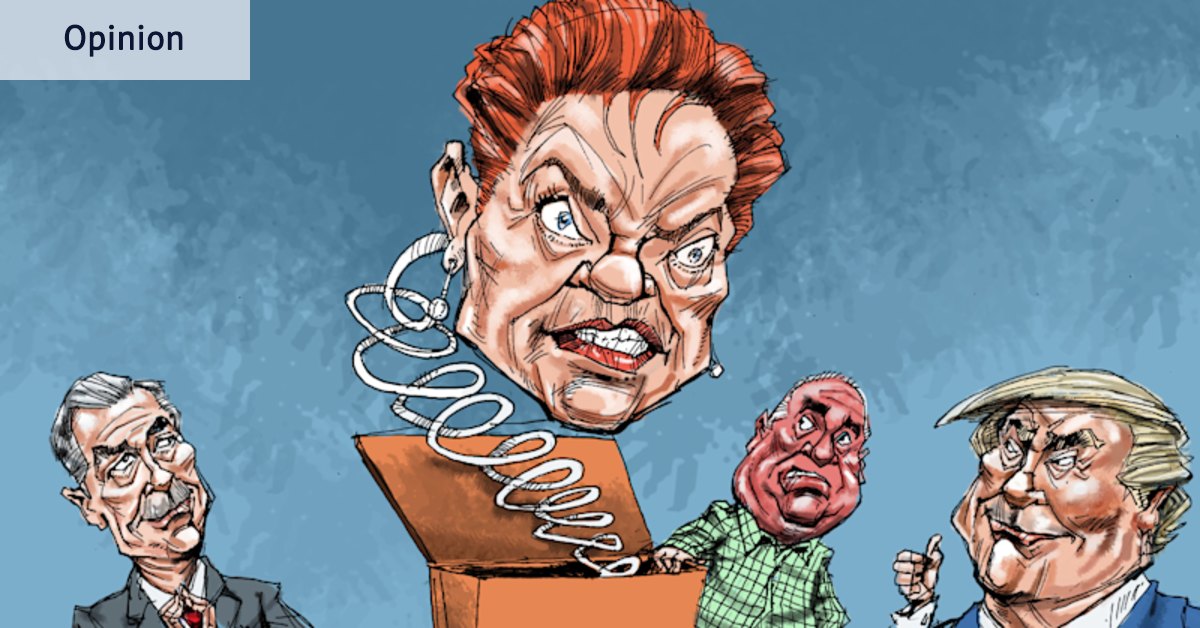
Just a few weeks ago it seemed the global far right had peaked. Viktor Orban had just been electorally smashed in Hungary and the Iran War disaster had made President Donald Trump a lame duck. Vladimir Putin was even starting to lose in Ukraine. How quickly things turn around. In the space of just three days, from Thursday to Saturday, the international populist revolt came thundering back in the form of Nigel Farage’s Reform Party and Pauline Hanson’s One Nation. The hard right populist revolt is Australia’s problem now. How should our democracy respond?
So far there have been two dominant approaches.
The first – the strategy of Liberal leader Angus Taylor and Nationals leader Matt Canavan – is to abandon the centre and follow One Nation rightward to poach its voters, or at least staunch the bleeding. If the more than 30 percentage point swing against the Liberals on Saturday is any guide, it’s not working. The British Tories tried something similar under a succession of failed leaders and it didn’t work there either. So far all it has achieved is what many moderate Liberals warned it would: legitimise voting for Hansonite extremism and push the Coalition parties into third or fourth place.
The second strategy, which dominates the progressive side, is for Labor to follow the Greens out to the left with a far more aggressive tax and redistribution platform, turning the battle into one between rich and poor – often framed in contemporary populist terms as a battle between the old and the young.
This second strategy isn’t without its attractions in this world of widening inequality. But it runs into some of the same objections as the first option. Where it has been tested on the electorate, it has proved highly unpopular. When made the centrepiece of Labor’s 2019 election platform, it produced disaster. Another objection might be added: the Australian Greens have employed this strategy for decades, are still a minor party, and don’t look like breaking through Zohran Mamdani-like any time soon. Their vote in Farrer also declined.
So, as American political scientists like to put the question nowadays: What might Labor’s theory of power be in these dangerous times when ugly populism is on the march?
In more normal times the ALP could take risks with more adventurous policies, safe in the knowledge that electoral defeat would see a return to the Coalition status quo ante. Unwanted certainly, but not morally catastrophic.
But in an age of populism, when defeat potentially means a MAGA-style One Nation government, with all the divisive and race-based politics that entails, staying in power is itself a progressive act and even a democratic responsibility.
We are living in a dangerous historical moment whose importance we should recognise. And in such times we need to learn from history.
The world has been in this situation before, where liberal democracy has to hold the line against ugly right-wing populists who want to burn everything down. In March 1930, Weimar Germany was governed by a grand coalition of centrist parties led by the Social Democrats – the rough equivalent of our modern ALP. Irresponsibly, that government split in a dispute over how to finance the rising cost of unemployment benefits. It seemed an important matter of principle at the time, but its practical effect was to hand power to democracy’s enemies at the precise moment the Nazi Party was on the rise. Within three years – one of our electoral cycles – Adolf Hitler was chancellor. Populism can triumph far quicker than we think.
The broad historical lesson is clear: in dangerous times you need to hold the electoral centre as you address populist concerns. And the rise of populism signals that our politics are changing, fast.
In recent years we could characterise Labor’s broad strategy as follows: with trust in government at an all-time low, keep your election promises moderate, then implement them to the letter once in government. No more, no less. This seems to be the broad lesson Keir Starmer took from Anthony Albanese’s 2022 victory.
In those now seemingly far-off times that strategy worked, but in the middle of a fast-growing populist revolt when angry voters are demanding urgent change, it seems far too flat-footed.
Labor needed something more dynamic than obstinately standing its ground on election promises, but also something more subtle than rushing off to the populist extremes of left or right.
In the seven years since its election defeat in 2019, electoral demographics have changed considerably and voters have become far more aware of the damage caused by our unbalanced housing market and rising cost of living. As a result, the centre has shifted moderately leftward and Labor has sensibly pushed out to fill it. And being in power, it can use the advantages of office to make the case for changing its election platform – as the Howard and Hawke governments also did in their day.
This strategy – of cautiously pushing outwards without abandoning the centre – provides a useful way to understand the politics of the 2026 budget, especially Labor’s moves in the direction of tax and housing reform.
Democratically speaking, it’s far from perfect, but when the alternative is losing support through inaction or excess action, and ceding power to MAGA-style populists, it may be the most democratic alternative there is.
Dennis Glover is a speechwriter who has worked for the Labor Party. His most recent book is Repeat: A Warning from History.
The Opinion newsletter is a weekly wrap of views that will challenge, champion and inform your own. Sign up here.


