





[ad_1]
Beijing: When Don Farrell sat down for a video meeting with his Chinese counterpart, Wang Wentao, in January, he had his three-year-old grandson Leo with him. It was the school holidays and the toddler was spending the morning in the Adelaide office of his grandad, Australia’s trade minister.
Grandchildren are the treasured heart of the Chinese family model, and grandparents are expected to play a hands-on role in raising them. On the call, Farrell introduced Wang to Leo, and the two men briefly swapped notes about their roles as grandparents before getting on with business.
Wang was reportedly so delighted by Leo that when the serious discussions had wrapped up, he asked for the child to come back on screen to wave goodbye and help “close” the meeting.

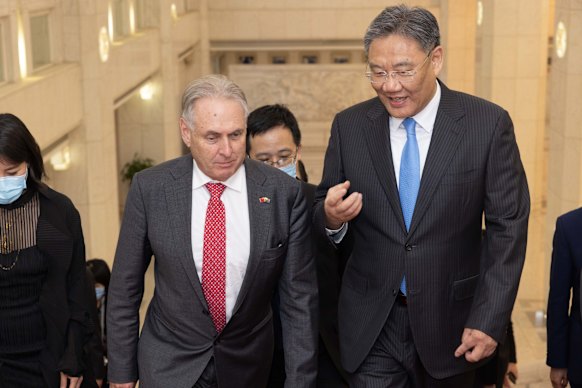
“What I’ve found in this job is that if you’re prepared to go that extra mile to establish a relationship with your counterparts, then you’re more likely to get a good result for Australian businesses and farmers and producers and miners,” Farrell says in an interview from Shanghai, where he met with Wang again this week.
It was the 14th meeting between the men, in person or via video – the most face time Farrell has had with any of his foreign ministerial counterparts since becoming trade minister in the Albanese government in 2022.
Their frequent catch-ups are one measure of how much trade ties have firmed since the deep freeze of the COVID-19 era. Back then, Coalition ministers couldn’t get their counterparts to pick up the phone after Beijing punished Australian exporters with $20 billion in sanctions, the last of which was removed only in 2024.
But personal rapport between ministers can only do so much. For Canberra, no relationship is more volatile than that with Beijing. China is Australia’s largest trading partner, accounting for $195.6 billion (about one-third) of exports in 2025. It’s also the main driver of our national security concerns, and the foremost rival to our closest security ally, the United States.
Farrell arrived in China this week at a time when the global trading system has been stretched to breaking point, while Australia, as a middle power, has found itself wedged between two capricious giants whose leaders have proven themselves willing to weaponise trade for their own ends.
A week earlier, Chinese leader Xi Jinping hosted US President Donald Trump in Beijing against a backdrop of a year-long feud in which they carved up global supply chains with tariffs and export controls, sending markets and businesses all over the world spiralling with the chaos.
With the trade tensions between the two countries playing out, Trump kicked off a war with Iran in February, triggering a global energy crisis.
“It’s fair to say that we are in a very challenging time in terms of world trade. The certainty that we have enjoyed since the post-war period isn’t there any longer, and we have to adapt and be nimble in a far more challenging set of circumstances,” Farrell says.
As for China, he says there are “plenty of opportunities” for Australian businesses, but adds, “we can’t rely [solely] on them. The world is unstable.”
Farrell was in China to attend the APEC trade ministers’ meeting, a prelude to the main summit in November in the Chinese tech capital of Shenzhen, where Prime Minister Anthony Albanese is expected to rub shoulders with Xi, Trump and other world leaders.
It will cap off a year in which Beijing has positioned itself as a global force for stability and a reliable trading partner in contrast to US-driven chaos – a message that will rankle with Australian businesses with long memories of the sanctions period.
The ongoing Strait of Hormuz crisis has served as another reminder of Australia’s vulnerable reliance on China, this time for 30 per cent of its jet fuel supplies. Unlike other countries, China quickly ordered its state-owned companies to stop exporting fuel supplies to bolster its own reserves, leaving Australia and other countries scrambling to negotiate access.

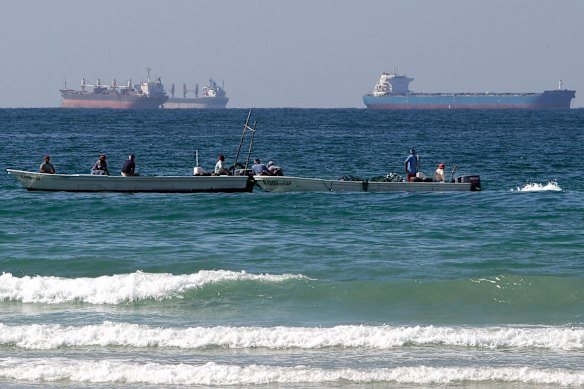
The federal government announced this week it had secured three shipments of jet fuel from China totalling about 100 million litres. Meanwhile, Australia’s liquefied natural gas exporters have continued to honour their supply obligations to Chinese buyers.
Farrell is not prepared to match Canadian leader Mark Carney’s bleak assessment – made first at the APEC summit in South Korea last year and repeated at the World Economic Forum in Davos in January – that this great power turmoil has put the global rules-based order and liberalised trading system on death watch.
Nor is he prepared to publicly question China’s newfound narrative as defender of the global trading system despite its history of economic coercion, saying: “I’m not the sort of person who dwells on the past.”
It’s part of the government’s low-volume strategy when it comes to frictions in the China relationship, leaving any harsh words behind closed doors, while talking up the positives. On the latter front, Farrell is the country’s chief salesman.
“Last year, our [two-way global] trade was a record $1.3 trillion. We’ve never, ever in our history done so much trade,” Farrell says.
Driving a large chunk of this is China’s demand for Australian iron ore, with export volumes at a record high despite softening prices, while agricultural exports are also at peaks.
China is primarily interested in buying what’s underneath our red soil and coastlines – iron ore, which alone counts for more than half of Australia’s exports to China, followed by LNG and gold.
But Farrell wants Australian businesses to drive harder into the Chinese market, seeing more opportunities for seafood, wine, dairy and the wellness and supplements industry.
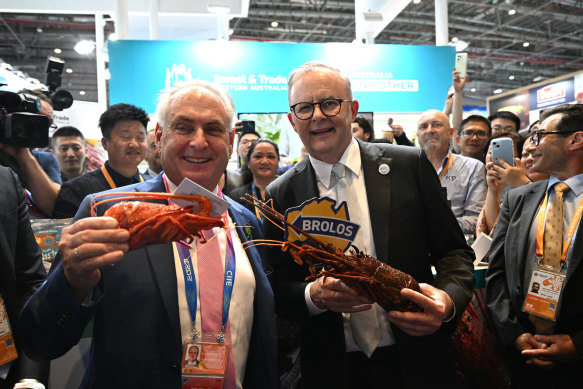
“We’re now selling more lobsters [by total value] into China than before the impediments had been imposed, and so it reflects the opportunities in this market in my home state of South Australia,” Farrell says, referring to Beijing’s sanctions that crippled the industry.
He adds: “I’ve learned the lessons of the past, and as I’ve said with the lobster people, I’m encouraging them to look for alternative markets.”
It’s a twin message that can seem contradictory. It is also one that unnerves China hawks who have argued the sanctions era showed that trade and national security were intrinsically fused and have called for greater de-risking from the Chinese market.
As for the lobster industry, it has diversified to some extent. In 2020, when the sanctions hit, China was buying more than 90 per cent of Australia’s live lobsters. That figure had dropped to 76 per cent by 2025 as other countries upped their purchases, although it remains heavily exposed to Beijing.

Economist James Laurenceson, director of the Australia-China Relations Institute at the University of Technology Sydney, says ultimately businesses won’t take their cues from Canberra, but will make their own risk assessments.
“Australian companies are ploughing back into China, not because they’re naive, but because they’re actually just pretty confident that they can handle the risk,” Laurenceson says.
Many of the industries targeted by Beijing’s sanctions were able to find new markets, he says, with Australian coal, cotton and barley, for example, snapped up on the global market.
In two weeks, Farrell jets off to Paris for another series of economic meetings where he is set to have a pull-aside with US Trade Representative Jamieson Greer, one of the chief architects of Trump’s sweeping tariffs that failed to spare Australia.
It’s all part of a tightrope that Farrell must walk in a rupturing trading system, where the universal currency is transactionalism and self-interest.
Get a note directly from our foreign correspondents on what’s making headlines around the world. Sign up for our weekly What in the World newsletter.
[ad_2]

