









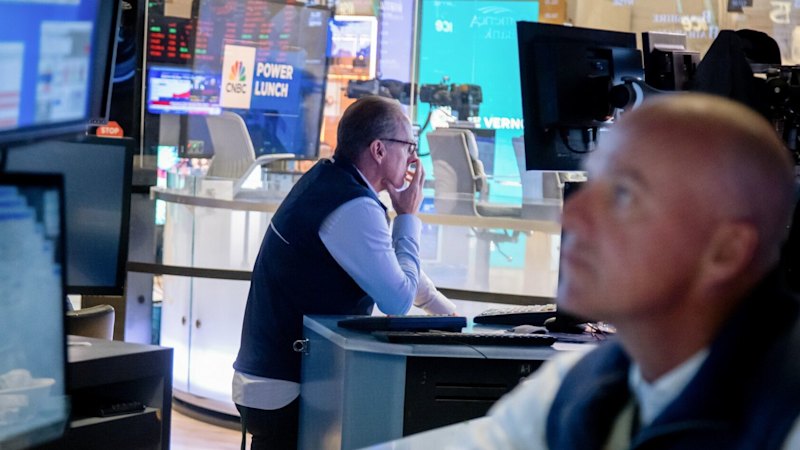
Stocks look to be in their most vulnerable position since their April lows given how much complacency has built up and how the rubber band recently has been “as stretched as it gets in some parts of the market,” Krinsky wrote in a research report.
Wall Street’s ultimate hope is that the US economy stays in a delicate balance where it’s slow enough to convince the Fed to cut rates but not so weak that it leads to a recession.
Treasury yields ticked higher in the bond market as traders pared bets for the number of upcoming cuts to rates by the Fed. The yield on the 10-year Treasury rose to 4.18 per cent from 4.16 per cent late Wednesday. The two-year Treasury yield, which more closely tracks expectations for the Fed, climbed more sharply.
One of Thursday’s better-than-expected economic reports said that fewer US workers filed for unemployment benefits last week. That could be a signal that the pace of layoffs is slowing.
Another report said the US economy grew at a stronger pace during the spring than earlier thought, while a third said orders blew past economists’ expectations last month for US manufactured goods with a relatively long life span.
On Wall Street, CarMax tumbled 20.3 per cent after the seller of used autos reported a weaker profit for the latest quarter than analysts expected. It sold fewer vehicles during the quarter than it had a year earlier. It also was hurt because it increased its expectations for losses from loans made in earlier years.
Amazon lost 1.3 per cent after it was announced the online behemoth will pay $US2.5 billion ($3.8 billion) in fines and reimbursements to Prime subscribers to settle the Federal Trade Commission’s allegations that it deceived its customers to generate subscriptions, the FTC said on Thursday.
While a win for consumers and the FTC, the settlement is relatively painless for Amazon: the company takes in around $US2.5 billion in sales every 33 hours.
Around 35 million Prime customers will be eligible for payout from a $US1.5 billion fund, the FTC said. Amazon will pay $US1 billion in fines to the FTC.
Jabil fell 6.6 per cent even though it reported a stronger profit for the latest quarter than analysts expected, thanks in part to demand coming because of artificial intelligence.
It also gave forecasts for upcoming revenue and profit that topped analysts’ expectations, moves that typically send a stock’s price higher. But Jabil came into the day with an already huge gain of 56.6 per cent for the year so far, more than quadruple the S&P 500’s big gain of its own.
Loading
Another AI winner, Oracle, gave back 6.4 per cent. Earlier this month, it surged to its best day since 1992 after announcing several huge contracts signed because of AI.
Starbucks slipped 1.5 per cent after the coffee chain announced a $US1 billion ($1.5 billion) plan to restructure, including the closure of stores and the cutting of 900 non-retail jobs.
On the winning side of Wall Street was IBM. It rose 4.7 per cent after HSBC announced a promising trial with IBM of quantum computing in hopes of improving bond trading. The bank said they delivered an improvement of up to 34 per cent in predicting how likely a trade would be filled at a quoted price.
Companies are racing to develop quantum computing in order to solve complex problems beyond the reach of classical computers.
KB Home rose 0.7 per cent after the homebuilder reported stronger profit for the latest quarter than analysts expected. CEO Jeffrey Mezger said he was encouraged to see mortgage rates ease through the quarter, which could encourage more potential customers to buy homes.
Mortgage rates have been sinking on expectations for coming cuts to rates by the Fed.
In stock markets abroad, indexes fell in Europe following a more muted finish in Asia.
AP, Bloomberg


