


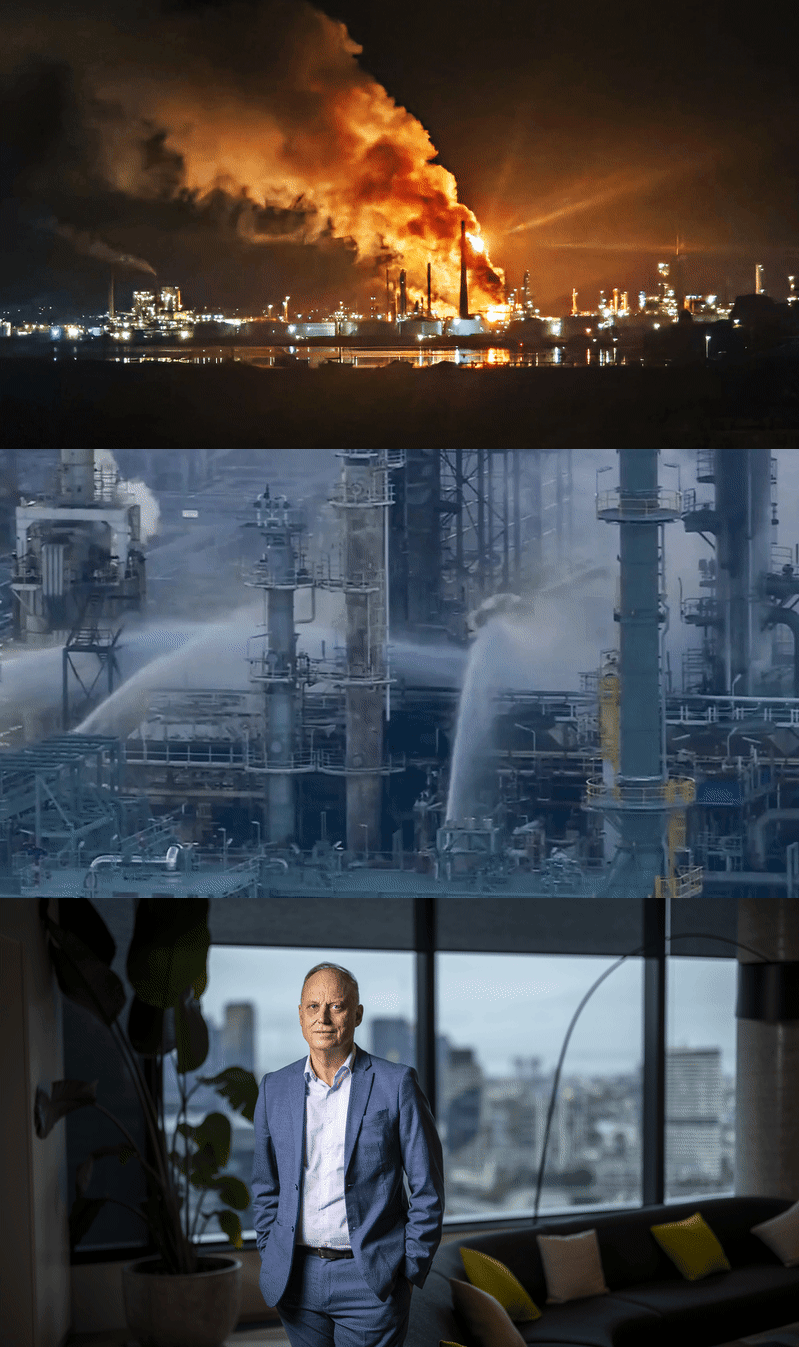
It was getting close to midnight on Wednesday, April 15, and Scott Wyatt was still on the phone. As the head of Viva Energy, one of Australia’s top fuel suppliers, his job of keeping petrol and diesel flowing in the middle of a global oil shortage had become a relentless pursuit. Workdays rarely ended at sunset. Calls were running long into the evenings.
On this night he was talking to Bill Patterson, one of his top lieutenants. They were going through the final details for the purchase of 100 million litres of extra diesel, split across two giant fuel tankers from Brunei and South Korea.

Then suddenly the line fell quiet. Patterson saw he was getting another call – it was coming from the night shift at the company’s Geelong oil refinery and he had to answer right away. A “major alarm” had gone off inside the heart of the complex.
Early details on the ground were still thin. But when Patterson got back on the phone to Wyatt he said a fire had broken out in the alkylation unit, a critical part of the section that produces petrol. “That was really enough to know it was a serious incident,” Wyatt recalls. “Bill hung up and was heading down there; I grabbed some clothes and jumped in the car to get there as well.”
Fires are an ever-present occupational hazard at oil refineries due to the inherent risks involved in processing and storing highly flammable hydrocarbons. But the timing of this blaze amid the chaos caused by the closure of the Strait of Hormuz was uniquely troubling.
Fortunately, Wyatt quickly received the update that would ease his biggest fear: no one had been harmed, everyone was accounted for. “The primary relief was around the fact that all our people were safe,” he says. “You can rebuild assets; you can’t rebuild people.”
Still, at a time of heightened sensitivity around the precarious state of Australia’s energy security, he was under no illusion that any damage to this particular asset – impairing the nation’s already-limited capacity to produce its own fuel – could have potentially disastrous consequences.
The Geelong refinery, west of Melbourne, is the last one left in Victoria, and one of just two remaining in Australia, following a wave of closures that has left the nation 80 per cent reliant on fuel imports in an increasingly volatile global market.

Before leaving home, Wyatt sent a text message directly to Chris Bowen, Australia’s energy minister, to convey what he knew so far. Prime Minister Anthony Albanese, who was in Malaysia at the time, decided to fly home earlier than expected.
“People were going to be concerned about the incident but also what it means for fuel supply,” Wyatt says. “We didn’t have all the answers to that at the beginning.”
As the war in Iran continues draining the world’s supply of oil without a clear path to resolution, the economic stakes of the incident could hardly have been higher. Before the fire, Viva’s Geelong refinery and Ampol’s Lytton refinery in Brisbane had both been running at their absolute maximum output rates to pump as much fuel into the local market as possible and head off the threat of shortfalls. The Geelong plant had been processing 120,000 barrels of crude oil into millions of litres of petrol, diesel and jet fuel each day, accounting for 50 per cent of Victoria’s daily fuel usage and 10 per cent of the national total.
By the time Wyatt reached the refinery gates it was about 3am, and the night sky was orange. Dozens of firefighters were battling the blaze, including from Fire Rescue Victoria and Viva’s own workforce. As chief executive, Wyatt’s primary role for the coming hours was to support the team where possible and begin engaging with stakeholders and managing concerns of the broader community. The first call he received in the morning was from Bowen.
As the sun rose over Corio Bay the blaze was yet to be extinguished and the smoke had not yet cleared. But one thing was immediately clear: the impact of the fire could have been a lot worse.
Firstly, the flames had been contained to a single unit in the gasoline complex, while another had been taken offline until operations stabilised. The damaged alkylation unit, which processes gases into a component needed in petrol, is important but the refinery can operate at “pretty much full production” without it. “Our team had responded incredibly well and had done all the right things to contain the fire to the smallest area possible,” Wyatt says. “The last thing you want is for it to spread.”
His second reason for relief was the knowledge that the refinery’s only longer-lasting production impact would be for petrol output, while the plant would soon be able to return its production of diesel and jet fuel – the two products that are in the shortest supply across the Asia-Pacific region – to near-maximum levels. So far, during the current oil shock, petrol has remained well-supplied in the region, and importers can access additional petrol supplies from the US if needed.
The extent of the refinery’s production cuts would also not be as deep as some at the company had first feared. While the plant had wound back to minimum output rates while damage assessments were carried out, within 48 hours it was able to safely return to 60 per cent of its petrol production volumes, and 80 per cent for diesel and jet fuel, with a path to further ramp back up to above 90 per cent of the plant’s total maximum output within weeks.
Viva Energy, which typically supplies about 30 per cent of Australia’s overall fuel from the Geelong refinery and via its network of import terminals scattered along the coastline, has sufficient fuel stocks to cover the short-term drop-off. Wyatt says any longer-term gaps could be comfortably bridged by increasing imports from overseas supplies.
“There is no reason to worry from a fuel supply perspective,” he says. “I can understand why people are concerned about what they see in the Middle East but sitting behind it all are supply chains that continue to run very well.”
Albanese, speaking alongside Wyatt and Patterson at the refinery on the Friday after the fire, praised the emergency response and welcomed Viva’s ongoing supply assurances.
“We all saw the visuals of what was a serious fire,” he said. “The fact that 80 per cent of diesel is continuing and 80 per cent of jet fuel is continuing as well … is very positive going forward.”
Some energy analysts have warned the output cuts may increase the risk of the government having to move to the next stage of its fuel-saving strategy, which could include directing fuel to priority areas, promoting voluntary measures such as carpooling or working from home, and further releases from strategic reserves. However, Albanese has rejected that suggestion outright.
“The event here will not lead to any change,” he said.
While the Geelong fire may look like a crisis averted, it has reignited debate about Australia’s long-term resilience to fuel security risks.
Australia’s fuel industry is well-equipped to meet demand 99 per cent of the time but it is not designed to deal with “black-swan events like we are currently going through”, Wyatt says. Once the current supply crunch is over, he believes the federal government will need to consider whether a larger buffer is needed to protect Australia from extremely rare disruptions in the future. “It will be an absolutely critical conversation to have,” he says.
For now, fuel shipments are continuing to arrive in Australia, the federal government is paying whatever it takes to buy up more, local refineries are delivering all they can, and more than a month’s worth of supply is still being held in strategic storage tanks.
While the nation’s stockpiles are the highest they have been for more than a decade, they remain below where some argue they must be. Australia also remains in breach of an International Energy Agency requirement for member countries to hold emergency fuel reserves equal to 90 days of net imports.
Wyatt believes fuel storage will have to be a “bigger part of the solution”.
“These past eight weeks have enlivened everybody to the dependence we have on fuel for our way of life,” he says.
The Business Briefing newsletter delivers major stories, exclusive coverage and expert opinion. Sign up to get it every weekday morning.
