







Luke Broadwater and Zachary Small
Washington: During his first term, US President Donald Trump visited the Arc de Triomphe in Paris to attend a commemoration of Armistice Day, which marked the end of World War I. The memory of the arch stayed with him, and eight years later, he is determined to surpass it.
“The one that people know mostly is the Arc de Triomphe in Paris, France, and we’re going to top it by, I think, a lot,” Trump said in December of his plans to build his own triumphal arch in Washington. “The only thing they have is history.”
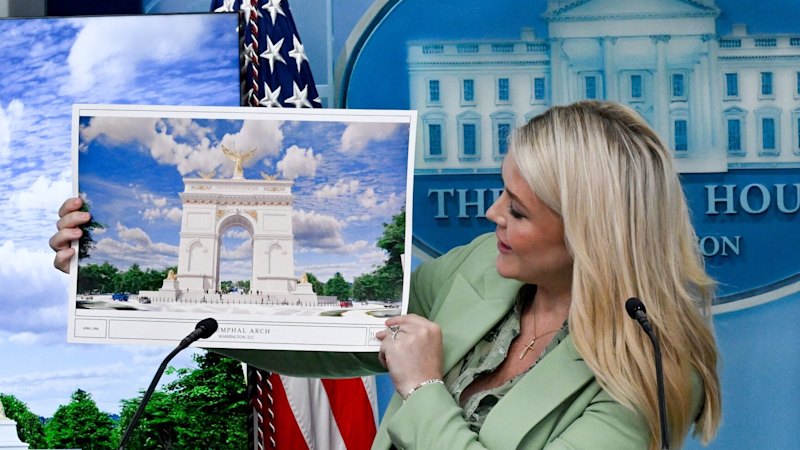
Trump now wants to build a 76 metre-tall arch on the other side of the Potomac River from the Lincoln Memorial.
If it is approved as drawn, with statues on top, it will be 50 per cent taller than the Arc de Triomphe.
Trump’s push to build the giant arch – more than quadrupling its size from original plans – has alienated early proponents of the project, classical architects and veterans groups who say it will diminish nearby Arlington Cemetery.
It has even alarmed Catesby Leigh, an architecture critic who encouraged Trump to build a triumphal arch, most recently in a 2025 article in The American Mind, an online magazine of the Claremont Institute, a right-wing think tank.
“Washington is the only major Western capital without a monumental arch,” Leigh wrote. He cautioned that the arch need not be “huge” and should stand no taller than about 20 metres.
But that was before the idea made its way to Trump, who has rarely met a project he didn’t think should be bigger.
The Commission of Fine Arts, which is filled with Trump’s appointees, on Thursday (Washington time) gave preliminary approval to the arch, though the panel’s vice chair suggested significant changes, including losing the statues of golden eagles and a winged angel atop the structure that add more than 24 metres to its height.
The commission has an advisory role, but no enforcement power. It asked the administration to return with updated drawings before a final vote on the project.
At first, the arch proposal grew modestly, to 76 feet (23 metres), to symbolise the year of America’s founding: 1776.
But soon enough, Trump was insisting his arch be taller than the Arc de Triomphe, which is about 50 metres tall. Eventually, the president settled on the idea that the arch should rise to 250 feet (76 metres), to celebrate America’s 250 years, making it what is believed to be the tallest triumphal arch in any of the world’s capitals.
Some classical architecture proponents, including Leigh, were surprised by the scale.
“I was proposing a celebratory project,” Leigh said. “An arch of not titanic dimensions; an arch that could be built by July 4, 2026. And if the arch were considered to be of enduring value in its design, then it could be rebuilt in permanent form.”
“It’s way too big for that site,” Leigh added, referring to the grassy roundabout that sits near Arlington Cemetery.
Ancient civilisations often built grand arches to commemorate their military or civic achievements. The Romans decorated their cities with arches to celebrate imperial conquests like the sacking of Jerusalem. The French originally commissioned the Arc de Triomphe to symbolise Napoleon’s military victories.
But when a CBS reporter asked Trump last year whom the monument was for, he pointed to himself and answered: “Me.”
Karoline Leavitt, the White House press secretary, said on Wednesday that the arch would celebrate “the enduring triumph of the American spirit”.
“Great nations build beautiful structures that cultivate national pride and love of country,” she said, “and this triumphal arc should be a project that all Americans of all political persuasions can support.”
‘A rude interruption’
The story of how the arch grew by leaps and bounds follows a now-familiar pattern in Trump’s Washington. Across his administration, the president has empowered classical architects, who argue that federal buildings should emulate the grandeur of ancient Greek and Roman structures. He has appointed them to important boards and commissions, and signed an executive order to “Make Federal Architecture Beautiful Again”.
But once a proposal gets in the hands of the president himself, he typically adds on his signature style, insisting that it grow in size and gilding parts of the structure.
Trump clashed with James McCrery II, the original architect of the president’s planned $US400 million ($560 million) ballroom, who objected to the ballooning size of the project.
McCrery is the vice chair of the fine arts commission who on Thursday suggested removing the statues from atop the arch. “I wonder if you need those up there,” McCrery asked, suggesting it might be “even a better, more Washingtonian design” without the statues.
Thomas Luebke, the panel’s secretary, said that it had received nearly 1000 messages from the public about the arch. “One hundred per cent of the comments were against the project,” he said.
But Rodney Mims Cook Jr., the panel’s chair, called the president’s idea “beautiful”.
“The president wants to do something that in his heart he feels is good,” Cook said.
While the commission has signed off on Trump’s ballroom, the project is embroiled in a court battle over whether it can be built without the approval of Congress.
The arch is facing a similar legal fight. A group of Vietnam War veterans has sued to stop its construction, citing congressional authority and arguing that the arch would obstruct the view between the Lincoln Memorial and Arlington National Cemetery.
“The cemetery is supposed to be doing the speaking,” said Calder Loth, the retired senior architectural historian for the Virginia Department of Historic Resources, who is one of the plaintiffs in the suit. “This arch is just a rude interruption. No matter what you may think of it aesthetically, it just is the wrong place for it.”
He added: “It’s too gaudy with too much gold ornament on it, but that’s the style of the current administration.”
The architect designing the monument, Nicolas Leo Charbonneau, helped conduct research for Leigh’s papers proposing the arch. Charbonneau briefly worked for McCrery, as well.
Charbonneau’s design gained the president’s attention because of its ornamentation, including gold eagles and lions. The architect also presented a physical model of his design to Trump, while another competitor for the project – who lost out – proposed a smaller, less decorative arch with an image rather than a 3D model.
The president has put Vince Haley, the director of the Domestic Policy Council, in charge of the project. The council’s director normally is tasked with developing a president’s domestic agenda and advising presidents on issues ranging from education to health care policy.
Plans and obstacles
The popularity of the triumphal arch reached its peak in America in the early 1890s, when New York unveiled two memorable structures: the Soldiers’ and Sailors’ Arch in Brooklyn’s Grand Army Plaza and the Washington Square Arch in Manhattan.
But other projects continued into the 1900s, including the National Arch in Valley Forge, Pennsylvania, which commemorates Revolutionary War heroes. The country largely left the style behind when it entered the 20th century and designers started looking for other ways to commemorate war heroes and soldiers’ sacrifices.
There have only been a handful of triumphal arches built in recent decades, with most rising in countries including Indonesia, North Korea and Iraq.
There are still many questions about the arch’s path to being built. The Trump administration has not released a budget or even a cost estimate for the project.
The president has suggested donors could pay for the arch, but documents show that the National Endowment for the Humanities, an independent federal agency, is reserving $US15 million for the project. The overall cost is likely to be much higher.
A White House official said that the cost of the arch was still being calculated but that it would likely be paid for through a mix of public and private money. The administration anticipates breaking ground on the site this summer with construction completed before the end of Trump’s term.
There is also the question of whether the administration will seek congressional approval for the project.
Loth and other plaintiffs in the lawsuit against the arch’s construction maintain that Trump cannot build it without the authorisation of Congress. They cite the Commemorative Works Act of 1986, which details a multistep process for authorising and designing commemorative works in the District of Columbia and says any such work must be “specifically authorised” by Congress.
But in legal documents, the Trump administration has argued that congressional actions in the 1920s connected to the design of the Arlington Memorial Bridge already give it the legal right to build the arch.
Congress at the time authorised “construction of two tall columns surmounted by statues on Columbia Island”, the administration wrote in court documents. “Although those columns have not yet been built, the statutory authority to build them remains.”
Supporters of the arch insist the plan is sound. In the conservative publication The Federalist in February, writer Joseph Wozniak said the backlash was “merely predictable given that critics have long panned President Trump’s penchant for classical architecture”.
This article originally appeared in The New York Times.
Get a note directly from our foreign correspondents on what’s making headlines around the world. Sign up for our weekly What in the World newsletter.


