


US President Donald Trump has warned Iran to make a deal or reopen the Strait of Hormuz within 48 hours before he unleashes “all hell”, as an American airman remains missing behind enemy lines.
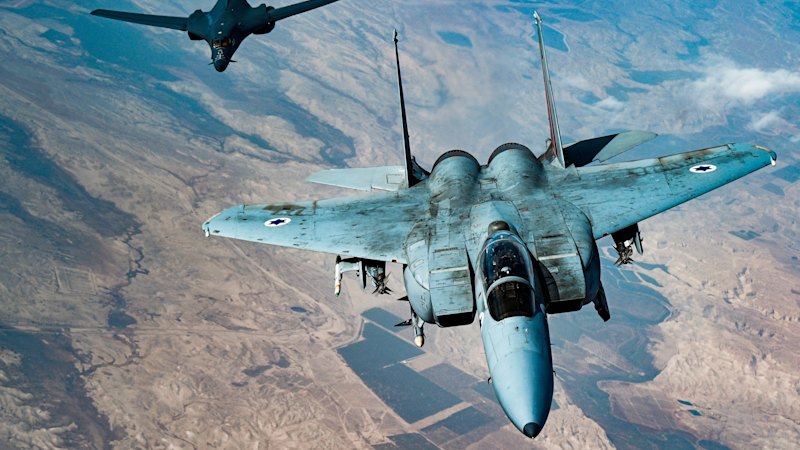
One airman was rescued after a US F15-E Strike Eagle fighter jet was shot down by Iran, as the regime scored an exceedingly rare success against US air power.
The downing of an F15-E, which carries a two-member crew and can conduct air-to-ground and air-to-air missions, has highlighted the Islamic republic’s continued ability to hit back despite Trump’s assertions that it has been “completely decimated”.
In a post on Truth Social on Saturday (US time), Trump reminded Iran of the 10-day extension he made in late March to his threat to bomb Iranian power plants unless the critical oil route reopened.
“Remember when I gave Iran ten days to MAKE A DEAL or OPEN UP THE HORMUZ STRAIT,” Trump wrote. “Time is running out – 48 hours before all Hell will reign [sic] down on them. Glory be to GOD!”
The rescue of the downed airman occurred as the US military was conducting a search and rescue operation, said three people familiar with the matter who spoke to the Associated Press on condition of anonymity to discuss the sensitivity of the situation. Israel is helping the US with the operation.
Iran’s Revolutionary Guard Corps said it was combing an area near where the pilot’s plane came down in south-western Iran, and the regional governor promised a commendation for anyone who captured or killed “forces of the hostile enemy”.
A US Air Force UH-60 Black Hawk helicopter was badly damaged by Iranian ground fire during the rescue operation, but it managed to fly to safety in Iraq.
Meanwhile, Iranian state media also said that a US A-10 attack aircraft crashed after being hit by Iranian defence forces. The A-10 crashed over Kuwait, with the pilot ejecting, two US officials told Reuters.
White House press secretary Karoline Leavitt said, “President Trump has been briefed.”
Iran’s parliamentary Speaker Mohammad-Bagher Qalibaf mocked the US after his country shot down the US F15-E.
“This brilliant no-strategy war they started has now been downgraded from ‘regime change’ to ‘Hey! Can anyone find our pilots? Please?’ ” Qalibaf wrote on his X account.
The last time a US fighter jet was shot down in combat was an A-10 Thunderbolt during the 2003 US invasion of Iraq, said retired Air Force Brigadier General Houston Cantwell, a former F-16 fighter pilot.
But, he said, that’s because the US had largely been fighting insurgents who didn’t have the same anti-aircraft capabilities. The fact that there have not been more fighter jets lost in Iran, Cantwell said, is a testament to the capabilities of US forces.
“The fact that this hasn’t happened until now is an absolute miracle,” said Cantwell, who served four combat tours and is now a senior resident fellow at the Mitchell Institute for Aerospace Studies. “We’re flying combat missions here, they are being shot at every day.”
US Central Command said in a statement on Wednesday that American forces have flown more than 13,000 missions in the Iran war while striking more than 12,300 targets.
After more than a month of punishing US-Israeli airstrikes, a degraded Iranian military nonetheless remains a stubborn foe. Its steady stream of strikes against Israel and its Gulf Arab neighbours have been causing regional upheaval and global economic shock.
When it comes to American dominance over Iran’s airspace, there’s still a distinction between air superiority and air supremacy, said Behnam Ben Taleblu, Iran program senior director at the Foundation for Defence of Democracies, a hawkish Washington think tank.
“A disabled air defence system is not a destroyed air defence system,” he said. “We shouldn’t be shocked that they’re still fighting.”
American planes have been flying missions at lower altitudes, which makes them more vulnerable to Iran’s missiles, Taleblu said. It’s possible that Iran fired at the F-15 with a surface-to-air missile, but it’s more likely that a portable, shoulder-fired missile was used, he said. Those are much harder to detect and reflect how Iran is “weak but still lethal”.
“This is a regime that is fighting for its life,” he said.
The war, now entering its sixth week, is destabilising economies around the world as Iran responds to the US and Israeli attacks by targeting the Gulf region’s energy infrastructure and tightening its grip on oil and natural gas shipments through the Strait of Hormuz.
However, a container ship owned by a French maritime company reportedly passed through the waterway on Saturday (Australian time), making it the first European vessel to do so since the war broke out.
The container ship, the Kribi, flies the Maltese flag and is owned by French company CMA CGM. A liquefied natural gas tanker co-owned by Japanese and Omani companies has also passed through, marking the first passage of a Japan-affiliated vessel through the waterway since the start of the war, Japan’s NHK public television said.
The Japanese shipping company Mitsui O.S.K. Lines said the Panamanian-flagged tanker Sohar LNG, also owned by Oman Shipping Company, crossed the strait on Friday (Australian time).
Iran has so far managed to keep attacking targets across the region. Authorities in Dubai said the facades of two buildings were damaged by debris from intercepted drones, including one belonging to the US tech firm Oracle. No injuries were reported.
The Abu Dhabi government media office said on Friday (US time) that one Egyptian national was killed in fires caused by falling debris at Habshan gas facilities, following the interception of an Iranian aerial attack. Another four expats, including two Egyptians and two Pakistanis, sustained minor wounds.
The Kuwaiti army’s air defences have also had to engage with seven ballistic missiles, two cruise missiles and 26 drones over the past 24 days, according to a statement.
AP, Reuters
Get a note directly from our foreign correspondents on what’s making headlines around the world. Sign up for our weekly What in the World newsletter.
