


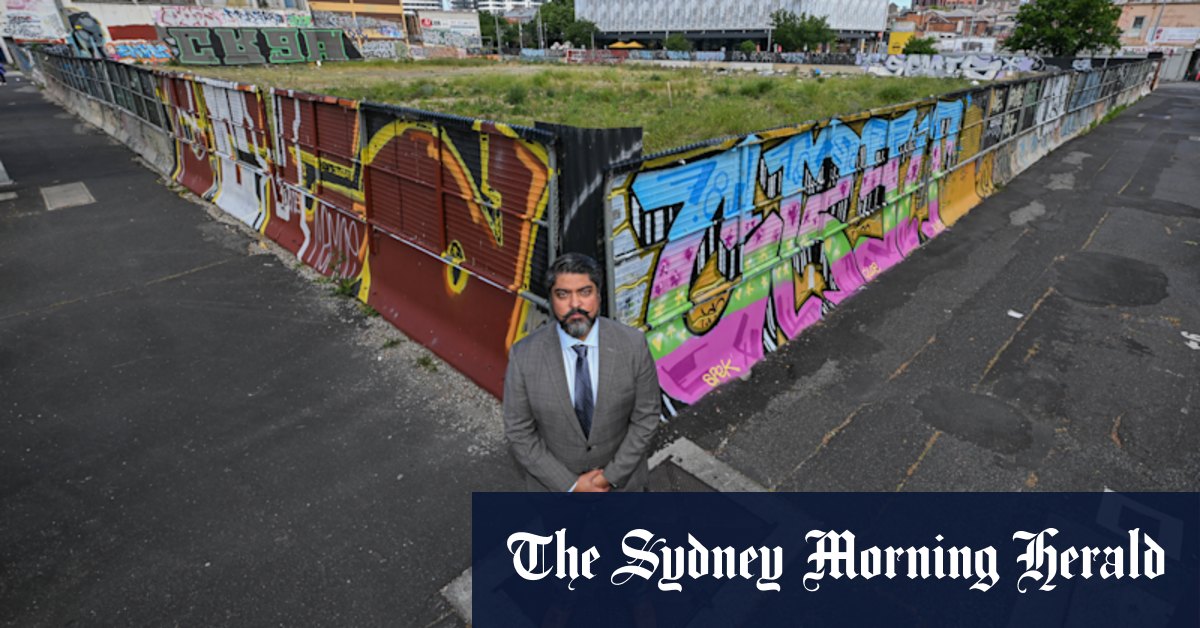
Haddock said more housing would support key workers at the $1.5 billion Footscray Hospital, due to open next year.

Maribyrnong City Council chief executive Celia Haddock.Credit: Elke Meitzel
“We’ve got all of these empty sites across the city, and we’ve got the hospital opening in February next year, and we’d love to be able to house all the staff in Footscray so they can walk to work.”
Peter Tulip, chief economist at the Centre for Independent Studies, said property owners could sit on sites they had a permit to develop for a host of reasons: the permit could be for medium-density housing, on a site they judged to be better suited to high-density housing.
“It doesn’t make sense to put up a four-storey block of flats if in five years’ time you get a bulldozer to put up 20 storeys,” Tulip said.
Another reason could be that the approved development was no longer financially profitable, but Tulip said this was rarely the case in inner Melbourne.
In its report, Western Growth: Unlocking Melbourne’s Economic Engine, WoMEDA identified landbanking as one of the biggest barriers to business investment in the western suburbs.
Landbanking is hampering housing supply, the alliance argues.
“This has been driven sometimes by anti-competitive behaviours, sometimes by profit. It is preventing the release and use of land for residential, commercial and agricultural purposes,” the report says.
It says more research is required on whether a carrot or a stick, such as a tax, would be the best way to deal with the practice.
Tulip, who is based in Sydney, said the NSW Housing Development Authority had brought in “use it or lose it” rules that set a five-year expiry date on permits.
Linda Allison, chief executive of the Urban Development Institute of Australia Victoria, said developers were finding it challenging to make apartment projects stack up in Melbourne, even in a prime location such as Footscray.
Few would see landbanking as a positive strategy, she said.
“A developer sitting on a site, paying a lot of holding costs – when you think about all of the land tax and vacant land taxes – is not where property developers want to be,” Allison said.
Loading
“They want to be developing sites. So I would suggest that it’s more to do with making it stack in terms of what’s the highest and best purpose for that land.”
Allison said it was worth investigating why the heart of Footscray was failing to thrive.
“On paper, they’re fantastic sites,” she said. “Proximity to the city, it’s a vibrant and growing part of Melbourne … And the most common answer I get from industry is that the feasibility just doesn’t stack up, and a big part of that is the tax component.”
Maribyrnong Mayor Pradeep Tiwari said Footscray was transforming, with the support of public and private investment.
The council was also progressing its Creative West project, which includes a 500 to 700-seat performing arts centre, a contemporary library, arts and cultural spaces, and a large outdoor civic area for community events and activation, Tiwari said.
Start the day with a summary of the day’s most important and interesting stories, analysis and insights. Sign up for our Morning Edition newsletter.
