








Opinion


Last week, a newly elected MP took to his feet to deliver his maiden speech to the South Australian parliament. In several ways, it was exactly what you’d expect of the occasion. A history of his formative life experiences, heartfelt thanks for people who helped him along the way. Then, about 15 minutes in, he broke down in tears as he thanked his partner, the “love of my life”, a man named Rhisang.
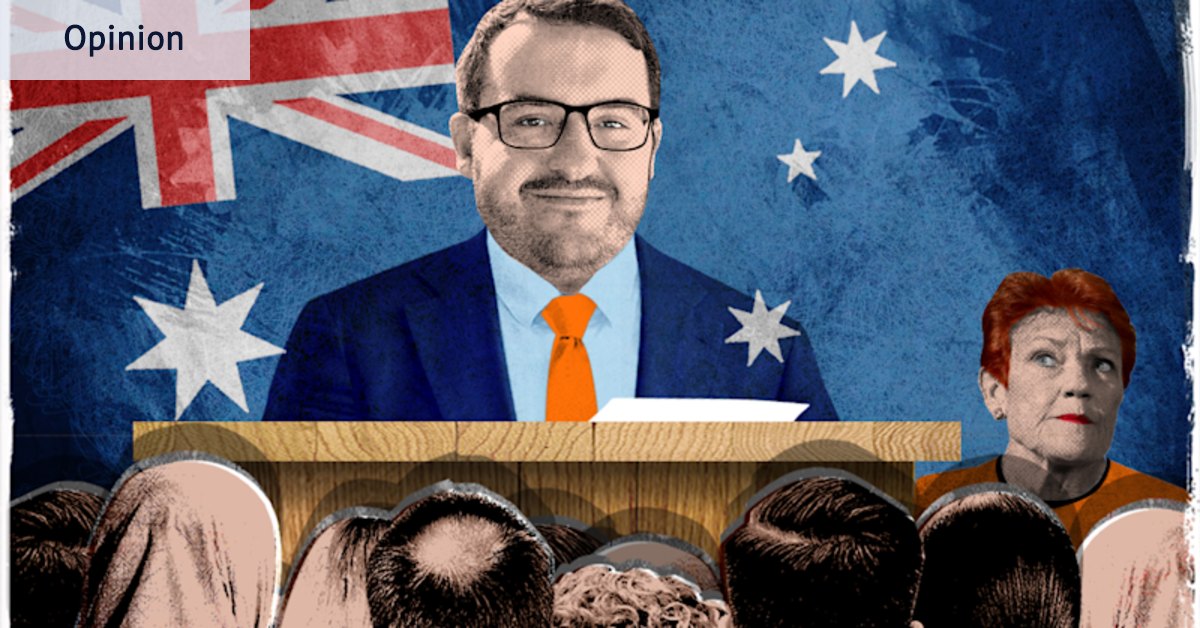
“Rhisang was born in Indonesia, a Muslim, and is now a proud Australian. Our closest friendship circle is made largely of immigrants from China, India and the Philippines.” He paused, took off his glasses, and wiped his eyes as he sniffed. Then he continued, thanking his partner’s family, and said: “I love migrants. The overwhelming majority are simply searching for a better life.” Then, about two minutes later: “Thank you to Senator Hanson, who created this movement”. Meet Jason Virgo MP. The One Nation member for MacKillop.
That’s a lot to process. I’ll give you a moment.
Immediately, I thought of Rod Culleton. He was very briefly a One Nation senator for Western Australia – part of the cohort that brought the party back to parliament in 2016. Culleton lasted a tick over six months before the Federal Court ruled he was bankrupt and therefore ineligible to be in parliament. But that was long enough for him to do an interview in which he shared his thoughts on multiculturalism: “I wouldn’t say it’s failed. I respect multiculturalism. You know, I’ve married a very beautiful Greek woman and her family love me like a son.”
That, in turn, sounds a little like Sarah Game, the first One Nation candidate elected to the South Australian parliament in 2022. Her maiden speech declared her support for “genuine refugee intake”, acknowledged that “immigration has enriched our culture and skill base”, and celebrated her oma’s “thick Bavarian accent” which she kept after migrating to Australia as an 18-year-old. “I believe in people’s right to maintain their culture and belief practices in Australia in a way that fosters a unified Australia, good relationships and respect between everybody,” she said.
Game quit One Nation and became an independent a year ago. Culleton found time in his fleeting innings to do the same, only some 5½ months in. This has often been the fate of members of protest parties. Jacqui Lambie, you’ll recall, defected from the Palmer United Party. That eventually begat the Jacqui Lambie Network, whose senator Tammy Tyrell declared herself independent in 2024, and this year joined Labor. The effect was even more pronounced in the Tasmanian parliament, where Lambie expelled two of her three MPs elected in 2024 over irreconcilable differences. She’s pledged not to run candidates in Tasmanian politics again.
That’s what happens with politics borne of disaffection. It’s altogether different to build a party the way the majors did in the 20th century, through deep coalition building. That means they proceed from the politics of assent. The politics of dissent, however, is much more volatile because it’s not the result of cultivated constituencies, or stable social groupings.
What might this augur for One Nation, whose surging support is now real and sustained? Jason Virgo only gave his maiden speech because polls turned into votes in South Australia. The Farrer byelection showed this could become a high primary vote, too. An Essential poll this week has One Nation a mere point behind Labor in the aftermath of the federal budget. Does this suggest One Nation may have become something more than its motley predecessors? That as it grows, it might be less vulnerable to disintegration?
Virgo’s speech points to interesting times. His party leader in South Australia is Cory Bernardi, an arch-conservative culture warrior. It’s hard to imagine him singing in harmony with Virgo, who campaigned busily for same-sex marriage, and noted in his maiden speech that his new seat voted Yes in that plebiscite. But Virgo is not quite Culleton, either. Culleton was a political novice. Virgo began his political life in the Labor Party, then ran twice as a candidate for the Sex Party. For the past three years, he’s been on the Mount Gambier City Council.
Virgo’s views are also more aligned with One Nation policy than Culleton’s were. He is sceptical of the renewable energy agenda. He thinks Australia has been taking too many migrants, and thinks those who come should respect the Australian way of life. But he also acknowledges some parts of the country are crying out for migrants. He seeks a “nuanced debate” on this.
But Virgo’s clearest ambition appears to be to undo our “broken two-party system”. He has taken to calling the major parties “the uniparty”, and says the people of MacKillop “are sick and tired of being taken for granted or ignored” by parties that “either thought they couldn’t win, or they couldn’t lose”. This, surely, is the central One Nation message: the point where party and electorate meet. Polling consistently shows anger at the established parties is the No.1 reason for One Nation’s support by some distance. More than any particular policy. More than immigration.
That makes One Nation’s rise a more subtle phenomenon than you’d deduce from listening to Pauline Hanson. Its support can’t be reduced to any particular set of social views or policy obsessions. It is less an ideology than a style: a vehicle for dissent as such. That’s unstable, but once it generates a certain momentum, it’s extremely hard for a party of government to counter because it offers no clear target. Insurgency politics can afford to do this, to be many different things to many different people. It can thunder in the language of identity politics, then in the next breath eschew it. And that allows it to assume some unlikely forms. Including, it seems, the unlikely form of Jason Virgo.
Waleed Aly is a broadcaster, author, academic and regular columnist for The Age and The Sydney Morning Herald.
The Opinion newsletter is a weekly wrap of views that will challenge, champion and inform your own. Sign up here.


