






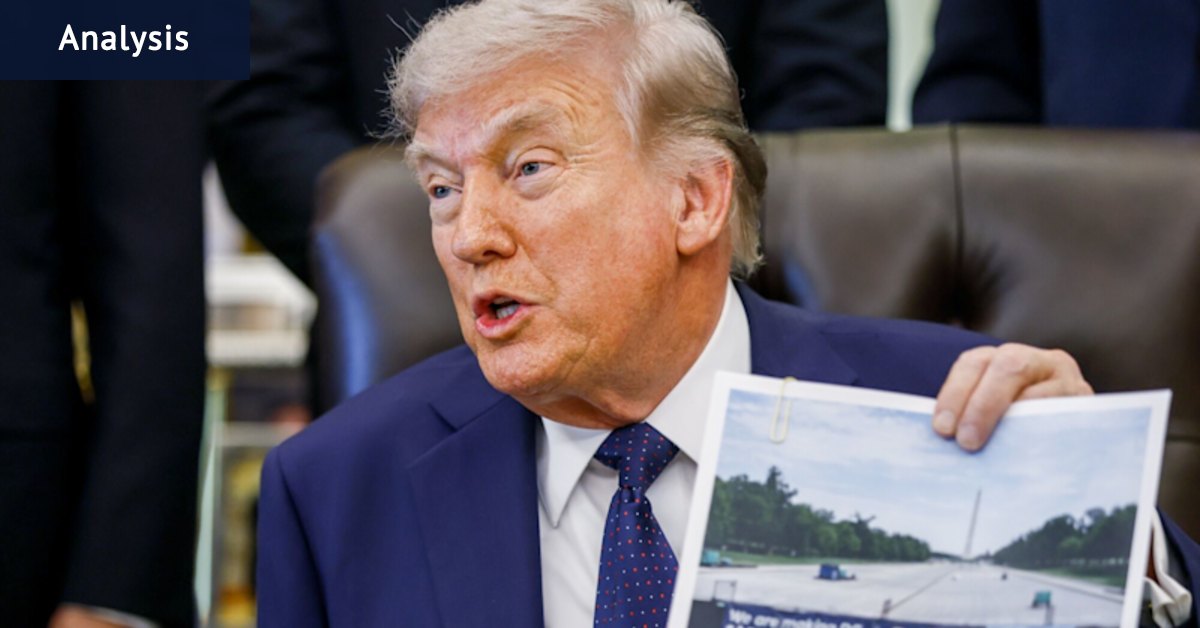


During an Oval Office news conference about healthcare on Thursday (Washington time), Donald Trump drew everyone’s attention to a repaving of the West Wing colonnade, where he is replacing decades-old flagstone pavers with polished black granite.
He then held up photos of the reflecting pool next to the Lincoln Memorial, where he has commissioned swimming pool contractors to renovate the landmark and make the water appear as “American flag blue”.
All told, Trump’s digression – replete with details about surface materials and construction methods – lasted 12 full minutes, before he turned it over to questions.
And when he was inevitably asked how long he was willing to give Iran to come back to the negotiating table, he became stroppy.
“Don’t rush me,” Trump said. “We were in Vietnam, like, for 18 years. We were in Iraq for many, many years … we were in the Korean War for seven years. I’ve been doing this for six weeks.”
Later, he called a reporter “such a disgrace” for asking what he would say to Americans who are wondering how much longer this whole thing is going to go on.
“All we’re doing is sitting back and seeing what deal [happens]. And if they don’t want to make a deal, then I’ll finish it up militarily,” Trump said.
“I don’t want to rush myself. Every story says, ‘Oh, Trump is under time pressure’. No. You know who’s under time pressure? They are. If they don’t get their oil moving, their whole oil infrastructure is going to explode.”
The wells might not literally explode, but Iran is facing the likelihood of having to reduce oil production if the American blockade isn’t lifted. With no ability to export its oil, the Iranian regime is running out of places to store it.
TankerTrackers, a company that monitors movements of the world’s oil vessels, says Iran has brought a very large crude carrier, named NASHA, out of retirement, “to prepare for the possibility of running out of oil storage space at Kharg Island”. The MarineTraffic website shows the ship is slowly making its way up the Iranian coastline toward Kharg.
This is the guts of Trump’s strategy: choke off Iran’s exports, tighten sanctions on Iran-linked vessels, entities and bank accounts around the world, and financially cripple the regime until it is forced to make a better deal.
So, when Trump says he has “all the time in the world” to make a deal, that’s a message that is primarily aimed at Tehran. He wants the regime to know he is prepared to smoke them out.
It’s certainly not a message aimed at Americans. Polls indicate relatively few people support the war or think it was worth it.
Nonetheless, Trump is in a strategically comfortable position. The US military operation was successful – the president says American forces took out 78 per cent of targets, and could always finish the job – and no American lives are in danger.
The markets seem to have moved on. The Strait of Hormuz might not be fully open, but the Dow Jones is back above 49,000 and not that far from its record high. Trump’s biggest issue, politically, is that petrol prices are still above $US4 a gallon ($1.50 a litre), which, by Australian standards, is not high.
But he’s not up for re-election, and he appears to have accepted that Republicans are going to go backwards in this year’s midterm elections regardless.
Still, Trump would clearly like to move on from Iran. Right now, he is at his most animated when talking about the Lincoln Memorial renovation or his White House ballroom. He is frustrated – understandably, perhaps – by questions that ask him to provide a timeframe or an endgame. And he has a high-stakes meeting with China’s Xi Jinping, already rescheduled once, in a few weeks.
Some people close to Trump are urging a faster resolution. Republican senator Roger Wicker, chairman of the Senate Armed Services Committee, on Friday (US time) called for the president to resume bombing Iran.
“The time is over for negotiations with Iran’s regime. The radical successors of [the late supreme leader Ali] Khamenei can never be trusted to keep any promise or agreement,” Wicker said on X.
“Our commander-in-chief should direct his skilled military leaders to finish destroying Iran’s conventional military capabilities and eliminating any last remnants of their nuclear program. This is the only way to ensure lasting stability in the region.”
At this stage, there are no signs that the US president wants to do that. He unilaterally extended the ceasefire when Iran failed to come to the table for peace talks, and pressed Israel and Lebanon to extend their ceasefire for three more weeks.
He has not ruled out further military action – indeed, American troops are still arriving in the Middle East – but seems to believe the returns are diminishing. His envoys, Steve Witkoff and Jared Kushner, are heading back to Islamabad despite nothing concrete – not even a guaranteed meeting with Iran’s foreign minister – being assured.
Whatever Trump says publicly about not being in a rush, patience does not come naturally to him. He wants everything done yesterday. The sooner this “excursion” ends, the sooner he can try to steer the American focus back onto more advantageous ground. He will not want to remain in limbo long.
Get a note directly from our foreign correspondents on what’s making headlines around the world. Sign up for our weekly What in the World newsletter.


