







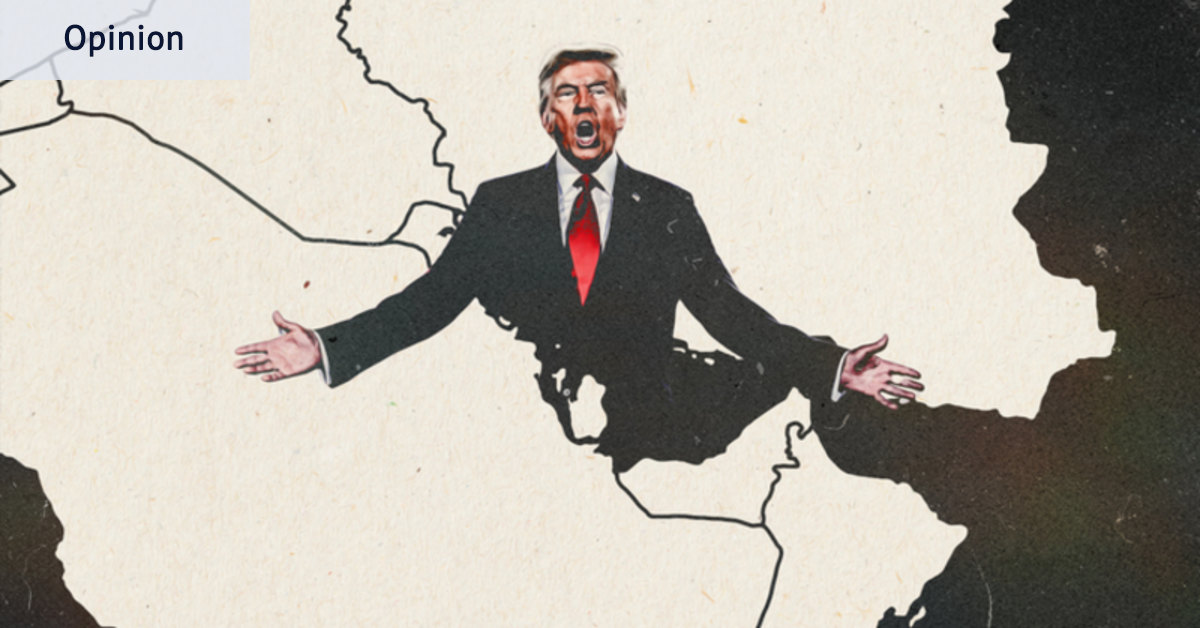
US President Donald Trump’s decisions in the Third Gulf War seem erratic and puzzling, but many of them make sense when you follow the money trail.
There is a robust explanation for his stop-start behaviour: Trump and his associates have significant financial investments in pro-US Gulf states, and these may be ruined in an Iranian retaliatory campaign. There are more than 400 desalination plants in the Gulf, which are responsible for more than 40 per cent of drinking water used by the United Arab Emirates, 70 per cent used by Saudi Arabia and 90 per cent by Kuwait. Iranian attacks on this infrastructure would shatter the Gulf states’ economic prosperity, and with it, billions of dollars that the Trump organisation stands to gain. Modern life there would be unsustainable.
This is why Trump keeps extending his deadlines on Iran. Since the killing of supreme leader Ayatollah Ali Khamenei on February 28, Trump has paused strikes on several occasions. On March 22, he threatened to “obliterate” Iran’s power plants within 48 hours if it didn’t reopen the Strait of Hormuz. On March 23, hours before the deadline expired, he announced a five-day delay, citing “very good and productive conversations” with unnamed Iranian officials. On March 26, as the world held its breath, he ordered another pause, this time for 10 days to April 6. He said it was “as per Iranian government request”.
What these excuses boil down to is that Trump and his wealthy supporters have too much to lose if the Gulf remains entrenched in war and dysfunction. He faces a competing pressure in the need to show that he isn’t scared of American troops being killed in action if needed. Otherwise, great power rivals such as China may doubt his resolve in a war over Taiwan.
Despite arguments to the contrary, the Trump presidency is the opposite of fascist. Fascism is a political ideology with an economic program, namely that a powerful state led by a ruling party and an all-powerful leader should command the society, the economy and the corporate bosses. Under Trump, the US resembles a wealthy kleptocracy – one in which the state apparatus bows to serve the super-rich. His clique’s self-interest serves as a powerful restraint against an energy apocalypse.
Take cryptocurrency. World Liberty Financial – a business venture of the Trump family and the family of his special envoy, Steve Witkoff – received a $US2 billion ($2.9 billion) deposit courtesy of Sheikh Tahnoon bin Zayed al-Nahyan, who controls $US1.5 trillion of the Emiratis’ sovereign wealth. Witkoff’s son Zach, 32, heads up World Liberty, which has earned the Trump family at least $US1.2 billion in cash in less than two years. Donald Trump Jr and Trump’s youngest son, Barron, are listed as co-founders.
Days before Trump’s inauguration in January 2025, the Emirates purchased a 49 per cent stake in World Liberty by signing an agreement with his middle son, Eric. For his part, the president effectively controls a large stake in World Liberty through an entity called DT Marks DEFI LLC. The Trump family made at least an additional $US2.25 billion in paper gains from other crypto holdings.
Trump’s new-found enthusiasm for cryptocurrencies is in sharp contrast to his earlier public disdain for them. Towards the end of his first term, he said they were “not money” and their “value is highly volatile and based on thin air” with the potential to “facilitate unlawful behaviour, including drug trade and other illegal activity”. But when money talks, the rhetoric walks. Today, thanks to contributions by the United Arab Emirates and others, Trump is both a major crypto dealer and the industry’s top policymaker. In April last year, he issued an executive order that resulted in the closure of the National Cryptocurrency Enforcement Team, which investigated crypto crimes.
More generally, the Trump cabinet consists of people with a direct interest in keeping the global economy going. His is the wealthiest administration in modern history, with a combined net worth of $US60 billion – five hundred times richer than the $US118 million combined net worth of president Joe Biden’s cabinet. Major campaign fundraising organisers and cabinet members include Commerce Secretary Howard Lutnick, a billionaire, and Treasury Secretary Scott Bessent, an extremely wealthy hedge fund manager.
And that’s just those who naturally fell on Trump’s side. There is a longer list of the hyper-wealthy who supported the Democrats until they realised that Trump could and would upsize their fortunes. Trump’s artificial intelligence and crypto czar is David Sacks, a financier who supported Hillary Clinton in 2016 and denounced Trump after the riots in Washington DC in January 2021. Financier Marc Andreessen, who endorsed Trump in 2024, had backed Clinton in 2016 because he disliked Trump’s immigration policies. Elon Musk, the world’s wealthiest individual, once waited in line for six hours to shake Barack Obama’s hand. He had quit Trump’s business advisory council over his climate change policies in 2017. But he donated heavily to Trump in 2024, and he plans to do so again at the midterm elections in November.
The key consideration is money. “We’ll get richer if he wins” as one private equity executive put it to the Financial Times in 2024. The euphemism for this is “saving Western civilisation”. Trump has no interest in killing the Middle Eastern goose that lays their golden eggs. Money talks, and his donors expect him to protect their billions. After all, they’re his billions too.
Professor Clinton Fernandes is in the Future Operations Research Group at UNSW. His latest book is Turbulence: Australian Foreign Policy in the Trump Era.
The Opinion newsletter is a weekly wrap of views that will challenge, champion and inform your own. Sign up here.


From our partners


