









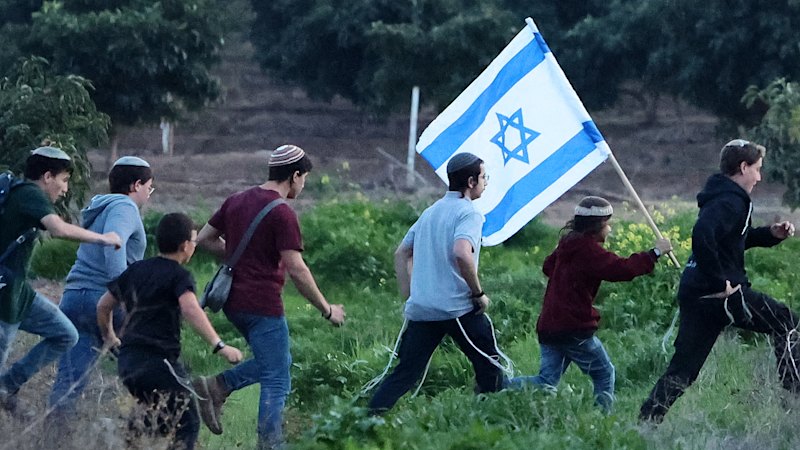
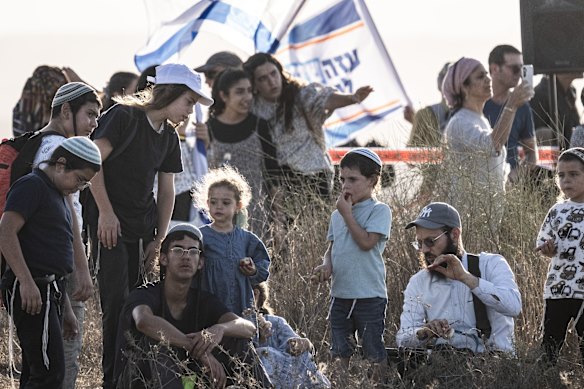
At a picnic spot and a memorial for fallen Israeli soldiers just a few hundred metres from the Gaza border, Israel’s new pioneers are planning to expand the country.
During the six-week war in Iran, international attention has turned away from Gaza. But for these would-be settlers, it has remained very much in focus.

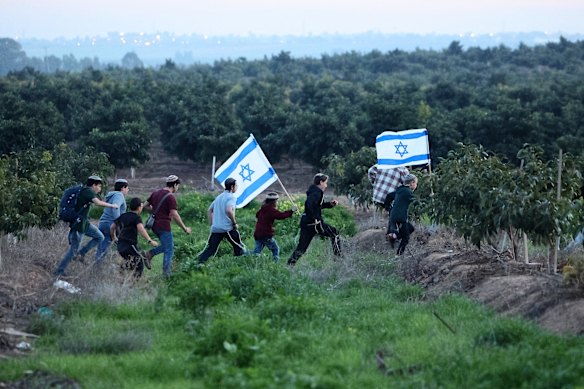
Visitors are handed leaflets marked “Our Gaza”, showing how they intend to settle the entirety of the strip, creating settlements in the top, middle and bottom of the Palestinian territory between the horizontal military corridors the Israeli military has carved there.
“The people in Gaza are generally terrorists or terrorist supporters, and they don’t deserve to live there,” says Neri Abraham, an articulate 19-year-old with ringlets and a knitted kippah as he gestures across the fields to the Gaza fence and the ruins beyond.
“The good ones can stay if they like and live peacefully under Israeli rule, but the rest should go to Egypt. And the terrorists? Well, they are terrorists, and I don’t care what happens to them.”

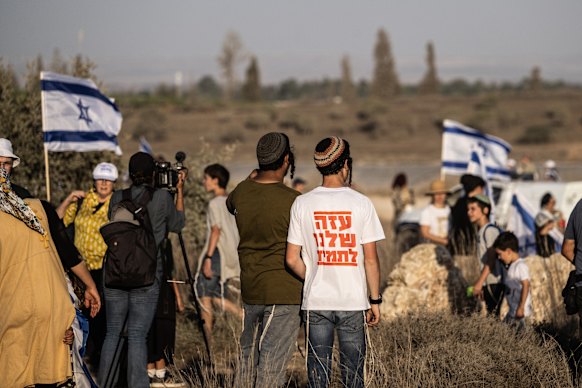
Abraham and his colleagues are “religious Zionists” and they are the vanguard of a new and radical social movement sweeping Israeli politics and its institutions.
They are dedicated to the creation of a greater Israel – one which encompasses not just Gaza and the West Bank, but the Golan Heights and parts of southern Lebanon too.
Fuelled by a political system that has given Finance Minister Bezalel Smotrich and National Security Minister Itamar Ben-Gvir outsized power and influence, they have become the political and cultural force in Israel to be reckoned with.

As handy with guns as they are with the Torah, their men now dominate large parts of the Israeli army, manning many of its front-line commando and special forces units.
Avichi Goodman, 34, an Israel Defence Forces officer and rabbi whose father moved to Israel 40 years ago, says the sect’s success is explained by its willingness to act and serve.
‘We have to teach the Gazans that they have lost. How do you do that? You must take this land from them.’
Avichi Goodman, IDF officer and rabbi
He, like the others gathered near the fence, exudes the rugged pioneering spirit of the country’s kibbutzniks of old, combined with the religiosity of the black-clad ultra-Orthodox.
“When help is needed, who turns up? Religious Zionists,” says Goodman.
The group’s outlook and ideology are direct and formulaic and many of the same arguments are deployed repeatedly. They are go-to heuristics used to argue against any counter-view.
Goodman, and two others, remind the London Telegraph of a quote by former Israeli prime minister Golda Meir on guns: “If the Arabs put down their weapons today, there would be no more violence. If the Jews put down their weapons today, there would be no more Israel.”
The logic of the would-be settlers is as self-serving as it is catchy.
“We have learnt that war is binary. You win or lose. If you take a middle line, you get rocks on your head,” says Goodman.
“We have to teach the Gazans that they have lost. How do you do that? You must take this land from them.
“We want a victory now that prevents future wars. We want to finish all the wars now.”
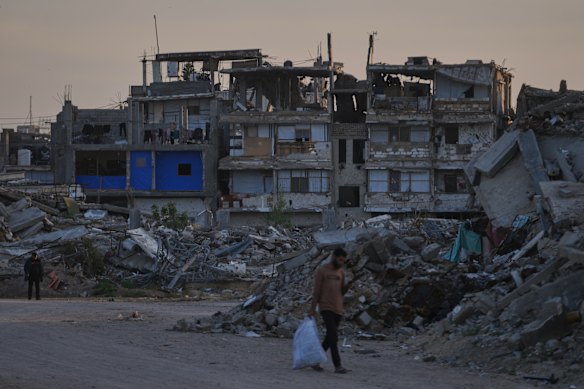
Across the fence in Gaza, people say there is “no war but no peace”.
The roads hum as you approach, as they are still imprinted by the tanks that were rushed there on October 7, 2023, but the near-constant artillery barrage that was maintained for more than two years stopped when a Gaza ceasefire came into effect in October last year.
Nevertheless, more than 720 people have been killed in Gaza during the ceasefire by Israeli forces, and conditions within the Strip, although improved, remain dire.
‘The basic necessities of life are nonexistent. Our children do not go to school, we have no rights, we do not feel safe. I have a constant fear famine will return.’
Abed Al-Hadi Qahman
Abu Said Al-Barrawi, a 57-year-old farmer, said his and other families “live like cats moving their kittens from one place to another” in search of safety, food and shelter.
“I am a farmer, but my land, which I used to cultivate, lies behind the [Israeli-controlled] yellow line. I dreamed of returning to it after the ceasefire was announced, but nothing has changed.”
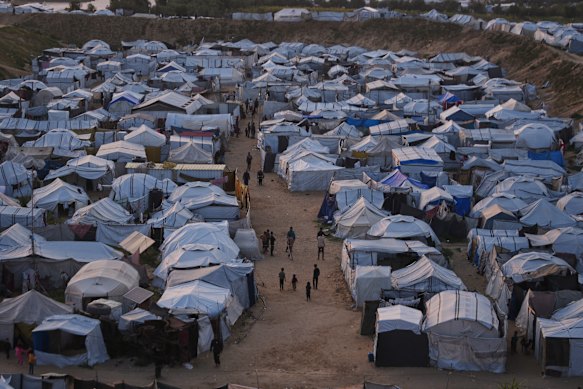
The winter, which has only just broken, was “hellish”, said Abed Al-Hadi Qahman, 40, from northern Gaza.
“Our tent was blown away several times, our belongings got soaked, and we were struggling just to protect our children from the biting cold.
“The basic necessities of life are nonexistent. Our children do not go to school; we have no rights, we do not feel safe, and we do not feel that the war has ended. I am terrified of being displaced yet again, and I have a constant fear that famine will return.”
Miraculously, the Gaza ceasefire – overseen by a US military team parachuted in last year by US President Donald Trump – has held over the past five weeks, and the peace process is grinding on.
A technocratic board of Palestinians has been put in place to administer the Gaza Strip, reporting to Trump’s Board of Peace and its executive board, on which former British prime minister Tony Blair sits.
Although hardly reported, a plan for disarming Hamas was published last month.
It envisages a gradual handing in of guns over an eight-month timeline and Israeli forces withdrawing completely upon “verification that Gaza is free of weaponry”.
The disarmament process will be monitored by a weapons collection verification committee, a body to be established by Nikolay Mladenov, a Bulgarian politician and diplomat who serves on the Board of Peace.
Hamas has agreed in principle to disarmament and it has until the end of the week to accept the proposal, although negotiations are likely to drag on.
The terrorist group is unhappy with Israel’s failure to adhere to all elements of the first phase of the peace plan, pointing to the lower than promised number of aid trucks that have entered Gaza, repeated Israeli military strikes and a recent tightening of the Israeli-controlled yellow line.
There is support for the disarmament plan within Gaza, but limited hope that it will be swiftly implemented – prerequisites for Israeli withdrawal and the reconstruction process to begin.
“I am in favour of disarming Hamas because their weapons have brought us no security, nor have they protected us from the occupation’s missiles; instead, they have served as a reason and a pretext for the killing of the people in Gaza,” said Hamza K, a 32-year-old Gazan, last week.
“I fear that Hamas might renege on what they signed, leading Israel to return to war under that pretext.”
Israel is moving towards a general election in October, and the ruling coalition led by Benjamin Netanyahu will be looking for any excuse it can find to upend the Gaza peace process.
Like the Iran ceasefire, it is seen as something imposed on Israel by the US and many Israelis – such as the religious Zionists – see annexation as a better option.
Provocative vision
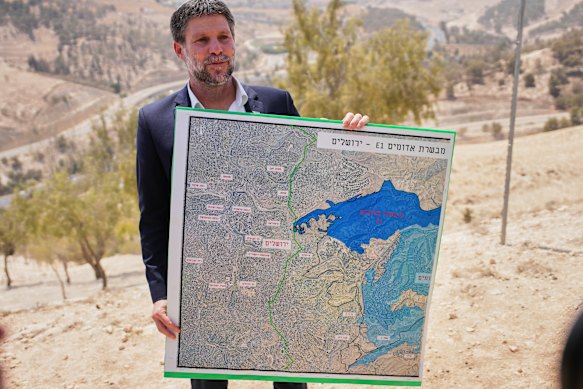
At the inauguration of a new settlement in the West Bank this week, Smotrich provocatively set this vision for a greater Israel.
“There will be expansion in Gaza that will extend our borders. In Lebanon, to the Litani, in Syria, Mount Hermon, parts of the north, south and east,” he told the gathered crowd.
This is no longer a fringe view in Israel. About 22 per cent of the Jewish population in Israel identify with the religious Zionist movement and support its settlement ambitions.
Not all are extremists, but some are, and violence in the West Bank has reached unprecedented levels since October 7.
The UN recorded about 1800 incidents of settler violence between October 7, 2023 and December 16, 2024, averaging four incidents per day.
More than 1000 Palestinians, including at least 233 children, have been killed by Israeli forces or settlers over the period.
“Jewish terrorism” is raging in the West Bank with the backing of the Israeli state, said a letter signed by 21 of Israel’s most senior former security chiefs last week.
The letter, signed by former heads of the Mossad, Shin Bet and the IDF, said settler violence had turned into terrorism and threatened to bring down the Jewish State.
“A black flag unfurls over the [Israeli] blue and white,” they said. “The Jewish terrorism raging in Judea and Samaria [the West Bank], with the tolerance – or worse, the backing – of government authorities, constitutes not only a profound moral failure, but a grave strategic threat to Israel’s security, especially in a time of war,” says the letter.
On the Gaza border, none of the settlers the Telegraph spoke to proposed violence or any other illegal act. But they were certain they “held the truth” and were determined to do what they believed God had demanded of them.
“We just want to make Gaza Jewish again,” said Hadat Barhai, a 36-year-old mother of nine and a local leader of the movement.
“I don’t understand why after two and a half years [the Gazans] are still there, these miserable people.
“The world must open their doors and let them go. They do not deserve Hamas, but nor can we live together.”
The Telegraph, London
Get a note directly from our foreign correspondents on what’s making headlines around the world. Sign up for our weekly What in the World newsletter.


