








In Australia, we like to think we take a strong stand against modern slavery. So when we are confronted with clear signs of human trafficking on our shores, we must act quickly, with humanity and a clear commitment to justice.
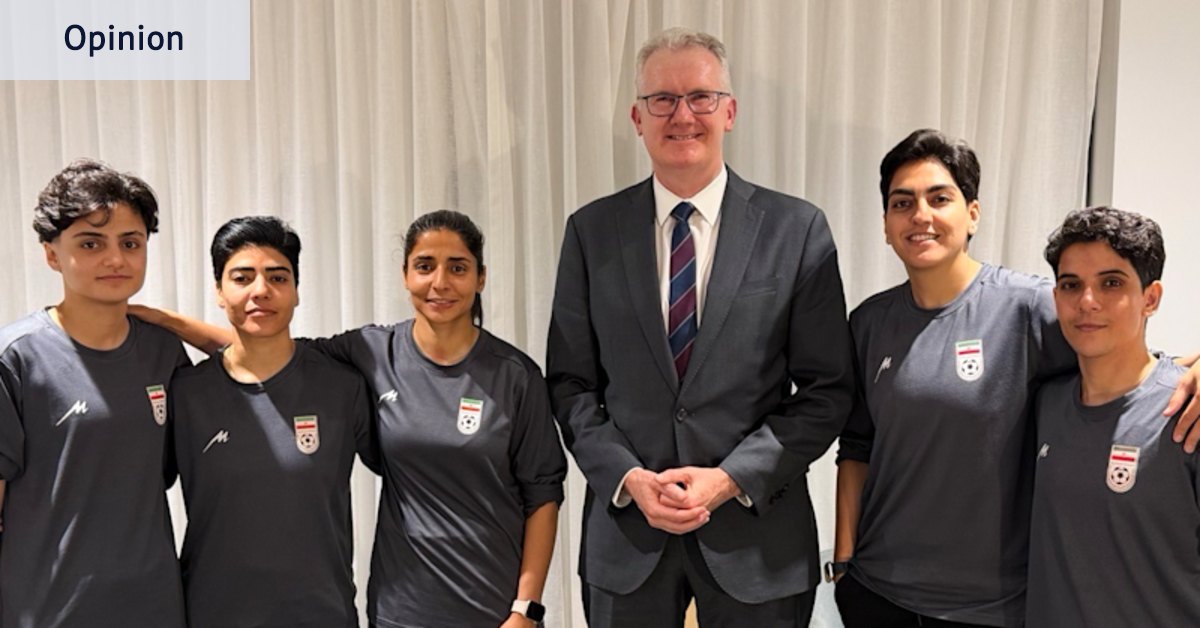
All available signs suggest that members of the Iranian women’s football team, and their support crew, were and are being coerced to return to Iran. If so, that would constitute exit trafficking under Australian criminal law – a crime punishable by up to 12 years’ imprisonment.
On Monday, I wrote to Australian Federal Police Commissioner Krissy Barrett calling for an urgent criminal investigation. The priority must be the safety of athletes, their support crews and their families back home – whether the team hails from Iran or somewhere else, such as North Korea.
I welcome the efforts by the Albanese government to create opportunities for the team to express themselves safely and freely. The government should continue these efforts, using a trauma-informed approach.
That means ensuring discussions with athletes and support staff are conducted in private, away from Iranian minders. It also means having those interviews led by female officers, with suitable interpretation and access to independent legal advice. Very clear, consistent and reliable signals about future visa options, and the possibility of future family reunion, must be offered.
Australia has mechanisms in place to help victims of human trafficking.
Modern slavery is the theft of agency. Only by creating safety for these athletes and support staff will their agency over their own lives be restored. But their safety is not the end of the story. The government still has two more complications to wrestle with.
First, there is the question of justice. If it does turn out that there is an unlawful attempt under way to coerce people into leaving Australia, the government will need to decide whether to lay charges against suspected perpetrators – and whether to detain them here in Australia.
It has been reported that the so-called “minders” accompanying the Iranian team are security officials from Iran. That introduces some complex geopolitical and diplomatic factors into any decision to prosecute trafficking offences.
No doubt there are also agreements in place between the government, the Asian Football Confederation and the governments of teams participating in this tournament, governing the handling of allegations of criminal conduct by accredited officials.
The question of whether to prosecute will not be a simple one to answer. But it is not a question we should ignore, or simply hope, disappears when officials board a flight out of Australia.
I, for one, am not comfortable with the signal that sends to other human traffickers, and indeed other state sponsors of modern slavery, about Australia as a safe haven. Already, there are serious questions being asked about Australia’s incredibly low prosecution rates in modern slavery cases.
Reports of modern slavery to the AFP have almost doubled in the past five years, to an all-time high of 420 reports in 2024-25. There have been only about 50 convictions for modern slavery offences in Australia.
Precisely due to such concerns, the US Department of State last year called on the Australian government to “vigorously investigate and prosecute trafficking crimes, including those involving complicit officials”. So we must not let officials found to be attempting exit trafficking from Australia off the hook.
That brings me to the second complication: the Matildas’ upcoming quarter-final game, against the team from the Democratic People’s Republic of Korea.
We have known for a long time that the regime in North Korea is a state sponsor of modern slavery. Indeed, the great Australian jurist Michael Kirby chaired a UN Commission of Inquiry which found that in some cases this amounted to crimes against humanity.
There are good reasons to suspect, too, that the North Korean regime controls its athletes outside its borders in much the same way that the Iranian regime does.
For that reason, the Australian government will need to be on its guard for signs of attempted exit trafficking of members of the North Korean team. None of this is without complications.
But we are a nation of laws. If we are truly committed to fighting modern slavery, enforcing our laws, on our shores, seems like an obvious place to start.
Dr James Cockayne is the NSW Anti-Slavery Commissioner.
Get a weekly wrap of views that will challenge, champion and inform your own. Sign up for our Opinion newsletter.


