








Opinion


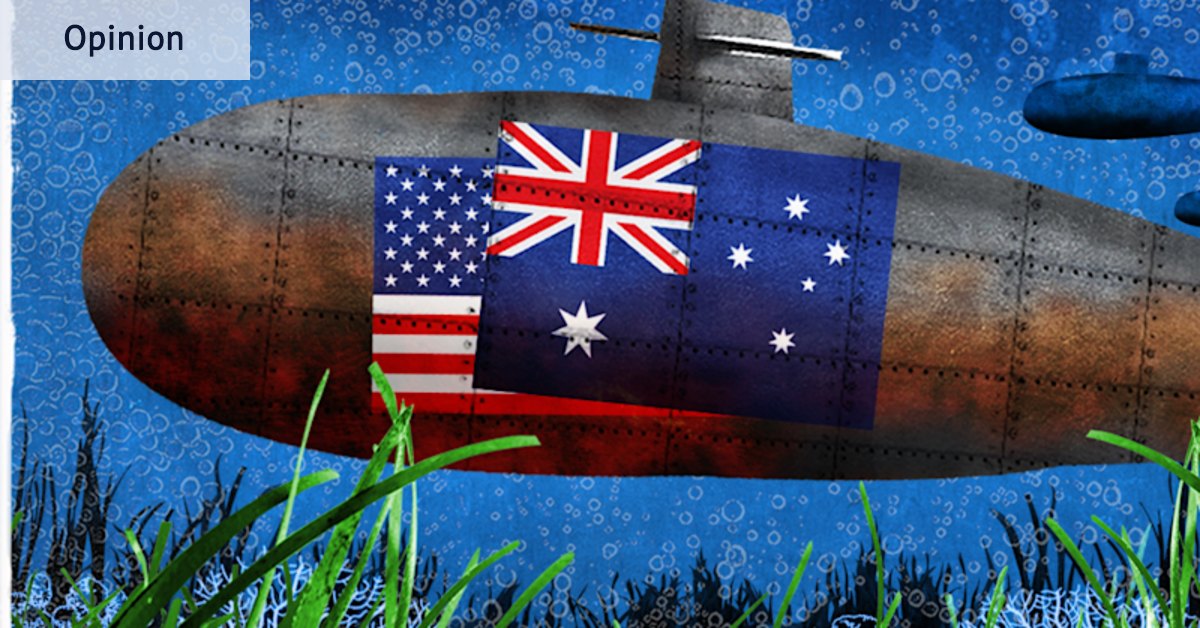
In public relations terms, it wasn’t a great week for AUKUS. On the weekend, Defence Minister Richard Marles told us that all three of the nuclear-powered submarines we’d get next decade from the US would be second-hand. Previously, we’d heard one of them would be new. By Tuesday, Peter Garrett and Chris Barrie – respectively a former Labor minister and a former chief of the defence force – announced they’d be launching a “people’s inquiry” into AUKUS, made possible by crowdfunded donations.
Neither development is terribly significant in and of itself. Even together, they will not change the government’s course of action, and will make little difference to whatever Australia’s defence arsenal ends up being. But they are more significant for what they symbolise, and that is important because AUKUS is now crystallising into an argument over competing worldviews, and Labor is caught between them.
Take the matter of used subs. The government now insists it is better for Australia to receive only used submarines, and was in fact what we wanted all along. That’s counterintuitive, but it isn’t as silly as it sounds. It costs less. The used subs will require a smaller crew, which is no small benefit when we have a shortage of personnel. We’d also be acquiring them after they’ve had their first maintenance, meaning the teething problems should have been ironed out. Throwing a brand-new submarine into the mix would have meant training crew in the workings of a whole new ship.
Meanwhile, the benefits any new submarine brings are probably negligible. They’ll be better at launching land attacks, which the US quite likes doing, but isn’t really our business. We are, you might have heard, girt by sea: an island nation with an enormous coastline. Our subs are there to deter and if necessary to fight other submarines in the water. The newer submarines won’t be meaningfully better for that purpose.
The trouble isn’t that this is a bad argument. It’s that the more you make it the more you’re forced to admit we got a sub-optimal deal the first time. And that’s a problem because the government has been telling us all along the original deal was, well, “optimal”. Perhaps this meant it was the best of the available options at the time. But that admits the available options were very much determined by the United States. For us are the crumbs of America’s interests.
That leads us somewhat to the “people’s inquiry”. It’s a misnomer, to be sure: less an inquiry than a campaign. It is headed by fierce critics of AUKUS, funded almost certainly by people who share that view, and will therefore deliver a pre-determined outcome. We can even guess confidently at several of its conclusions: that the US will not deliver us any submarines, that the price tag is too high and should be spent on more domestic concerns like the cost of living, and that AUKUS compromises our sovereignty by letting the US dictate to us our weapons and ultimately our foreign policy.
But beyond all this, the inquiry expresses a more fundamental frustration that AUKUS seems to be something that just happened. We woke up one morning and there it was. A surprise to the Australian people, a surprise to the French, who thought we were buying submarines from them, and a surprise to the then Albanese-led opposition. That last point is crucial: it put Labor in the position of fashioning a response quickly on a matter that is usually a point of bipartisan agreement. Within 24 hours, and on the strength of a two-hour briefing, the Labor shadow cabinet had backed the pact, without seeking the consent of the Labor caucus, much less the unions or its rank and file. Only two years later, at the ALP conference, did the broader movement ratify it.
That has left behind a sense that AUKUS was never really properly examined. That it was a secret agreement, sprung on the nation and the world, given bipartisan support with no serious debate, and no sustained case being made. Such debate as exists has been led by former politicians – most notably Malcolm Turnbull – but these have no home in the party-political debate. The people’s inquiry pointedly exists because a parliamentary inquiry doesn’t. Its main self-justification is that debate has been snuffed out from day one.
The government won’t entertain that debate for two reasons. One, it would signal prevarication. And two, the debate is almost too large for the public conversation to process. Contrary to appearances, AUKUS isn’t simply about submarines. It’s about a far more thorough integration than that. It involves Australia, the UK and the US working together on cyber warfare and developing a range of other military tools like underwater drones and artificial intelligence. It connects these countries’ military industries, so in the long run, each is building things for the others. It also means the US shares some of its military technology, which has until now been a closely guarded secret. Even the used submarines everyone’s now talking about are only a transitional measure before the ultimate goal: a new AUKUS submarine, designed in the UK using US nuclear technology and built in Australia.
To debate this is to debate who Australia is, especially when it is caught between an increasingly erratic ally and China. And that’s why AUKUS is a flashpoint. In political terms, criticism of AUKUS runs leftward from the teals. Support begins within Labor and runs rightward to One Nation. Critics are likelier to be sceptical of the US alliance. Supporters are more likely to see China – which has plenty of nuclear submarines – as a security threat, and regard our integration with the US as too thorough to unwind. While we trade blows on whether and what kind of submarines will arrive, we’re really debating whether to embrace a huge geopolitical realignment.
That’s the debate we needed to have first. It’s the foreign policy question of this century. But it’s one governments almost never have in public, fearing unintended diplomatic consequences. The result, though, has been to resolve it by stealth, without having even declared the matter open. Now we’re seeing the cracks, no longer able to conceal that the fissures are far deeper. AUKUS is now a proxy debate for the big geopolitical conversation we’ve never been able to have.
Waleed Aly is a broadcaster, author, academic and regular columnist for The Age and The Sydney Morning Herald.
The Opinion newsletter is a weekly wrap of views that will challenge, champion and inform your own. Sign up here.


