









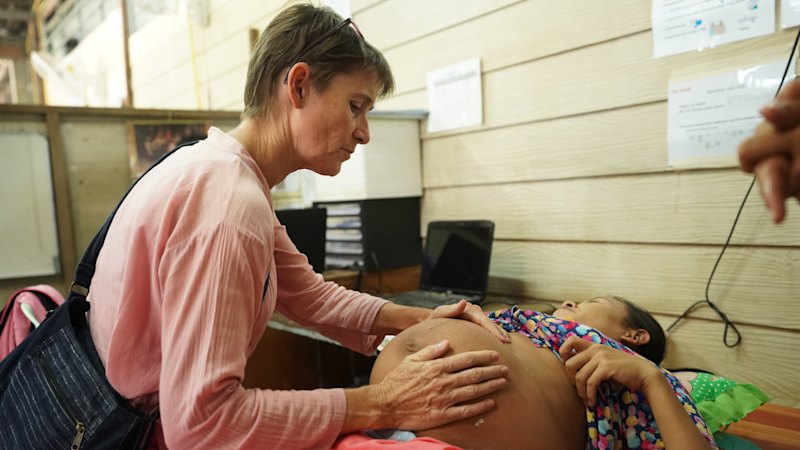
As she drives alongside the winding river that separates Thailand from Myanmar, Rose McGready recalls the night she ran to a bunker with nothing but a banana leaf to shield her from the debris of bombs. “It was a night to remember,” she says, tall stalks of sugar cane whipping past. “Not in a good way.”
The setting sun smears a yolky light as the Australian doctor reflects on that night in 1995 when the Shoklo refugee camp came under attack. It no longer exists, but at the time, Shoklo was home to thousands of Karen refugees, an ethnic minority largely from eastern Myanmar. The camp was raided by an armed Karen faction backed by the Myanmar military.
There was a bright, full moon, McGready remembers, so bright you cast shadows as you walked. Bullets travelled as blue-green lights across the sky. It was “total chaos”, people running in every direction. She watched as someone grabbed a flimsy plastic mat to protect themselves.
In her characteristically understated manner, McGready recounts how a blast sent debris sprinkling into her bunker. Someone grabbed a banana leaf and pulled it over their heads. Suddenly, she envied the person with the plastic mat.


Still to this day, loud sounds take her back there. A less resilient person may have called it quits and flown home. But not McGready. “If I run away, how do the staff feel? It doesn’t help any of us.” And so, she stayed.
For more than three decades, the 61-year-old doctor has been fighting malaria and tuberculosis in this fraught borderland, while helping women deliver their babies into the world.
A leading expert on maternal malaria, McGready has helped shape the World Health Organisation’s guidelines on treating the mosquito-borne disease. Notably, McGready and her team’s research showed artemisinin drugs – which had caused foetal reabsorption in animal studies and previously were not recommended in humans – were in fact safe and effective in early pregnancy.
Those findings have had global implications, says Julie Simpson, a professor of biostatistics at the University of Melbourne who has researched malaria for 30 years and has collaborated with McGready. A lack of data on pregnant women means they often don’t have access to highly effective medicines, Simpson explains. “Rose has contributed to all that information so that guidelines could be changed, and now women are getting access to those important treatments.”
What makes McGready unique, Simpson adds, is not just her valuable research, or running a dedicated maternal health service, but also her commitment to training local staff.
She doesn’t seek publicity or accolades, but her peers are quick to highlight her achievements. The Dr Rose McGready Foundation was launched in her name in 2022 to raise funds to support her work. She was also named the ACT’s 2026 Australian of the Year.


Despite significant medical advancements since the mid-1990s, the past few years have been some of the most challenging for McGready and her team at the Shoklo Malaria Research Unit (SMRU). A brutal coup in Myanmar in 2021 displaced millions and contributed to a surge in malaria.
Between 2020 and 2024, cases tripled in eastern Myanmar’s Kayin state, including a spike in Plasmodium falciparum malaria, the deadliest form of the parasite, before numbers began to decline thanks to early treatment and detection. Still, the ongoing crisis threatens to unravel decades of work to eliminate the disease – an approach McGready says is vital, given rampant drug resistance. “When you have conflict, you can’t run basic healthcare,” she says. Her team has also seen a rise in tuberculosis cases and an influx of pregnant women seeking to give birth safely in their clinics.
The COVID-19 pandemic and recent USAID funding cuts under President Donald Trump have also taken their toll. The SMRU has been forced to cut staff and wind back services by 20 per cent due to slashed funding – even as their doctors are trying to plug some of the health gaps left by the withdrawal of other US-funded organisations. Most recently, the dire fuel crisis triggered by the US-Israel war with Iran has put further strain on the SMRU’s ability to reach the most vulnerable in remote posts inside Myanmar and rural Thailand.

But McGready has also faced personal hardship. A recent cycling accident left her with a “descalping” head injury and burst fractures to her spine, which kept her sidelined for months. The bike crash is something she talks about hesitantly – partly out of embarrassment, she says, and partly out of guilt. Usually hypervigilant about wearing a helmet, she left hers on a bus on the day of the accident in March 2024. “It’s the first day in 30 years I didn’t wear a helmet,” she says.
McGready has no memory of the moment of impact. But from what she can piece together, she supposes she veered off the road into the back of a parked vehicle. A friend riding ahead of her turned back and found McGready severely injured.
‘She cannot be separated from her work. No one can stop her.’
Wannee Ritwongsakul
Repairing a 17-centimetre scalp flap at the local hospital required 42 stitches, and she needed five blood transfusions. She was transported to Bangkok for a spinal operation. “I broke ribs and my sternum and most of my thoracic spine,” she says. “I’ve got a lot of metal holding six of the vertebrae together.”
The recovery was arduous. She was away from her work for several months, but it would be more than a year before she felt like herself again. Her husband, Stephane Proux, describes watching her relearn how to breathe and walk to her full capacity.
It’s the kind of injury that would take many people much longer to recover from, says Wannee Ritwongsakul, the chief operating officer at SMRU and a former nurse who visited McGready in hospital. But Ritwongsakul says McGready was determined. “She cannot be separated from her work,” she says. “No one can stop her.”
McGready chalks up some of that tenacity to having grown up with three brothers. She was raised in Canberra as the second child and only daughter of John McGready, a carpenter and joiner by trade, and his wife Elizabeth, a teacher. A gifted swimmer in her youth, she narrowly missed out on qualifying for the 1982 Commonwealth Games in Brisbane before completing her medicine degree at the University of Sydney.
At 30, McGready arrived at the far western border of Thailand in 1994 for what was supposed to be a six-month stint. She wanted to gain experience treating tropical diseases before returning to work in the Northern Territory with Indigenous communities, and hoped to one day work in Africa. But she was confronted by the high mortality rate of malaria on the Thai border and saw young, strong people, pregnant women and children, all succumb to the disease. “You know that if you got them 24 hours earlier, 48 hours earlier, they wouldn’t have died,” she says.

The work was all-consuming, but she would juggle it with motherhood. In Thailand she met Proux, a French parasitology lab supervisor who would become her husband. He was first struck by her “beautiful eyes”, he says, and then by her Australian accent. “The first time she talked to me, I could not understand,” Proux says with a laugh.
They wed in the Mae La refugee camp in 1999, in a humble ceremony with a nod to traditional Karen marriage customs, and had two children, a boy and a girl. Just two weeks after the birth of her first child, McGready was back at work in the camp, helping other women to deliver their own babies.
For more than a decade, the couple kept up a demanding routine; one parent would spend a week with their children in Chiang Mai, where they went to school, while the other would work on the border, several hours’ drive away. They would swap each week, reuniting on weekends to take the children camping or hiking near waterfalls. “She’s very dedicated to her work,” Proux says, “but she always found … time to [give to] the kids and to the family.”
She often appeared to forgo sleep and food for long stretches as she sifted through patient files, says Mellie Gilder, an American family doctor at SMRU and a mentee of McGready’s. Gilder draws on a Karen phrase, hay law tha, which means “to give all of yourself”.
“It’s used to be generous, but also to be generous with your time, to be a team player,” Gilder explains. “I feel like it describes Rose really well – she’s always giving herself.”
Wearing sandals worn down at the heels, McGready attends to her patients at the Wang Pha clinic, one of a handful run by SMRU on either side of the porous borderline. In the raw hours after birth, McGready curls her legs up to sit beside a young mother and her newborn on a raised wooden platform, gently checking heartbeats.
Alongside senior medic Thi Dar San, she pores over charts, scanning for details, eager for answers. Thi Dar San says McGready radiates kindness. She wants to know “the whole story” of her patients. All too often, their stories involve flight from Myanmar, where their aspirations for the future have been snuffed out by the regime. Many joined protests and armed resistance groups in the wake of the coup, while the junta’s conscription of young men has torn families apart.
When asked what motivates her to persevere despite the setbacks, McGready cites the bravery of Karen and Burmese women. “They’re just stoic. [It’s] stoicism that I never – I haven’t seen before,” she says. “They have nearly nothing, and they still share.”
Just outside the clinic’s delivery room, McGready glances at a young father cradling and singing to his day-old newborn while the mother rests. “She’s pale,” McGready says, her face creasing with concern for the woman, who had suffered a haemorrhage during birth.
The coup has uprooted the lives of young couples like them in untold ways. Yet the birth of a child can’t help but stir some hope. This tiny creature, with a head full of black hair, re-orients and holds their focus.
“Life goes on, even with the bombs,” McGready says. “You don’t know which one of those babies is going to help us in the future.”
Read more stories from Good Weekend:
Get the best of Good Weekend delivered to your inbox every Saturday morning. Sign up for our newsletter.


