


The 28-point peace plan had demanded that Ukraine give up large tracts of land, including territory that has not even been captured by Russian forces.
This issue was “placed in brackets” for Trump and Zelensky to agree at a later date. However, the US president is expected to hold talks with Vladimir Putin beforehand.
The US-Ukraine framework came after a separate meeting between the Ukrainian delegation and national security advisers from Britain, France and Germany.
Together, they drew up a counter-proposal aiming to limit Russia’s ability to neuter Ukraine’s armed forces and influence NATO and EU decision-making processes.
European plan ‘does not work for us’
The Kremlin on Monday rejected a European counter-proposal to the US-Russia 28-point plan.
Yuri Ushakov, a Kremlin foreign policy aide and a former Russian ambassador to the US, said: “The European plan, at first glance … is completely unconstructive and does not work for us,” adding that “not all, but many provisions of this [US] plan seem quite acceptable to us”.

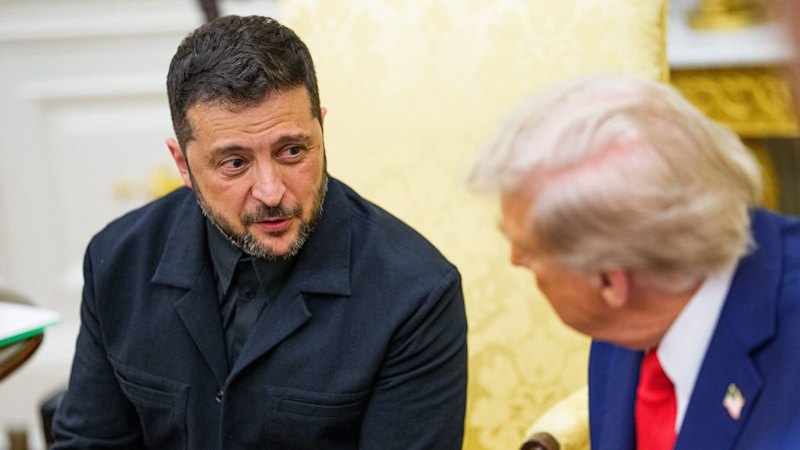
Donald Trump is expected to speak to Vladimir Putin before any meeting with Volodymyr Zelensky. Credit: AP
A European source familiar with the latest talks told the London Telegraph that much work was still to be completed on the plan, erring on the side of caution because of the lack of Russian agreement.
Kyiv has so far resisted Russia’s demand to give up the remainder of the Donbas region not currently under Moscow’s control.
British Prime Minister Keir Starmer and French President Emmanuel Macron have convened a meeting of the coalition of the willing for a debrief on the Geneva talks, but their aides were understood not to have seen the latest plan.
Loading
It is unlikely that Starmer, Macron, and other European leaders will join Zelensky at the White House in the coming days, as has happened previously.
Instead, EU leaders, who held their own summit on Monday, agreed they had to accelerate plans to deliver Ukraine €140 billion ($249 billion) in loans using frozen Russian assets.
Diplomatic sources indicated that this was because there was little confidence that the Geneva peace talks would lead to an immediate ceasefire.
Ursula von der Leyen, the European Commission’s president, whose top aide was involved in the talks, said that “good progress” had been made in Geneva.
The Europeans, including Britain, are pushing to exclude any mandated cuts to Ukraine’s army from any future deal, while also asking that discussions over territory begin only after a ceasefire.
Von der Leyen said, “We are united in our support of Ukraine. These are core European principles moving forward; Ukraine’s territory and sovereignty must be respected. Only Ukraine, as a sovereign country, can make decisions regarding its armed forces. The choice of their destiny is in their own hands.”
German Chancellor Friedrich Merz cast doubt on progress, saying: “The next step must be Russia coming to the table”.
The Telegraph, London
