


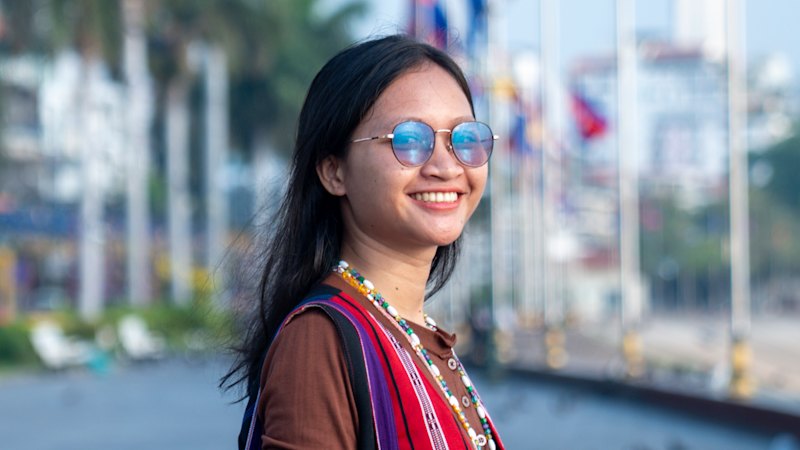
When Kary was just 13, her parents tried to force her into marriage with a boy in her village in Cambodia.
Kary, a proud Indigenous woman from the Praov ethnic group in Ratanakiri province, refused.

“They wanted me to get married because [they said] if I got old no one would love me,” Kary says.
“I didn’t want to at the time because I thought I was still young and still enjoyed going to school.
“Parents on the boys’ side had a dream that we were a perfect match.”
Ratanakiri, in Cambodia’s north-east, is rich in natural beauty and known for its stunning gemstones. It’s also the site of the highest rate of child marriage in the country.
According to Cambodia’s Ministry of Women’s Affairs, about 37.7 per cent of girls here are married off before the age of 18.
It’s long been a social norm deeply rooted in many remote communities for girls to be forced into marriage from the age of 13 or 14.

For families struggling with poverty, marrying early is often considered a form of financial security in her village of Ta Veng, which can feel like it’s stuck in time.
But Kary, now 23, stood firm, and insisted that she stay in school instead of marrying. She says her father did not speak to her for two years.
“When my dad was angry, he was really angry for a long time,” she says.
“It wasn’t one day, two days or even three days, when he was angry he didn’t look at me in the face. I thought, ‘Why is he so angry? Why are we arguing over that?’ Something like that shouldn’t be causing a nasty fight with your parents.”
The village also turned against her, calling her names and questioning her morals.
“They say I’m a bad girl, that I disobeyed my parents.
“It’s really hard when the whole village is used to one way and you have an idea that’s so different, you can’t stand up and fight them and win.”
Kary is calm as share recounts her story, wearing wide-legged jeans, a long-sleeve top and a vest made from traditional indigenous Khmer fabric.
Halfway through our interview, Kary’s father, Chor Lek, arrives home for lunch, and the mood becomes slightly tense. But she powers on.
She says that when times get tough, she thinks of the hardship her mother has faced.

Her mother, Taby, is thin, a sarong firmly tied around her tiny waist. Forced into marriage at just 14, Taby has never been to school and is banned from working. Women in the village can only look after the children, cook and clean.
“I thought that I should do something to show my mum that girls have power, value and can make decisions, and I want her to be proud of me,” Kary says. “When I’m sad I think of my mum.”
Kary is now studying psychology in the Cambodian capital, Phnom Penh. She’s the first woman from her village to go to university and hopes to one day become a journalist.
She says: “We should strengthen our knowledge and education, find a good job and earn a modest living. So we can manage our own lives and don’t have to rely on anyone.”

Taby says it’s hard having her daughter so far away. “I do miss her. When I see her arrive at home, I’m happy.”
Even though he was furious that Kary refused marriage as a young teen, Kary’s father now says he’s grateful to the aid workers at Plan International Cambodia for helping Kary achieve her dreams and very proud of his accomplished daughter.
“At first I wanted her to be like others, but when the NGO [non-government organisation] supports, I’m thankful for the help she’s received,” Chor Lek says.
For her part, Kary hopes she can inspire other girls to choose education and avoid the trap of becoming child brides. “I want young girls to have a voice, young girls to be valued, I want the community to change their mentality about how women can’t do anything and don’t have the opportunities like men.”
‘If I could go back in time, I’d want to finish school’
Many people in the communities in Ratanakiri believe that early marriage protects a girl’s reputation and prevents premarital sex, which is culturally shameful.
In a nearby village, we meet a girl who was forced at 16 to marry a 24-year-old man.

“I didn’t want to get married back then,” she says.
The teen, who can’t be identified but is now 18, was punished for becoming pregnant out of wedlock, banished from her village and forced to live on a farm during her pregnancy.
She even had to pay the village chief.
“They fined me a medium-sized pig, one chicken, and 100,000 to 200,000 riels [between $25 and $50],” she says. “I had to pay because I already had the baby. In the village, it’s taboo to have a child before marriage.”
The young mother stays at home with her baby, cooking, washing dishes and sweeping her home.
She says she wishes she had stayed in school and hopes to enrol in a hairdressing course but needs to wait another year to finish breastfeeding.
“I’d like to keep studying. If I could go back in time, I’d want to finish school and have a job.”
Plan International Cambodia has been working closely with teens across 86 villages for three years to help them make their own decisions and avoid being forced into early marriages.
The training that is opening doors
Free vocational training is also offered, and for young mothers like Kanada, it’s been life changing.

She’s proud to be the first female mechanic in her town.
Stepping into her pristine workshop, it’s clear she loves her job. The walls are pink and decorated with hanging tyre tubes.
She chose fixing motorbikes over painting nails because it would make her more money.
“I noticed there are many motorbikes in the community. So I thought if I opened a mechanic shop, it might bring more income than a salon,” Kanada says.
But that decision didn’t go down well in her village. “Some praised me, while others bullied me.”
Kanada says fixing motorbikes is considered “heavy work and a man’s job”.

The 26-year-old was forced into marriage when she was 17.
At first, her husband supported her career choice, but soon after, they separated.
“When I first opened the shop, he was happy for me. But over time, since he has to go to the farm and work alone, he feels a bit upset that I’m not with him.”
‘We don’t think that where you’re born in the globe should determine your life chances.’
Susanne Legena, chief executive of Plan International Australia
The mother of one hopes her story can inspire other young women to believe in themselves and gain independence.
Kanada now makes enough money to support her family and send her daughter to school. She even has a small handbag collection on display near her workshop.
“I want to prove that even if it’s a man’s job, if we are determined, we can do it all,” she says.
Proven results
Three years ago, Plan Cambodia rolled out its program across the country, with aid workers determined to stamp out child and forced marriages.
Thanks to their work, youth groups are now forming, some led by girls, to meet to talk about sex education and reproductive health.

What once was a taboo topic is now being discussed among peers in a safe setting.
Kimthan Yi and his team have been working in the region for the past 14 years.
“To change the norm, to change the behaviours of the community, especially among the indigenous community, it’s not easy work,” he says.
A recent study by Plan Cambodia found that since its program began three years ago, the number of girls married before the age of 18 has dropped by 65 per cent across 86 Cambodian villages. The rates of marriage before the age of 15 fell by about 75 per cent.
Rates of secondary school completion have skyrocketed, along with vocational training and even university admissions.

“If you can keep a girl in school, if you can avoid her being married off early or being exposed to violence, if you can keep her healthy, then you can really … give her economic opportunities, you can actually transform entire economies,” says Susanne Legena, the chief executive of Plan International Australia.
However, Legena’s organisation fears all of its progress could be undone because the US government under Donald Trump has slashed its foreign aid contributions. There are fears Australia could follow suit.
“We don’t think that where you’re born in the globe should determine your life chances. It shouldn’t be a lottery or a, you know, a postcode lottery,” Legena says.
“You’re born in South Sudan, you’re born in Gaza, you’re born in Western Australia, your chances at life should be the same.
“So fundamentally it is this basic belief that childhood is precious and that every child is worthy of dignity and value.”
Neary Ty travelled to Cambodia with Plan International
