



Choosing a portable heater isn’t necessarily just about finding the “best” model but also matching the technology to your lifestyle. What areas need heat, how quickly do you need it, where is the unit going to sit, and so on.
I’ve broken portable panel heaters into four categories (no fan models, I’ll tackle them in a separate article) and tested one of each to give you an idea of how they work. Each one has at least some Wi-Fi or app capability, and can be placed anywhere in the home.
Basic panel convector
In terms of providing heat, devices don’t get much simpler than a basic electric convector panel. You can generally look in the top and see exactly how it works: a wire coil is heated by electricity, sucking cold air in through the bottom and letting the warmed air blow out the top. These can be fairly affordable – despite the RRP my test unit from Kogan is currently sold for $80 – but can also be power hogs, depending on the room you put them to work in.
Some convector panels have fans to assist the airflow but not this one. And it doesn’t really need it because hot air starts moving out immediately. It isn’t the prettiest, and the white casing is roughly put together, but it’s lightweight and has carry handles. It’s quiet, aside from the gentle hum of the element and the clonk when the thermostat turns it off and on, and it’s comforting to stand near or warm your hands over.
The simplicity does have some downsides. The outer casing of the heater gets very hot and it will only actually heat your room if the hot air isn’t being sucked somewhere else. It did a good job in my enclosed office, with its digital thermostat dutifully turning the heater off and on to stay within two degrees of my target.
But in my lounge room (which is larger, has no doors between the kitchen and corridors, and has higher ceilings) you only felt warm quite close to the unit, and the temperature fell quickly when it was off. Heating up an already cold room took a long time. These heaters don’t really modulate power, so if you have open spaces or draughts you could end up pumping a full 2000W constantly. It does have an eco-mode that limits it to 1250W but that means slower heating.
It connects to an app that is also pretty basic but there’s enough there to let you automate the heater. You can set your preferred temperature by day of the week in a calendar, run a schedule to get heat at certain times, or set the device to turn on according to outside weather data. You can also connect it to Google or Alexa. A touch panel on the side also works for quick adjustments.
Advanced panel convector
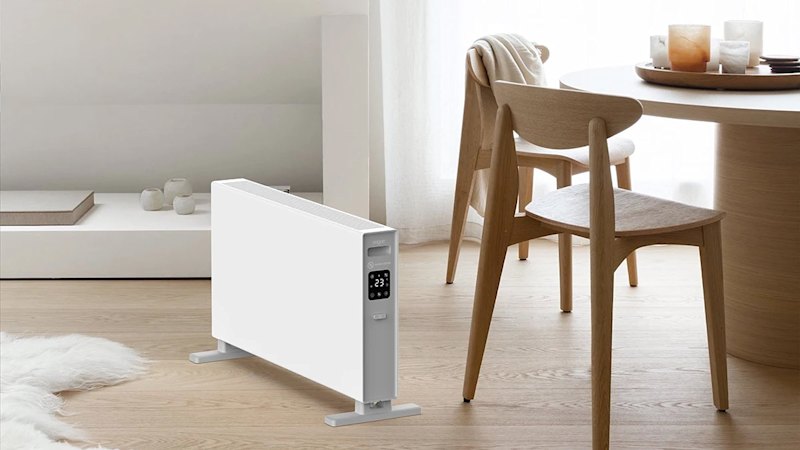
Given the large diversity of panel heaters, I’ve split them into two sections. More expensive models tend to have more accurate digital thermostats, additional power steps for efficient control, and smarter features. Plus they usually look a lot nicer. At their core, though, they use the same technology: electricity heats an internal coil to suck cold air in and push warm air out the top.
A lot easier on the eyes than the Kogan, the Breville has a thin design and comes with a built-in mount if you’d like to attach it to your wall. If not, it also comes with feet that have detachable castor-wheels. It takes a little longer to heat up than the Kogan, using 1500W maximum, but once it’s going it’s a similar upward draught of pleasant heat, and is very quiet.
The unit naturally works better in an enclosed space and will need to run continuously for a bit if you’re trying to get a room from 8 degrees to 20. But once it’s at temp it does an excellent job of holding it without noticeably oscillating between hot and cold.
That’s because it has three distinct power settings and if you leave it on the default “eco” mode it will switch between them automatically, depending on the ambient temperature. That said, it struggled with the open lounge room and we were starting from a base of about 10 degrees, so it might not pack enough punch for true winter temperatures unless you start it early and have all the internal doors closed.
I like the forward-facing display that shows you at a glance what the room’s temperature is and I especially like the cute little remote that magnets to the front, giving you an option for changing settings from your couch or bed without needing to rely on an app. There’s an app, too, of course, which lets you use the controls, set a schedule or connect to Alexa or Google.
Far infrared panel
While the technology is old, a desire for efficient heating built into green housing has led to a recent surge in this kind of panel. Rather than heating the air, they emit radiant energy that is absorbed and then released by whatever it hits (a person, the opposite wall). When used at scale they can warm people in desired spots as well as keep a whole home comfortable by switching on and off. But in portable form they really only work right in front of you.
Herschel makes two models of portable panel heater and this is the larger one. It comes with feet and cannot be wall mounted but it looks nice in a minimalist kind of way. This heater is notably more expensive than just about any convector heater but it also uses a fraction of the power. That 500W wouldn’t go very far if you were trying to keep a whole room’s air warm but if you put it under your desk you may end up with warmer feet than you’d have using a 2000W box.
The thing is, far infrared is a tough sell at this small scale. Some offices cover the roof with panels, and some homes have them disguised as mirrors or paintings on the wall, but there’s a limit to what a single panel can do on its own.
When the unit is on, you will only feel it if there’s nothing between it and you. It’s like sunshine, giving a very pleasant warmth if it hits you directly, but easily blocked by any solid object. Under the desk is an ideal use because I’m there for eight hours a day and it would be wasteful to burn gas on the whole-house heater.
I can also see it used in front of the couch or at the kitchen table but not if you needed relief from truly frigid air. For some reason, I didn’t expect these panels to be hot to the touch but they are extraordinarily so – up to 90 degrees while operating. So they can’t go where they might be accidentally touched.
The controls for the heater are a bit awkwardly placed, at the rear, near the ground, but there’s not much tweaking needed once you’ve set it at your desired strength. It can connect via Wi-Fi to the universal SmartLife automation app, which is handy if you want to put it somewhere out of the way and still be able to control it.
Oil column
A long-time favourite for bedroom use, the oil column uses electricity to heat a reservoir of internal oil, which transfers the energy to metal fins and out into the room. They take longer to heat up than convection panels but they continue to provide heat even when the element is switched off, meaning in certain circumstances they can maintain temperatures more efficiently.
This Delonghi looks like a space-age reinvention of the old oil column heater I remember from 30 years ago but it functions more or less the same. You turn it on, nothing happens, but then 15 minutes later the room is toasty. Oil heaters have a nice character because they don’t dry the air out as much, though you also don’t get that instant gratification of blowing heat. The Dragon line attempts to create a happy medium by sealing off the metal fins and venting the top, forcing some hot air up and out, which also means it’s not very hot to the touch.
This is a heavy heater but it’s on wheels that make it easy to drag around. Of all the heaters tested it did the best job keeping the large open lounge area warm, but then it also has the highest wattage. In an enclosed area it kept the temperature steady and didn’t need to turn on very often once it was at temp. Given it’s about $400 more than the Kogan, I imagine you’d need to run it for a number of winters before its efficiency saved you any money. There are other 2400W oil column heaters at half the price, though Delonghi claims its three steps of power settings make it more efficient, and it does have a long warranty.
The touch buttons on the side let you activate an eco-mode or set a timer, while a big tactile dial controls the thermostat with fun but unnecessary coloured lighting. The app gives a digital version of the same, plus scheduling features and an interesting geofencing option that turns on the heater once your phone arrives within a certain radius of your home. I did find the app a tad unreliable, though, with changes sometimes failing to go through.
Get news and reviews on technology, gadgets and gaming in our Technology newsletter every Friday. Sign up here.

