








Tesla is facing multiple legal battles over allegations it charged Australian customers more than $10,000 for its cutting-edge fully self-driving software despite their cars being technologically restricted from activating the autonomous feature.
Full Self-Driving (FSD) mode – which requires a human’s constant supervision to legally operate – was a feature promised by Elon Musk’s Tesla for years, but had been unavailable locally for many users needing to wait for software updates as well as local regulatory approvals to operate.
FSD mode finally became available for owners of certain newer Model 3 and Y Teslas in Australia in September, allowing those who pay $149 a month or a one-off fee of $10,100 to let their vehicles drive them around.
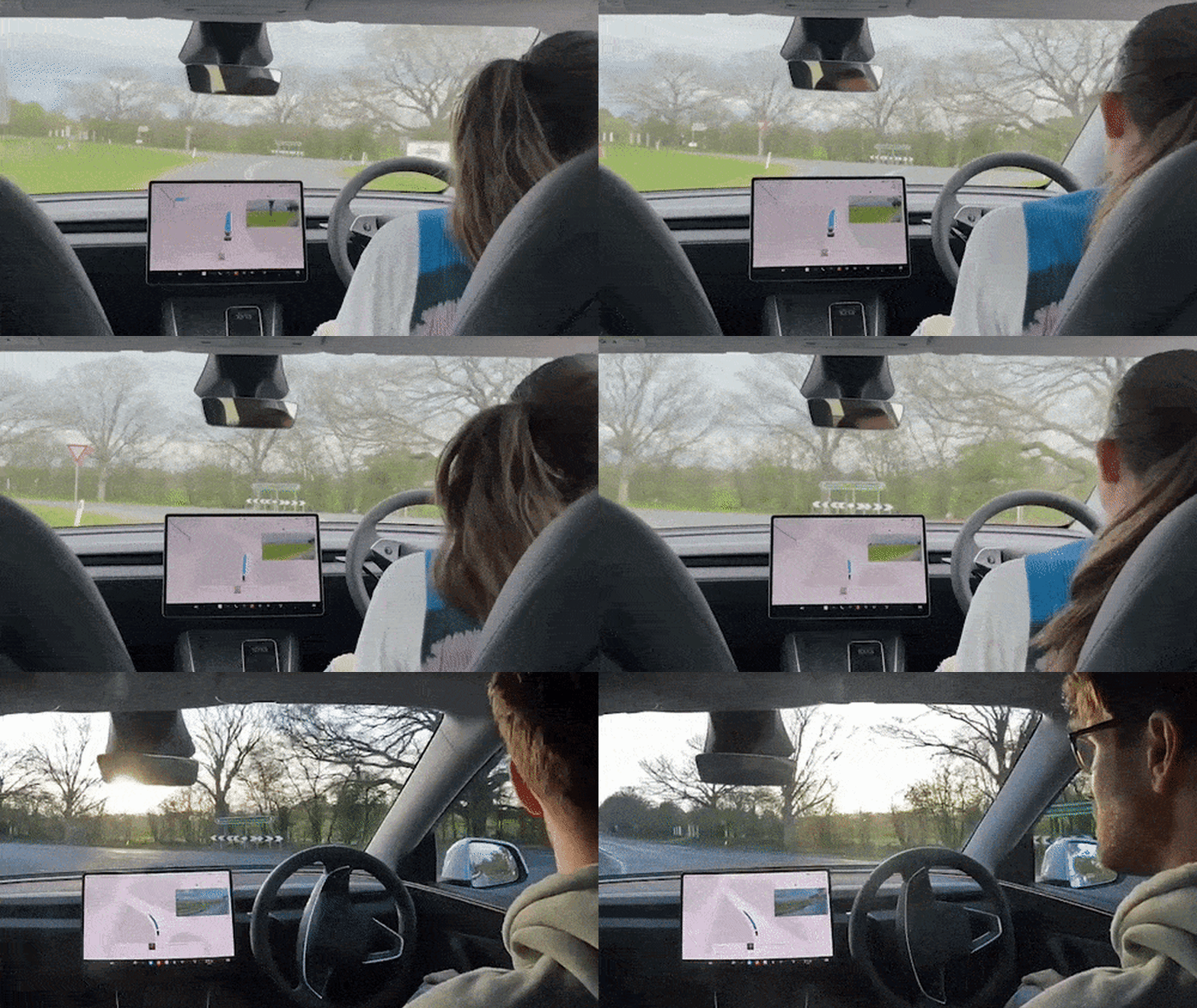
It has triggered a flood of social media videos and perplexed reactions from other road users and pedestrians when seeing Teslas move without their drivers touching the steering wheel.
The technology relies on cameras fixed on the car that provide 360 degrees of view, which feed information into a neural network navigation software that determines how to steer, accelerate, brake and change lanes to navigate to a user’s destination.
Drivers using FSD must be paying attention to the road. An internal camera ensures they are not distracted and are ready to intervene and take over control should the car make an error. A car will end FSD mode if it detects a driver is repeatedly distracted.
However, full functionality of the FSD feature is limited to Tesla vehicles with its latest technological hardware, known as HW4, which includes the most modern sensors and computer system.
Despite this, Tesla offered FSD to owners of vehicles with older on-board tech, known as HW3. As such, these customers have vented their fury online at what they say is a significantly limited automated driving experience.
Whereas FSD in more modern Tesla models can perform almost all driving manoeuvres, those with HW3 vehicles who paid the same price for the feature report only slightly enhanced automated features such as automatic lane changing and automatic parking.
Andy Young is one such Tesla owner now taking legal action against the car manufacturer.
Young has lodged a claim at the NSW Civil and Administrative Tribunal, alleging the electric vehicle giant breached Australian Consumer Law by engaging in misleading or deceptive conduct when selling him lifetime FSD access, priced at $10,100, when he bought his Model 3 in December 2021.
He claims Tesla has failed to supply its FSD feature in the subsequent four years, and that the purpose of the FSD product it sold him was not fit for the intended purpose, a contravention of consumer law if proved.
Young is seeking a refund of the $10,100, as well as $3530 in NSW EV stamp duty rebate he was unable to benefit from because the inflated cost he unnecessarily paid for the vehicle pushed its purchase value over the rebate threshold.
The inflated cost meant Young’s purchase also incurred $2059 in luxury car tax, for which he is also seeking a refund. Additionally, he is seeking interest on these amounts.
Separately, Tesla is facing a broader law firm-led class action launched in the Federal Court last year on behalf of other Australian customers who paid for FSD for their cars which were actually incapable of fully benefiting from it. The class action also includes claims covering other Tesla customers related to phantom braking and battery concerns.
Young lodged the tribunal matter separately to the class action, as he was not satisfied it incorporated all of the issues he wanted to raise, nor the amounts of compensation and refunds he sought.
Tesla asked for Young’s matter to be either dismissed or stayed, arguing he was automatically covered by the class action that deals with the same issue. Young had not yet been able to opt out of the class action.
However, principal tribunal member David Robertson rejected Tesla’s claim that allowing Young’s matter to proceed would be “frivolous or vexatious”. Robertson will now consider Young’s case through written submissions, while the class action – still in its early stages – progresses.
In determining both the federal and NSW matters could continue against Tesla concurrently, Robertson noted that individual vehicle owners had the right to seek recourse through a tribunal, a process that would probably lead to a faster resolution than a national class action.
Robertson noted the tribunal’s guiding principle is “to facilitate the just, quick and cheap resolution of the real issues in the proceedings”.
Tesla was contacted for comment.
Self-driving vehicles, including robotaxi-style operations such as Google’s Waymo, have been common on roads in some US cities for years, in contrast to Australia, where regulatory requirements are more cautious of the technology.
Tesla’s FSD, in requiring a driver’s supervision to operate, is classified as a level 2 advanced driver assistance system under Australia’s road rules, with the human behind the wheel considered legally in control of the vehicle.
The Business Briefing newsletter delivers major stories, exclusive coverage and expert opinion. Sign up to get it every weekday morning.


