








Adam Parkinson’s Instagram account for Sydney Charter Fishing is full of reels showing bull sharks, snapper, kingfish and tuna struggling to break free from fishing lines, only to become that night’s fish and chips.
With the uncertainty and the cost of the diesel far higher than he had ever paid, Parkinson (known as Parko) said he was starting to feel like he could snap too.
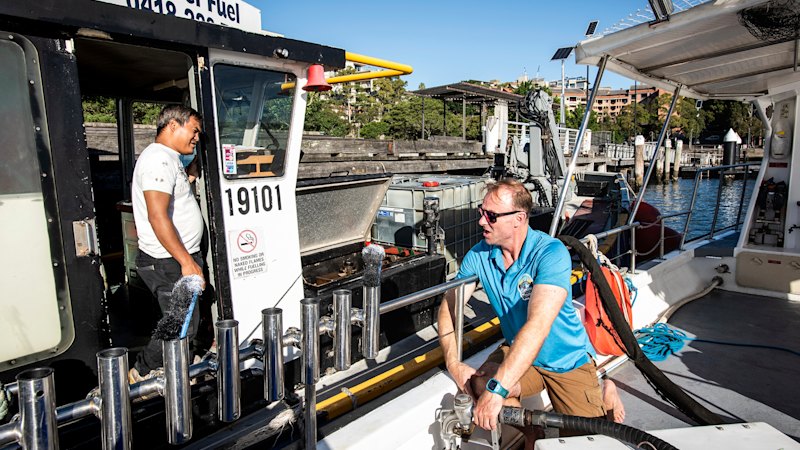
To save money and avoid long queues at marinas, his fishing boat travelled from Manly to meet a fuel barge on the water between Pirrama Park in Pyrmont and Mort Bay Park in Balmain to fill up.
“I put in 400 litres of diesel for $1728, which is three times as much as I have ever paid. I have never even paid half of that before.”
The number of petrol stations without diesel in NSW jumped from 131 on Monday to 164 on Tuesday, and those without any fuel rose from 38 to 51, as the fallout from the war in the Middle East continues to be felt far and wide.
“That’s so scary, if we run out of diesel I will be pissed off,” Parkinson said. “It sucks. I am a single dad trying to pay the bills.”
On Tuesday, Premier Chris Minns ruled out fuel rationing unless other states agreed to a national approach.
Minns told question time that if “management procedures are required, that might be rationing, that might be working from home, it might be other programs or remedies that we can introduce into the marketplace … it should be a nationally consistent approach that’s organised by the states, but the same across jurisdictions”.
Prime Minister Anthony Albanese said at the weekend that fuel rationing was a matter for the states.
Minns said an agreed approach was needed to stop people jumping borders with the ACT, Queensland and Victoria to purchase fuel.
The hikes are affecting those on the roads and going to sea.
For small operators running fishing and tourist charters and party boats around Sydney Harbour, fuel represents a significant part of running costs.
Peter Townsend, the owner and managing director of Sydney Luxury Cruise, said many of the tourist sightseeing charters they ran for international customers were booked a year ago, which meant they could not recoup any of the increased fuel costs.
“We’re taking a big hit on all cruises that were booked in the past 12 months,” he said.
The company has two vessels – one unleaded, the other diesel – that take about 400 litres to fill. The cost of catering for the cruises also rose 30 per cent because of fuel increases.
“We are encouraging charters to drive slower to minimise costs,” Townsend said.
Tess Patchett, the operations manager of Motor Yacht Charters Sydney, which leaves from Gladesville Marina, said the hike in fuel prices coincided with the quieter time of year when prices were reduced and passenger numbers were lower. She said the average motor yacht used as much as four litres per nautical mile.
“If I was coming into summer, we would be panicking,” she said.
The company has one vessel, the 80-foot motor yacht Ariston, that is also popular during Vivid.
“If it is a shorter-term thing, people can wear that. If not, they will have to pass on the prices,” she said.
Owners of luxury motor yachts and vendors were reluctant to comment on fuel price hikes.
It “wasn’t a good look” to complain, given that these motorised vessels sell for anywhere from $10 million to $100 million, said the operator of a company in the luxury motor cruise sector, who declined to be named.
Many take 14,000 litres to fill, and at $3.50 a litre (the non-members price quoted on d’Albora Marinas’ fuel app for Rushcutters Bay on Tuesday), that would cost nearly $49,000.
The uncertainty of fuel supply would have a bigger impact than the cost. Owners looking to go north to the Great Barrier Reef were afraid they would be stranded without the fuel to return.
For motorists and boat operators such as Parkinson, getting fuel is also taking more time. Parkinson said it cost him half a day’s business.
The state government has the power to direct fuel companies to sell supply to particular customers in need, or to direct fuel rationing, if the premier declares an energy supply emergency.
The federal government has similar powers under the Liquid Fuel Emergency Act – which federal Energy Minister Chris Bowen said has never been invoked.
The NSW government wrote to major fuel companies on Friday demanding an urgent stocktake of current and future supply, and information regarding sales contracts. The premier is concerned that independent service stations in the regions have been unable to secure supply.
Start the day with a summary of the day’s most important and interesting stories, analysis and insights. Sign up for our Morning Edition newsletter.


