


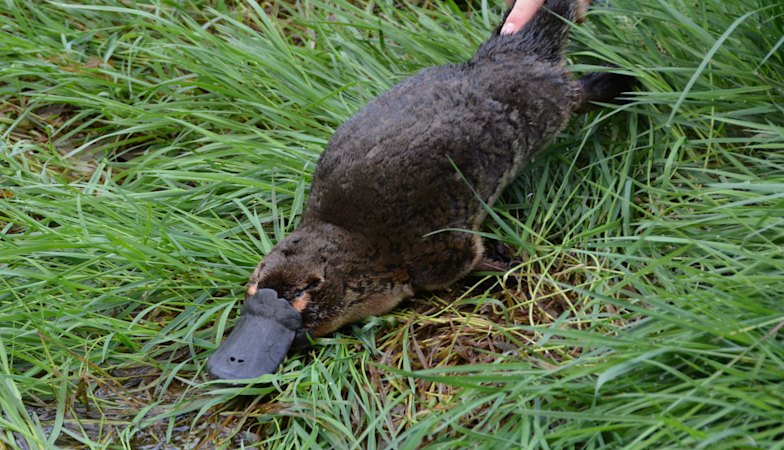

Along Monbulk Creek in Melbourne’s south-east, a platypus forages for prey. It’s busy business, being a platypus.
In usual times, she will eat 20 to 30 per cent of her body weight every day. If she’s lactating and caring for young, she will need to eat a hefty 80 per cent of her body weight.
No one knows for sure how many of these elusive creatures remain in this section of the creek, but Melbourne Water waterways and wetlands research manager Rhys Coleman estimates there could be as few as 30.
In nearby Ferny Creek, no platypuses have been detected since 1997, while in the Upper Dandenong Creek, none have been detected since 2011.
But at Monbulk Creek, there is still hope. During the most recent survey, conducted last month, researchers captured and released eight platypuses, including a juvenile female.
The discovery of the young platypus was heartening, Coleman said, offering the prospect for future generations of this vulnerable species.
“It’s always a great relief to see that they’re breeding, and that is obviously a big focus for us, to try and create conditions where they can breed,” he said.
The Victorian government listed the platypus as a threatened species in 2021, after a number of localised populations became extinct during and after the Millenium Drought.
Against this backdrop, Melbourne Water – in partnership with organisations including the Department of Climate Change, Energy, the Environment and Water, the University of Melbourne, Yarra Ranges Council and South East Water – is making a concerted effort to protect the isolated Monbulk Creek population.
With $4 million in funding, and support from the Victorian government, Melbourne Water is installing an Australian-first “smart” water initiative that aims to regulate water levels in the creek.
During heavy rains, stormwater systems that lead to the creek can erode creek walls and rapidly increase water levels, trapping and drowning platypuses in their burrows.
Climate change means the risk of drought and low flows is also increasing.
Under the scheme, households near the creek have been offered free rain tanks that will connect to smart technology. Sensors in the tanks, creek and nearby lakes will give authorities the ability to monitor water levels – and need – in real time.
Ahead of predicted heavy rains, the tanks can be partially emptied to capture rooftop rain flows and manage the flow of stormwater into the creek. During dry times, the tanks will release flows into a parched creek.
It’s hoped the strategy will also help the myriad creatures including crustaceans and water bugs consumed by platypuses.
“They’re really sensitive to having enough water in a stream, and one of the reasons is they need to eat so much … pretty much from dusk to dawn, they go out and feed,” Coleman said.
“And one of the big things we’re focusing on is topping up those dry weather flows in autumn to be able to sustain the food and help the females recover and get ready for the next season.”
Modelling included in the Victorian government’s 10-year Healthy Waterways Strategy, released in 2018, forecast that with no changes to stormwater management systems, the length of waterways unable to support platypuses would increase by about 1200 kilometres.
Get to the heart of what’s happening with climate change and the environment. Sign up for our fortnightly Environment newsletter.
 Bianca Hall is The Age’s environment and climate reporter, and has worked in a range of roles including as a senior writer, city editor, and in the federal politics bureau in Canberra.Connect via X, Facebook or email.