









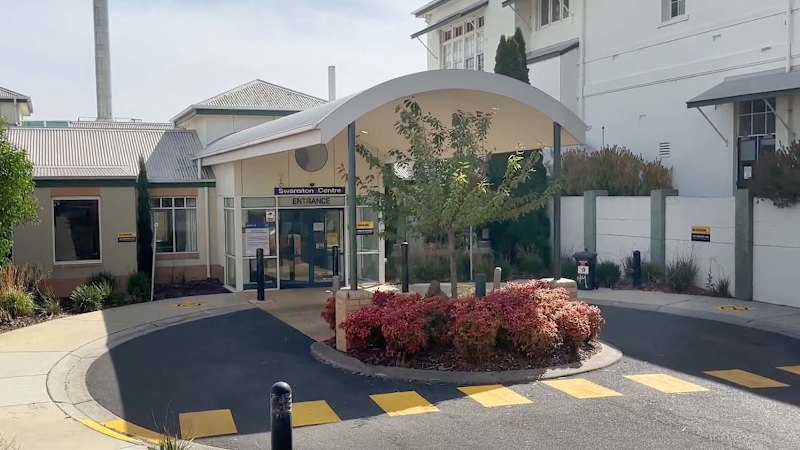
A man killed in his room at a Geelong psychiatric hospital had been sharing a bathroom with the patient alleged to have killed him, separated only by a flimsy non-locking door.
Staff working within the Swanston Centre have told The Age the 31-year-old Highton man was found dead in his room with his neighbour standing over his body and broken glass nearby about 2am on February 22.
Homicide detectives are investigating the 31-year-old’s death, and the man from the neighbouring room has not been charged.
Deemed a safety risk, shared rooms and shared bathrooms are forbidden from new psychiatric centres and are being phased out of existing hospitals. However, the Swanston Centre’s acute ward has been overlooked by rounds of the state government’s upgrade funding allocated to make the old wards “fit for purpose”.
WorkSafe is also investigating how the man could have been killed inside a monitored and secure psychiatric unit, which is the latest in a long list of security issues at the Barwon Health-run hospital.
Sources familiar with the investigations, who are not authorised to speak publicly, confirmed that patient access issues between rooms were a key focus of the inquiries.
Distressed Swanston Centre mental health workers have told The Age the two men had been placed in the 26-bed acute ward in outdated “Jack and Jill”-style rooms – where a shared bathroom allows them to access their neighbours’ rooms undetected by staff.
Mental health workers inside the Swanston Centre have reported the shared bathrooms are a constant “flashpoint” that put patients and staff in danger.
One Swanston Centre worker said a nurse undertaking routine patient checks at 2am on February 22 could not locate one man in his room, and was shocked to find him next door standing over the body of his dead neighbour in the adjoining room.
“There’s a joint bathroom in the next room, which the doors I think are non-compliant at the moment,” the staff member said.
“Many patients have raised that issue when we put them in their room, that they’re concerned someone can get into their room.
“You also can’t lock the bathroom door from inside your bedroom, so the person that’s using the bathroom can open the bathroom door and get into your room.
“They can still open your door from the bathroom to get into the bedroom, or they could simply crawl under it.
“They no longer make them [the doors], they’re no longer fit for purpose, so they’re going to be changed again, which is the frustrating because they’re always just Band-Aid fixes for what they actually need on the ward, and they don’t seem to listen to the staff that are doing the job.”
The Victorian Health Building Authority has been working to remove shared rooms and bathrooms from the state’s old acute mental health units, in line with royal commission recommendations.
In September 2025, the health building authority said it had reconfigured 16 mental health acute inpatient units to ensure all bedrooms have their own en suite under a $61.1 million safety overhaul. However, the safety upgrades did not include the Swanston Centre. Upgrades to a further unnamed eight acute units were in the design or planning stage, the authority said.
The Mental Health and Wellbeing Commission would not comment on whether it was appropriate for patients to have access to other bedrooms via shared bathrooms in acute psychiatric wards but said it had confidence in the investigatory processes.
“We encourage the government to maintain its momentum in upgrading mental health and wellbeing facilities across the state as and when required, to provide the safe, private and dignified environments essential to supporting consumer recovery and ensuring staff can provide high-quality care,” a commission spokesperson said.
Workers inside the Swanston Centre say it is the fifth adverse outcome suffered by a patient who had been admitted to the unit since December 2025. Barwon Health refused to comment on whether the patient’s death occurred in the context of wider security and systemic issues while investigations continued.
“All incidents are reviewed through established governance processes to identify, assess, and respond to any clinical and operational risks, and to support ongoing quality and safety improvements,” a Barwon Health spokesperson said.
In response to questions about whether its acute ward rooms and doors met current regulations, a Barwon Health spokesperson said all of Barwon Health’s mental health inpatient units were accredited against the National Safety and Quality Health Service Standards and maintained in line with established safety and privacy requirements.
“We continuously monitor contemporary evidence and best practice to guide any future upgrades to ensure ongoing quality care,” the spokesperson said.
Health and Community Services Union secretary Paul Healey said staff were traumatised by the recent homicide.
He said they had raised serious safety concerns about the design and fit-out of the Swanston Centre for more than a decade.
These include warnings about the risks of shared bathrooms and dimly lit corridors, which hinder staff from being able to see and monitor patients.
“It’s a unit that’s absolutely past its use-by date,” Healey said. “It wouldn’t meet the standard of a modern acute service and doesn’t ensure the safety of staff or patients.”
These concerns were compounded by increasing numbers of patients presenting with higher acuity and more complex needs were arriving at the hospital, he said.
“I work with people saying, ‘Can you keep my family safe?’ And you say, ‘I will do my absolute best, but I can’t guarantee it because it’s not safe,’” Healey said.
Following the death, the Health and Community Services Union this week surveyed the Swanston Centre’s workforce for information about any ongoing safety risks for staff or patients.
Of the more than 45 staff who responded, more than 70 per cent said they were not confident they could provide a unit free from violence or aggression in the Swanston Centre. Nine out of 10 staff said they were unaware of changes or improvements that had been made since the death, with many citing the use of shared bathrooms as the greatest danger.
“They constantly create flashpoints and put staff and consumers at risk,” one mental health worker said.
“Even if appropriate risk assessments are done, we cannot guarantee the consumers are safe in a shared room/bathroom.
“We cannot see what is going on in the room. Even if we are checking frequently, there is still a window of time where an incident could happen between consumers without us knowing.”
Another Swanston Centre worker said the Highton patient’s death could have been avoided.
“No one should have access to a patient’s room via a shared bathroom that has unlockable internal access,” the worker said.
“In this day and age, no patient in an acute inpatient unit should be forced to stay in a shared bedroom.”
One staff member said the Swanston Centre’s south wing had been closed over safety concerns from its shared rooms. However, the acute and women’s wards remained open despite having shared bathrooms and numerous blind spots.
Associate Professor Simon Stafrace, chair of the Victorian branch of the Royal Australian and New Zealand College of Psychiatrists, said the death of a person in care was one of the most “tragic and distressing” events that could happen.
“This is a tragedy every way you look at it,” he said. “This is about as rare as hen’s teeth. Homicides involving what I would call clients in care are very, very rare, and in hospital, rarer even still.”
Stafrace was reluctant to speculate on the physical facilities at Swanston Centre and the circumstances of the man’s death while a police investigation was under way.
However, he said there was no question “legacy facilities” at mental health units across the state needed to be updated.
“We’ve seen what some of the new facilities that are being built across the state look like,” he said.
“They present a far more dignified, more spacious environment that provides lots more different options for managing some of the behavioral challenges during the most vulnerable phases of a person’s illness.”
The patient accused of killing the 31-year-old man is understood to be too unwell to be interviewed by police and has been relocated to a secure psychiatric unit at a Melbourne hospital.
A Victorian government spokesman said the government could not comment on individual cases under investigation by police.
“This is a deeply distressing incident,” he said. “We send our deepest condolences to the person’s loved ones and staff at the centre.”
Start the day with a summary of the day’s most important and interesting stories, analysis and insights. Sign up for our Morning Edition newsletter.


