



London: Russian forces have struck a fuel storage facility at the decommissioned Chernobyl nuclear power plant in Ukraine on the eve of talks in London about the need for stronger air defence to shield targets from missile strikes.
A Russian drone blasted parts of a building at the site of the 1986 nuclear disaster that spread radiation across the region, although authorities said no spent nuclear fuel was being stored in the facility at the time of the attack.
Ukrainian President Volodymyr Zelensky condemned the move as an “extremely vile” Russian attack using a Shahed drone in what he termed a deliberate move.
“Russia deliberately struck this particular nuclear infrastructure facility,” he said before arriving in London for the talks with leaders from Britain, France and Germany.
“As of now, there are no readings exceeding normal background radiation levels. But there is certainly an increase in Russia’s brazenness, which long ago went off the charts.
“Ukrainian first responders extinguished the fire at this facility after the strike. And real new steps by the world are needed so that the Russians feel that this terrorist war of theirs is a blow to Russia itself.”
The International Atomic Energy Agency said it had been briefed by Ukraine and was preparing to visit the site to inspect the damage.
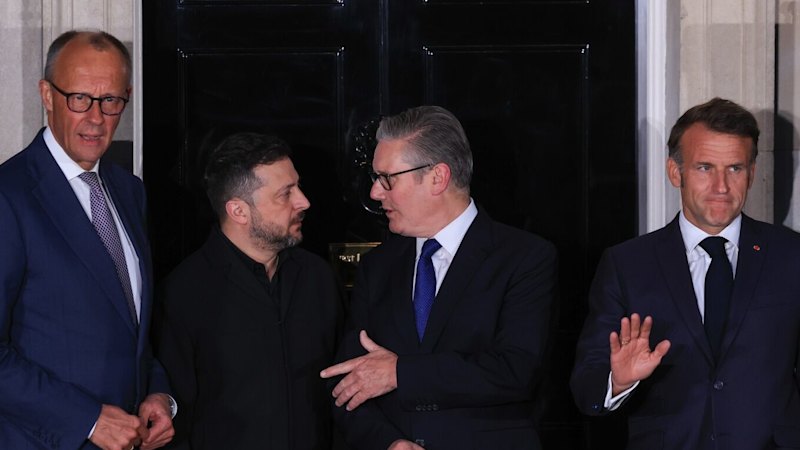
Hours after the strike, Zelensky landed in London for talks with British Prime Minister Keir Starmer, French President Emmanuel Macron and German Chancellor Friedrich Merz, a group sometimes known as the “E3” of European leaders.
Ukraine is facing a severe shortage of American missile defence systems to shield its cities from Russian attacks, leading Zelensky to turn to European allies for help in supplying finance and weapons.
While US President Donald Trump has authorised a $US4.8 billion ($6.8 billion) contract with Lockheed Martin to increase production of the Patriot air defence systems, it is likely it will take years to replace the interceptor missiles used in the opening months of the war with Iran.
Zelensky said the main focus of his meeting in London was air defences and the security of Europe, as well as the diplomatic effort to reach a ceasefire.
“Europe must be part of the negotiations and must be strong,” he said.
The four leaders issued a joint statement after the meeting calling again for a ceasefire and reiterating that any deal with Russian President Vladimir Putin should be cleared by European Union and NATO member states.
“The current line of contact should be the starting point for negotiations,” they said.
“International borders must not be changed by force, and Ukraine’s sovereign right to choose its own security arrangements and alliances must be fully respected.
“Ukraine must have robust and legally binding security guarantees in place once a ceasefire enters into force.”
European leaders have been frustrated at the lack of progress in talks between Moscow and the White House, while also fearing Putin and Trump would agree to a deal that handed Ukrainian territory to Russia.
Zelensky, who is also scheduled to meet King Charles III during his London visit, published an open letter last Thursday outlining his hopes for a face-to-face meeting with Putin to negotiate an end to the war, but the request was swiftly rejected in Moscow.
Putin said he saw no point in holding a meeting with Zelensky.
With American missile systems in serious shortage because of the war in the Middle East, the Ukrainian government is developing its own missiles and drones to protect its territory and go on the offensive against Russian targets.
In the latest example of Ukraine’s ability to hit targets deep within Russia, it launched dozens of drones against targets around St Petersburg on Saturday, reaching about 1000 kilometres from Ukraine.
The targets included oil terminals around the major city.
While the Russian military said it intercepted dozens of drones, the Ukrainian move highlighted the risks inside Russia when Putin was hosting the St Petersburg International Economic Forum, a gathering of political and business leaders.
Get a note directly from our foreign correspondents on what’s making headlines around the world. Sign up for our weekly What in the World newsletter.
 David Crowe is Europe correspondent for The Sydney Morning Herald and The Age.Connect via X or email.