



In the 1950s and ’60s, there was a push to introduce the American-style drive-in motels to Australia – think Cadillacs rather than Holdens.
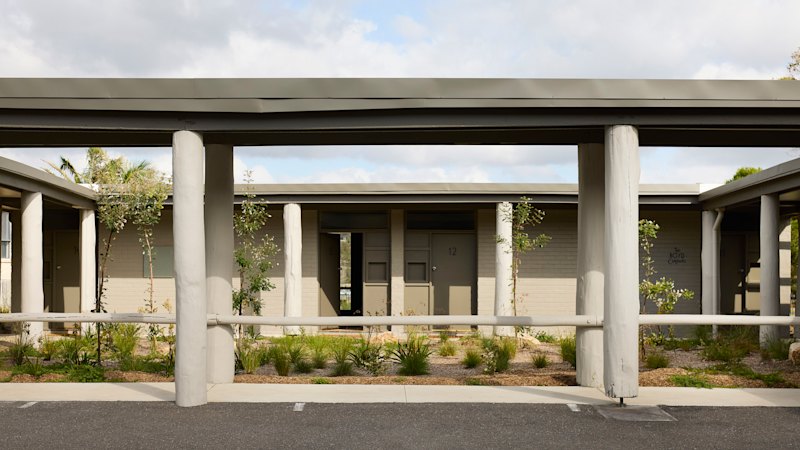
But around that time, in the sleepy seaside holiday town of at Merimbula on the NSW South Coast, pre-eminent architect Robin Boyd took a different approach. Instead of building American bling, Boyd created the Black Dolphin, a more Australian-style motel framed by a native landscape rather than towering palm trees.
Years later, another well-known Australian architect, Kerstin Thompson, kept a watchful eye on Boyd’s work while she was growing up.
“My parents were building a house at Merimbula when I was about five years old. We would stay a few nights at the Black Dolphin during construction,” says Thompson. She later worked as a waiter in the motel’s dining room, between finishing school and starting university.
“I still recall the bagged brick walls in the suites and the distinctive chunky black-stained timber beams. And of course, there were the breakfast hatches that Boyd included in 1960 when the motel was completed,” she adds.
So when Kerstin Thompson Architects (KTA) was commissioned by Ross Harding from Finding Infinity to reinvigorate the motel, it was a passion project from the outset.
Thompson had kept an eye on the motel over the years and could see its slow demise from an Australian experience to becoming just a motel adorned with superfluous finishes and features, something that Boyd railed against in his book The Australian Ugliness.
While some designers were keen to simply plonk luxe finishes onto the motel’s tired shell, KTA’s approach, in line with the budget, suggested a soft makeover.
“There just wasn’t the money to strip all the pastel yellow paint off the bricks or the pale green from the telegraph poles [used to support the verandas].” So, KTA used a series of mushroom tones to accentuate Boyd’s design, and had the black beams within each suite simply painted.
Doors to the individual courtyards, initially painted white as depicted in the photos by Mark Strizic at that time, were used as a reference by KTA.
As the owners were mindful of the budget, KTA suggested initially focusing on suites B, C and D. The other suites, along with the main dining room, will now form the next stage of the process.
“We used these suites like a prototype,” says Thompson, pointing out the subtle changes made to each – the new timber bench that extends across the entire length of each room and the new lights, including a Japanese-style pendant that hovers above the end of the bench which includes a place to write one’s postcards.
The breakfast hatches, such an important part of the 1960s motel experience, were opened up, along with new tiles on the bench inside – now offering more sophisticated fare rather than just toast and vegemite.
Thompson worked closely with Sarah Cooper from KTA, sourcing furniture such as the Planet lamps and the iconic Butterfly chairs that grace each terrace. And rather than looking at palm trees and box hedges, the view is to natives, including eucalypts and banksias, thoughtfully stitched together by landscape architects Open Work who collaborated with builder Wilderness Constructions.
Although the Black Dolphin isn’t heritage-listed, it was treated by all involved as significant. Each change was carefully considered, including the appropriate small mosaic tiles in the ensuites and sourcing sympathetic bathroom appliances rather than opting for the latest.
“We constantly wanted to create the ‘spirit’ of Robin Boyd,” says Thompson, who feels Boyd would have rolled over in his grave with the changes that had been indiscriminately made in the 1970s – including a strange idea to decorate each suite’s entry doorway with stone detailing, applied like chewing gum.
Anyone staying at the Black Dolphin will enjoy the new experience as much as the motel’s history.
The Market Recap newsletter is a wrap of the day’s trading. Get it each weekday afternoon.
 Stephen Crafti is a specialist in contemporary design, including architecture, furniture, fashion and decorative arts.