


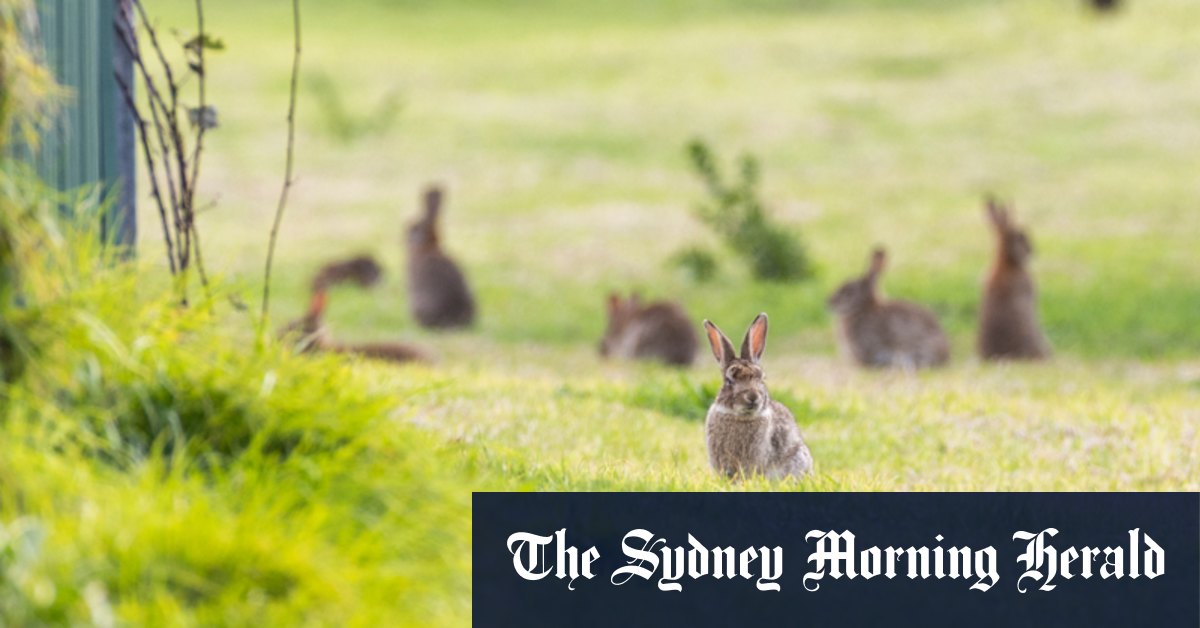
City of Casey Cranbourne Gardens ward councillor Michelle Crowther says the rabbits are damaging gardens, parks and sports fields, destroying native vegetation and pasture and worsening soil erosion.
Crowther says the plague has grown beyond the council’s capacity to manage, and can only be controlled by a combined effort that also involves state government land managers, community and environmental groups and private landowners.
Crowther has put forward a notice of motion requesting Casey City Council develop a council-wide pest animal control program, commission a cost estimate for the plan and seek state and federal funding. It will be considered by council on Tuesday night.
“Since joining council last year, I’ve come to learn that over recent years, there’s been ideal rabbit breeding conditions across eastern Australia,” Crowther says.
“A single breeding pair can generate dozens of offspring annually, with young rabbits reaching sexual maturity as early as three to four months, resulting in exponential population growth.”
Ecologist and feral animal management expert Richard Francis has worked extensively to control the rabbit population around Cranbourne, but says there are limits to what can be achieved.
His efforts have included fumigation of warrens and shooting them under licensed and controlled conditions. But baiting is unviable in a built-up region which is also home to children, dogs, cats and the protected bandicoot.
Francis says rabbits could be contained more effectively by erecting fences, though this would have undesirable side effects.
“It’s costly. It does mean that we have more barriers in the landscape, which is not good for wildlife. A place full of fences is also not as pleasant.”
Rabbits are not a new phenomenon around Cranbourne. They have been part of the local environment for a long time. Suburban encroachment has just made them visible to more people, Francis says.
It has also pushed them into nearby rural areas where communities and landscapes are also suffering.

Tony Bellinvia’s family has farmed in Cranbourne for more than 30 years. He says rabbits have only become a serious problem in the past five years. Credit: Jason South
Tony Bellinvia runs a small market garden just outside Cranbourne. His family has grown vegetables and herbs there for more than 30 years, but only in the past few years has the rabbit population got out of control.
“As they have been building the new estates, obviously the rabbits are just being pushed away because they’ve got nowhere to go, and they’re going to the only farm in the area, which is mine,” Bellinvia says.
The rabbits have destroyed crops of spring onions, carrots and lettuce; so much produce that he says his business faces closure.

Rabbits are thriving in the native bushland around the Royal Botanic Gardens Cranbourne.Credit: Jason South
“I’m losing thousands to be honest. We have only got a small farm and a small business. For us, it’s our livelihood. It’s pushing us out of our business [to a point] where I’m going to stop soon.”
The rabbits are also putting pressure on the region’s remnant native vegetation.
Royal Botanic Gardens Cranbourne executive director Tim Sansom says the gardens have tracked rabbit numbers for 20 years.
“While we’ve successfully kept them out of the Australian Garden, we’ve seen numbers rise in the conservation zone and surrounding landscape over the past three years,” Sansom says.
Loading
A council spokesperson said a Casey-wide pest management strategy would outline an action plan including data collection, community engagement and education.
The council uses fumigation and warren destruction, weed management to reduce above-ground shelter and biological control against rabbits, targeting areas of environmental significance such as bushland reserves and the Western Port coastline.
Start the day with a summary of the day’s most important and interesting stories, analysis and insights. Sign up for our Morning Edition newsletter.
